šŸ“£šŸ“£šŸ“£ REMINDER: The 2023 #ACA Open Enrollment Period is currently underway!

Here's 1ļøāƒ£3ļøāƒ£ important things to remember before. you #GetCovered: https://acasignups.net/22/11/02/its-time-again-heres-13-important-things-remember-you-getcovered-2023 #Healthcare #HealthInsurance #Obamacare #OpenEnrollment

It's That Time Again! Here's 13 important things to remember before you #GetCovered for 2023!

Tuesday, November 1st is the start of the official 2023 #ACA Open Enrollment Period (OEP) for anyone who needs quality, affordable healthcare coverage. The 2023 OEP is the best ever for the ACA for several reasons: First, the expanded/enhanced premium subsidies first introduced in 2021 via the American Rescue Plan, which make premiums more affordable for those who already qualified while expanding eligibility to millions who weren't previously eligible, are continuing for at least another 3 years via the Inflation Reduction Act; Second, because several states are either expanding or retooling their own state-based subsidy programs to make ACA plans even more affordable for their enrollees; And third, because millions more Americans who weren't previously eligible for ACA subsidies (even with the expanded ARP/IRA enhancements) are now eligible via the Biden Administration's closure of the so-called "Family Glitch." There's also expanded carrier & plan offerings in many states/counties, and as always, millions of people will be eligible for zero premium comprehensive major medical policies. If you've never enrolled in an ACA healthcare policy before, or if you looked into it a few years back but weren't impressed, please give it another shot now.
ACA Signups

1. DON'T MISS THE DEADLINE!

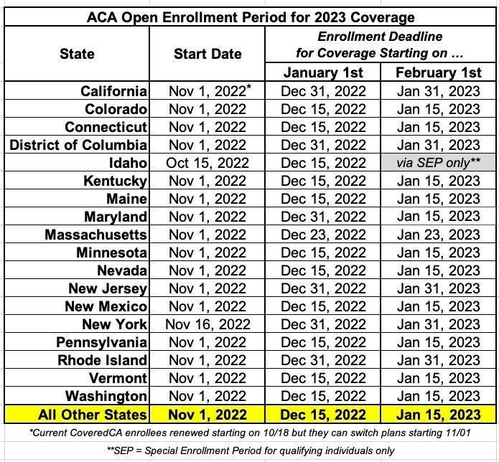
While the final #ACA Open Enrollment deadline isn't until January 15th in most states, if you want your coverage to start on January 1st, you have to enroll earlier. Plus, Idaho's *final* deadline is in December.

Here's a table laying out the deadlines for every state. Note that some of these may be extended closer to the listed date...but don't count on that! #GetCovered sooner rather than later if possible.

2. MAKE SURE YOU DON'T ENROLL IN A JUNK PLAN OR GET SCAMMED!

Some brokers sell Non-#ACA compliant health plans called things like "short-term", "sharing ministry", "farm bureau" etc. I strongly advise sticking to plans w/full ACA protections sold via authorized ACA sites only.

Here's the official #ACA exchange sites for all states + DC...

Covered Californiaā„¢ | The Official Site of California's Health Insurance Marketplace

Covered California is a free service from the state of California that connects Californians with brand-name health insurance under the Patient Protection and Affordable Care Act. It’s the only place where you can get financial help when you buy health insurance from well-known companies.

MNsure - Minnesota's health insurance marketplace / MNsure

MNsure is Minnesota's health insurance marketplace where individuals and families can shop, compare and choose health insurance coverage that meets their needs.

MNsure

3. SWITCH TO ON-EXCHANGE!

If you're enrolled in an off-exchange plan, you may save THOUSANDS of dollars by switching to an ON-exchange plan!

Many enrolled OFF-exchange because *at the time* they earned too much to qualify for financial help.

THIS YEAR many of them DO qualify...but ONLY if they SWITCH to an ON-exchange plan via an ACA exchange.

Thanks to the ARP & IRA, there's no longer a hard income cap on subsidy eligibility. This means millions who didn't used to be eligible are now.

4. THE "FAMILY GLITCH" IS NO MORE!

Thanks to the Biden Administration, millions of *other* people who used to be ineligible for #ACA subsidies are newly-eligible in 2023 as well!

This one is wonky, but there are many households which haven't been eligible for #ACA subsidies due to a goofy definition of how "affordable" one members employer-based coverage was. The Biden Admin corrected this in such a way as to open up subsidies for many of these folks.

5. HIGH INFLATION MEANS HIGHER SUBSIDY THRESHOLDS.

High inflation isn't good of course, but it *does* mean that the Federal Poverty Level is going up a lot more than usual in 2023.

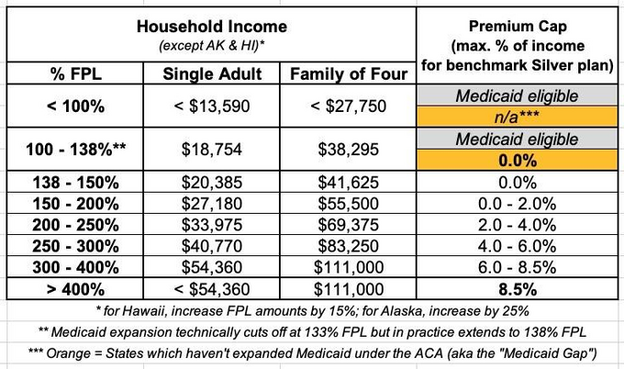
The #ACA's subsidy sliding scale is based in large part on your household income. As the FPL goes up year to year, so does the scale. This means a household which earns the same amount in 2023 as in 2022 will likely be eligible for more generous subsidies & savings next year.

Here's a table w/the maximum percent of your household income you'd have to pay for the benchmark Silver #ACA plan available in your area. If you earn <150%, your premiums are $0; 150 - 200% and it's no more than 2% of your income, and so on. NO ONE has to pay more than 8.5%.

6. TEN STATES HAVE *ADDITIONAL* SAVINGS *ON TOP OF* THE EXPANDED FEDERAL SUBSIDIES!

If you live in CO, CT, MN, MD, MA, NJ, ,NM, NY, VT or WA, you may qualify for extra savings!

COLORADO's Health Insurance Affordability Fund has extra savings for those earning 150-200% FPL, plus some help for undocumented immigrants as well.

CONNECTICUT is expanding their Covered Connecticut program for those earning up to 175% FPL.

MINNESOTA has their long-running MinnesotaCare program for those earning <200% FPL.

MARYLAND's Young Adult Premium Subsidy program offers extra savings to young adults aged 18 - 34.

MASSACHUSETTS offers ConnectorCare to households earning less than 300% FPL.

NEW JERSEY has expanded their Health Plan Savings program to those earning up to 600% FPL.

NEW MEXICO is launching their Health Care Affordability Fund to lower premiums even further for those earning up to 400% FPL.

NEW YORK's wildly popular Essential Plan is better than ever for those earning up to 200% FPL.

VERMONT has their VT Premium Assistance program for households earning less than 300% FPL.

Finally, WASHINGTON is launching their Cascade Care Savings program which reduces premiums down to $0 up to 250% FPL. They also offer $0 premiums for employees of child care facilities up to 300% FPL.

ALL OF THESE ARE ONLY AVAILABLE IF YOU ENROLL VIA THEIR STATE #ACA EXCHANGE!

7. MILLIONS OF PEOPLE ARE ELIGIBLE FOR *$0 PREMIUM* "SECRET PLATINUM" PLANS!

If you earn < 200% FPL, look for SILVER plans with the "CSR" or "Extra Savings" label.

Officially they're called "Silver CSR 94" or "Silver CSR 87" plans, but I call them #SecretPlatinum: The reduction of deductibles, co-pays etc. via Cost Sharing Reduction savings means these plans cover ~94% or ~87% of typical medical expenses...similar to Platinum's ~90%.

*Without* CSR, a Silver plan covers ~70% of expenses.

8. MILLIONS OF NON-CSR ENROLLEES MAY STILL BE ABLE TO GET $0-PREMIUM *GOLD* PLANS!

There's a long, wonky story here, but the bottom line is that there's hundreds of counties where Gold plans cost less than Silver...in some cases as little as $0/mo after subsidies.

This is thanks to a pricing strategy known as #SilverLoading which has been around since 2018 but which has become more widely used since then. Here's a simple explainer for those interested: https://acasignups.net/21/05/15/my-simplified-silverloading-explainer

My Simplified #SilverLoading Explainer

I've written in-depth explainers before of how Silver Loading came into existence and how it works as part of longer blog posts, but I also wanted to have a simpler, standalone version, so here it is. First, a quick backstory: The ACA includes two types of financial subsidies for individual market enrollees through the ACA exchanges (HealthCare.Gov, CoveredCA.com, etc). One program is called Advance Premium Tax Credits (APTC), which reduces monthly premiums for low- and moderate-income. APTCs are the subsidies which have been substantially beefed up by the American Rescue Plan (the additional subsidies will be available starting in April in most states, soon thereafter in most other states). The other type of subsidies are called Cost Sharing Reductions (CSR), which reduce deductibles, co-pays and other out-of-pocket expenses for low-income enrollees. The way the CSR program works is a bit unusual. Unlike premiums, which are a set, known dollar amount for every enrollee each month, the CSR program involves deductibles & co-pays, which can vary greatly from month to month. Therefore, instead of subsidizing the enrollees directly, the insurance carriers are contractually required to cover the given portion of the enrollee's deductibles, co-pays etc.

ACA Signups
In fact, last year TEXAS of all states--not exactly known for being #ACA-friendly--passed a bill UNANIMOUSLY to mandate #SilverLoading (aka Premium Alignment) thanks to a lot of hard work by a group of actuaries & legislators of all ideological stripes: https://acasignups.net/22/04/27/not-joking-texas-republicans-pass-law-which-dramatically-improves-aca-cms-should-follow
Not joking: Texas Republicans pass law which dramatically improves the ACA. CMS should follow suit.

I talked about it endlessly throughout 2017 & 2018, but it's been awhile since I last discussed the ACA's quirky Silver Loading pricing strategy in detail. In order for the rest of this entry to make sense, we need to review what Silver Loading is and how it works: The ACA includes two types of financial subsidies. Advance Premium Tax Credits (APTC) reduce monthly premiums for low- and moderate-income. Cost Sharing Reductions (CSR), meanwhile, reduce deductibles, co-pays and other out-of-pocket expenses for low-income enrollees. In 2017, Donald Trump cut off CSR reimbursement payments in a failed attempt to sabotage the ACA, thinking this would cripple the ACA exchanges. Instead, insurance carriers implemented a very smart alternative pricing mechanism to make up for their CSR losses, which came to be known as "Silver Loading." The carriers basically calculated how much they expected owe in CSR expenses the following year...and then simply added that amount to their premiums for the following year instead. While there's several ways that carriers can add the extra CSR cost to their premiums, "Silver Loading" involves doing so by adding 100% of the extra cost to Silver plans only, as opposed to spreading it out across Bronze, Silver, Gold & Platinum plans.

ACA Signups

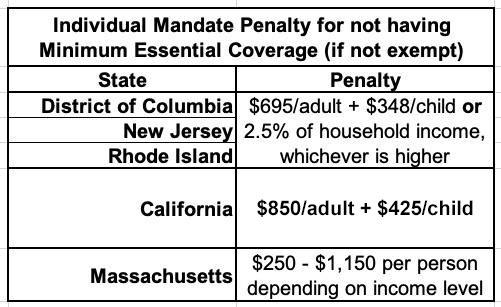
9. THE INDIVIDUAL MANDATE PENALTY IS STILL AROUND IN SOME STATES!

If you live in California, DC, Massachusetts, New Jersey or Rhode Island, heads up!

Here's the penalty for NOT having #ACA Minimal Essential Coverage in each. Note that you may be eligible for an exemption from this based on hardship or for other reasons:

10. MANY STATES/COUNTIES WILL HAVE MORE CHOICES THAN EVER...BUT SOME MAY HAVE FEWER.

Every year some insurance carriers expand into new areas while others drop out of them. 2023 is no exception.

Major carriers like CIGNA, UNITEDHC and AETNA are expanding into new states...while startups like FRIDAY, OSCAR and especially BRIGHT are pulling out of others.

Even among the existing carriers, many are either adding new plans or phasing out current ones. Speaking of which...

11. STANDARDIZED PLANS ARE BACK (w/a big caveat).

A few states require all plans w/in a given category to have identical cost sharing (deductibles, co-pays, coinsurance) to simplify enrollee decision-making. http://HC.gov is mandating these in 2023.

HOWEVER, these plans ("Easy Pricing" plans on HC.gov) are IN ADDITION TO existing #ACA plans.

IOW, you could have dozens of plans to choose from w/*different* cost sharing, but can then filter out the non-standardized plans if you wish.

Welcome to the Health Insurance MarketplaceĀ®

Welcome to the Health Insurance MarketplaceĀ®. Official government website.

HealthCare.gov

12. THE NAVIGATOR PROGRAM IS BACK AT FULL STRENGTH!

If all of the above sounds confusing, fear not: The Biden Administration has fully funded the #ACA Navigator program!

Last year the Biden Admin quadrupled the number of #ACA navigators--trained to help guide you through the often confusing process of health insurance enrollment. You can also get help from a qualified agent or broker. Go here to find assistance near you: https://localhelp.healthcare.gov/#/

Local Assistance for Health Insurance Application

Find local help to apply for health insurance. People and groups in the community offer free assistance both with the application process and with picking and enrolling in a plan.

13. Finally FOR THE LOVE OF GOD, *DON'T* LET YOURSELF BE PASSIVELY AUTO-RENEWED!

I know the array of changes can be overwhelming & it's tempting to just let yourself be auto-renewed, but I strongly advise against it!

Even if nothing has changed at your end (same address, same income, same household size, etc), the plans, provider network & subsidies you qualify for could be VERY different next year (better or worse).

You may renew your current plan after all--but ACTIVELY SHOP AROUND first!

P.S. If you find this thread or my other work at ACA Signups useful & wish to support it, you can do so here, thanks!
https://acasignups.net/support
Support ACA Signups!

It takes a lot of time and effort to maintain ACASignups.net. Donations of any amount are tremendously appreciated, though a minimum of $5.00 is generally preferred in order to minimize the impact of processing fees. Your support helps keep the healthcare data analysis and snark going as I keep trying to help guide people through the never-ending insanity of the American healthcare system. There are several ways you can support ACASignups.net. Monthly supporters at the $5 level receive the weekly email digest. Those at the $12 level also receive a login to remove the banner ads from the website. Note: Donations are not tax deductible.

ACA Signups

@charlesgaba
We're likely to renew exactly the same plan for next year.

BUT .... our subsidies will change significantly since our income this coming year is quite different from last year.

So, I gotta go thru the whole renewal / subsidy qualification thing again. Or I'd be looking at paying a lot more each month.

In short: don't passively renew. Do the work to get the right plan and the right subsidies. Listen to Charles ...

@charlesgaba wow, as a Blue Texan with bad news on the election front this year, this is awesome. TY for sharing!