 Paul Krugman
It's Thanksgiving weekend. I'm not driving, but many Americans are, confronting gasoline prices that ... aren't all that high 1/
 Paul Bober
Taking the historical perspective, here's the gas price relative to wages, which is higher than 2014-2020, but not in a longer-term view 2/
And as some have pointed out to me, mileage has risen a lot over time, so the actual cost of driving isn't especially high at all 3/
 DoctorOctothorp
@pkrugman question: similar to lower vaccination rates/higher death rates among GOP voters, might they be more sensitive to higher gas prices due to driving (cultural signifier) gas guzzlers like pick up trucks?
 Representative Agent
Vaidyanathan, S., P. Huether, B. Jennings. 2021. Understanding Transportation Energy Burdens. Washington, DC: American Council for an Energy-Efficient Economy https://www.aceee.org/white-paper/2021/05/understanding-transportation-energy-burdens

@representativeAgent @DoctorOctothorp @pkrugman great white paper - very interest and thought provoking on issues well beyond energy and transportation costs. Thanks for posting.
 excited for the mastodon rise
@DoctorOctothorp @pkrugman cultural signifier, vehicular codpiece, potato potato
 Benjamin Ross
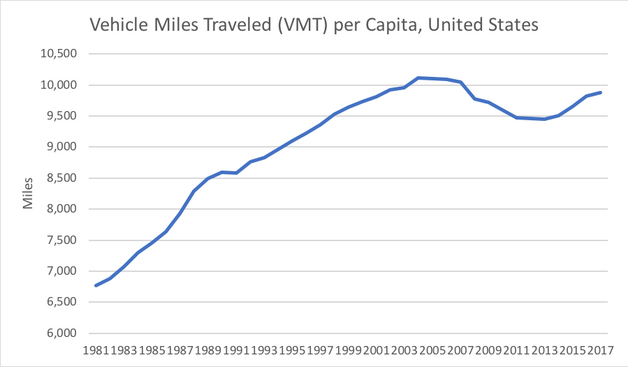
@pkrugman Before 2004, miles driven rose faster than mpg. This is mostly involuntary - land use policies put destinations farther apart and harder to reach on foot, people are not traveling to more destinations. The cost of gasoline per destination has gone up, and that, not the cost per mile, is the relevant number.
 Sam Coradetti
@BenRossTransit @pkrugman
Yeah but note also that 1980-2004 is a period of decreasing gas prices adjusted for inflation AND increasing fuel efficiencies. Those two factors kinda cancel out the increased mileage. Which sort of makes sense. If the cost to drive a mile is slowly decreasing in real terms over a 20 year period, people will tend to move farther from work, etc.
Yeah but note also that 1980-2004 is a period of decreasing gas prices adjusted for inflation AND increasing fuel efficiencies. Those two factors kinda cancel out the increased mileage. Which sort of makes sense. If the cost to drive a mile is slowly decreasing in real terms over a 20 year period, people will tend to move farther from work, etc.
@pkrugman It would be interesting to see this broken down for Dems, Reps, and Ints. A lot of liberals like me pay a premium to live close enough to work to not have to drive, and when we do drive, we drive hybirds or electrics now. So we have another bifurcation of American life there.
 RealGene ☣️
@pkrugman My 200-hp sedan gets around 31 mpg, and since I no longer commute, gets driven 10,000 miles less per year.
As a resident of the NE USA, I'm more affected by the cost of #2 home heating oil than the cost of gasoline.
 Steve
Steve@pkrugman I'd be interested in understanding that chart better - is that based on mileage driven, an average of all manufactured cars, an average of all sold cars, something else?
@pkrugman can you produce a graph showing how cost per mile driven has changed?
 scf
scf@pkrugman an awful lot of people bought very large vehicles, at least in part for the tax credits.
https://finance.zacks.com/6000pound-vehicle-tax-deduction-3484.html
One of many lists of vehicles:
https://www.pineapplemoney.com/save-money/vehicles-that-qualify-for-6000-lb-tax-credit/
What Is the 6,000-Pound Vehicle Tax Deduction?
A 6,000 pound vehicle can qualify for valuable tax deduction opportunities through Section 179 of the federal tax code. Understanding how these deductions can be claimed is absolutely indispensable for all business owners who may be considering making a significant purchase in the near future.
 Hanksingle
@pkrugman This an incoherent way to discuss gas prices - average fleet mpg doesnt account for who lives where and needs to drive how far; or how spikes and valleys in oil prices change what cars people buy, and are then driving when the next change occurs. When prices are low, people buy bigger vehicles, and vice versa. A spike coming after a relative low means that a disproportionate % of new vehicles - the ones being paid off - are bigger.
@pkrugman Attempting to do Extremely Online Economist Posting about cars is always bad, but this would be silly even if you werent insisting 'the pain you're feeling isnt real, costs are actually historically low' - which are basically WH admin talking points.
 Christopher Walker
@pkrugman this is especially true if you drive a hybrid. The car I drove when gas was $1/gallon got around 16 mpg. Now I get north of 48, so my cost per mile is about the same without even adjusting for inflation.
 Chrissy
@pkrugman NPR reported this morning that a TG trip of 140 mile round trip will cost about 50 cents more this year than last.
 Hank Layfield
@ChrisScott @pkrugman for some, saving that fifty cents was worth voting against democracy.
@hlayfield @pkrugman and just another example of how important good messaging is.
 #SCIENCEMATTERS
@pkrugman and wages are historically deflated thanks to corporate greed...
@pkrugman Here are two versions of that plot that include federal estimates of rural vs urban driving patterns (more rural miles driven) and average fuel efficiency for sedans vs trucks since 1980 (EPA data). The cost burden for rural pickup drivers is about twice urban sedan owners. Both groups likely saw the highest monthly sticker price for gas they have ever seen this summer, but adjusting for wages they experienced a longer, more expensive periods either side of the great recession.

@pkrugman it does look like over the period, the trend is that people are working about an hour more for a 15 gallon tank of gas. I agree that the recent price volatility was overstated but there is slowly increasing pain suggesting that wages over time are not keeping up with the cost of gas.
 JeffGeeBrown
 Antone Johnson
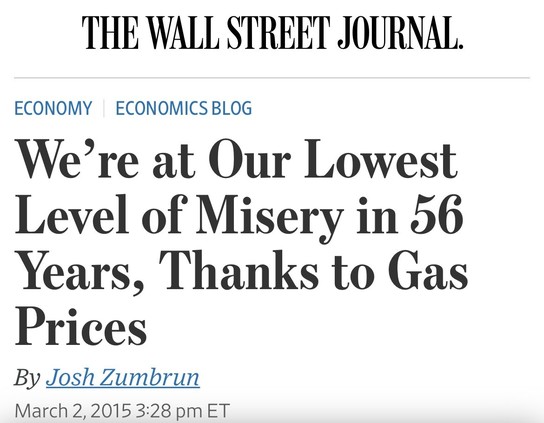
@pkrugman Just stumbled across this 2015 headline doing a “misery index” search. Fits 2014-2020 nicely. #macroeconomics