https://www.loc.gov/resource/gdcwdl.wdl_18198/?sp=7

The most excellent labor of The Elements by Euclid of Megara arranged together with the most sharp-sighted Campanus on the art of geometry happily begins:
A point is that of which nothing is a part.

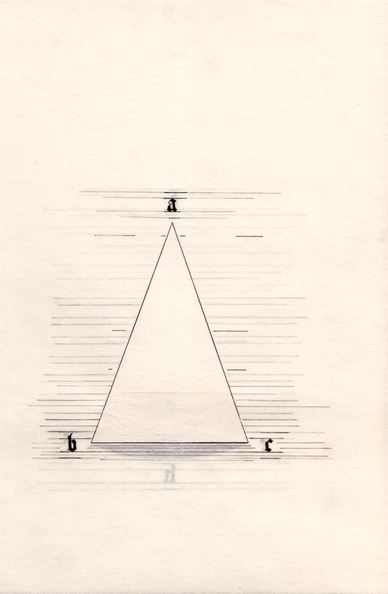
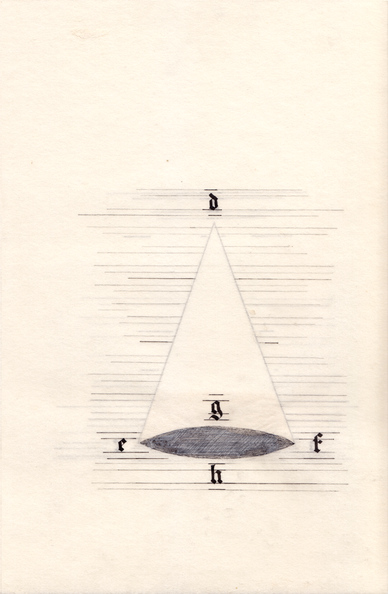
And the first page of the 1482 printed edition ends by, among other things, clearly illustrating the differences between orthogonal, ambligonius (obtuse), and oxigonius (acute) triangular forms.

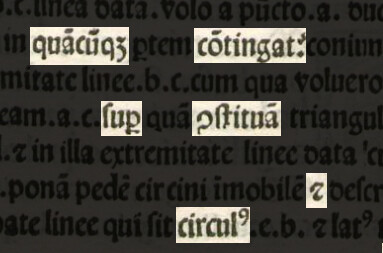
But the most fantastic thing on the entire first page is the abbreviated form of ūnīuscuiusque; the genitive masculine/feminine/neuter singular form of ūnusquisque.
https://en.wiktionary.org/wiki/unusquisque#Latin

It should be noted that the genitive masculine/feminine/neuter plural forms are, apparently, ūnōrumquōrumque, ūnārumquārumque, and ūnōrumquōrumque, respectively.

unusquisque - Wiktionary

The Latin text included in the 1482 print-edition of Elements was translated from the Arabic by Adelard of Bath in the 12th century, having itself been translated from the original Greek at some point (presumably before the 12th century though probably not possibly preceding 300-ish BC, around which time it was originally written by Euclid--of Alexandria.)
The Arabic source material for the Latin translation becomes quickly apparent when both the text and marginal diagrams on the first & second pages describe and label what are clearly a trapezoid and a trapezium as a #helmuaym and a #helmuariphe, respectively.

It is, perhaps, this transition from the Greek into the Arabic and then again from the Arabic into the Latin, which causes a relatively literal translation from the Latin into the English to feel relatively belabored. Or charming.

Anyway, the most sharp-sighted Campanus begins his rather-lengthy interjections and elucidations on the source material starting on page two of the 1482 print-edition in a voice that is relatively less belabored than the relatively more charming source material.

Besides the switch in vocabularial proclivities, the voice of Campanus is denoted with a visibly smaller font size (printed books using #blackletter along with other vestiges from the hand-written era make for some incredibly labor-intensive #skeuomorphs.)

Blackletter as a script works so beautifully with written Latin because blackletter was made for--or at the very least primarily evolved to primarily support--writing in Latin, with its emphasis on speed and its de-emphasis on difficulty.

Consideration to readability, however, seemingly ranged from “secondary” to “lol lmao” and the shortcomings of blackletter on that front are many and well documented.
The 1482 print-edition of Elements—and really any blackletter born from a printing press—at least has the benefit of having some degree of uniformity between identical letters within the confines of itself. Even still, though, legibility is usually dependent on the reader to gradually ascertain the quirks and grammatical tendencies of the scribe and/or typesetter for each and every book.
For an example found in the 1482 print-edition of Elements, a “v” in in the middle of a word will take on the appearance of a “u” and so the difference between “sine” & “sīve” can be easy to overlook.

Which is a pretty conventional quirk given the importance of #kerning. A more unconventional grammatical proclivity would be, as another example, combining sibi & invicem into one word to create a fever-dream monstrosity.

But it’s all a matter of taste—which is to say that quirks and fever-dream monstrosities aside, blackletter is a fantastic means by which the written #Latin language may be expressed. What blackletter is less fantastic for, however, is expressing math. Like Euclidean geometry.

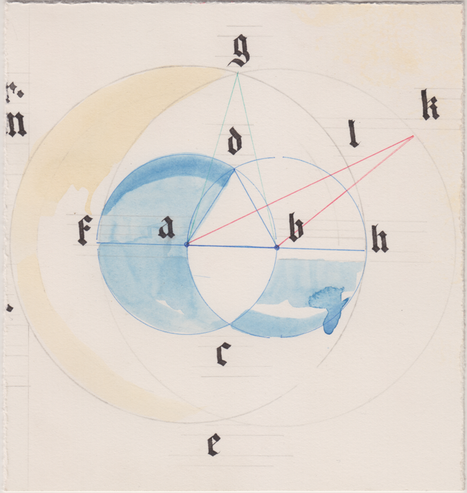
And yet. Proposition 1. To assemble an equilateral triangle over a given straight line.
#EuclideanGeometry

Overspecialized utilitarian glyphs aside, Latin supports The Elements of geometry rather well. The language’s built-in frameworks for spacial relationships and movement as directed through its procedural declension tables lend themselves nicely to the actual diagramming-out of Euclid's propositions.

Also, the adjectival form of the f-word may oftentimes be used interchangeably with "procedural" in regards to #Latin #DeclensionTables, if it so pleases.

To excerpt very briefly from Proposition 1:
and because these (nominative plural [lines]) a.b and a.f (exit [using a verb implying motion, as opposed to placement]) from the (ablative singular [center]) of the (genitive singular [circle]) c.d.f to of its own (accusative singular [circumference]), they will be equal.

Having spacial relationships and movement as an integral part of a word's grammatical function adds a stylish, eurhythmic element to geometric diagrams.
Declension tables be damned.

In his further-provided commentary on Proposition 1, the most sharp-sighted Campanus writes that "if, however, it is pleasing to assemble the remaining two types of triangles over that same line, there would be, it follows, a triangle with two equilateral sides and a triangle of three unequal sides..." and then continues on explaining how to do just precisely that.
#CampanusOfNovara #EuclideanGeometry
#ambligonius #oxigonius #equilateral
Campanus of Novara compiled this definitive Latin version of Elements in the 13th century, and it contains the remnants of prior works ft. Adelard of Bath, Robert of Chester, Herman of Carinthia, et al., all of who fall squarely into the Medieval era. And so it follows, then, that it is written in #MedievalLatin. Which is still #Latin, but it is Latin written by someone who writes it as a second language, never as a first.
And when reading it, as one normally does, the difference is appreciable.
Literary Latin from the classical era is so spectacularly inflected that it can start to feel purposely obtuse (or #ambligonius, per the source material) whereas Latin from the medieval era uses a more predictable word order and grammatical niceties such as prepositions and pronouns. Medieval Latin is host to its own other set of difficulties, but usually the Latin itself tends to be more easily understandable by someone not fluent in Latin (so, like, basically everyone.)

The difficulty with reading medieval Latin is actually reading it; punctuation, capitalization & spelling can be pretty variable and nothing written in #blackletter naturally stresses legibility.
Though blackletter itself is relatively fast and mechanical for the scribe, it is still extraordinarily labor-intensive given the scope at the time (all the books).

The letter m takes 9 separate strokes to make in blackletter; its abbreviated form is a single line over the preceding vowel. So, yeah.

The most convenient & succinct reference for scribal abbreviation is the book, meticulously-titled, “The elements of abbreviation in medieval Latin paleography,” and you may view an open access copy here:
https://kuscholarworks.ku.edu/handle/1808/1821
where you may also download a pdf of said book, if it so pleases.
#Eugepae! #MedievalLatin #paleography #scribalAbbreviation
The elements of abbreviation in medieval Latin paleography

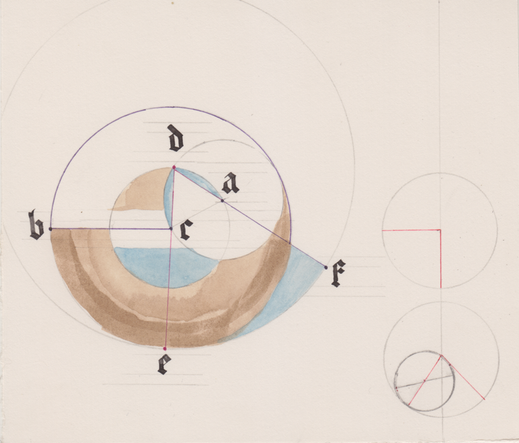
Proposition 2: To lead from a given point, a straight line equal to a proposed straight line.
#EuclideanGeometry
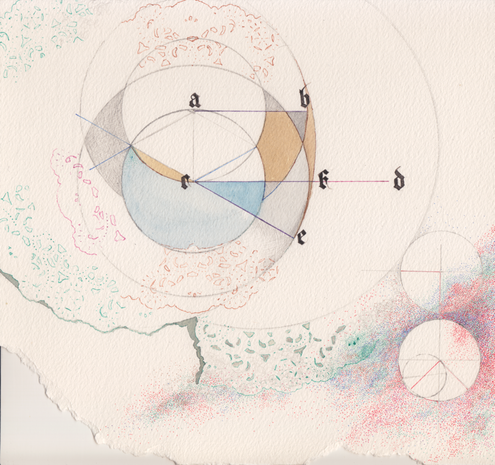
Proposition 3: To divide from the longer of two proposed unequal lines, one equal to the shorter.
#EuclideanGeometry
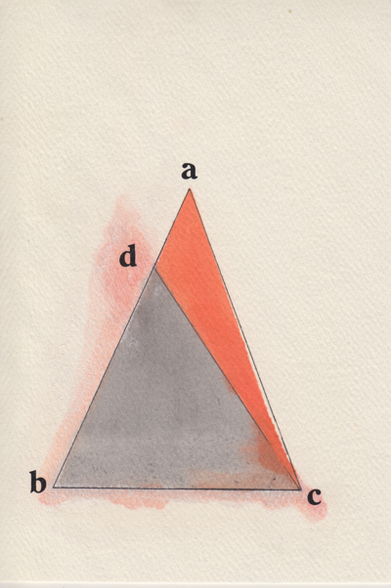
Proposition 4: Of all two triangles by which the two sides of one will be equal to the two sides of another and by which the two angles of them will be contained by those equilateral sides that are equal to the other, and as well the remaining sides of these are equal in respect to themselves: in truth the remaining angles of one will be equal to the remaining angles of the other, and so too is the whole triangle equal to the whole triangle. #micDrop
#EuclideanGeometry #triangleTuesday
The 1482 print-edition of Euclid’s Elements does not refer to isosceles triangles as "isosceles," using instead the genitive form of the words “two equal sides,” just as it refers to scalene triangles with the genitive “three unequal sides.” Equilateral triangles are just “equalaterus,” or "triangulum equilaterum,” though are sometimes referred to as “having" “tria latera equalia.”
I have not yet run into the genitive form of equilateral triangle, but I'm sure its just a matter of time.

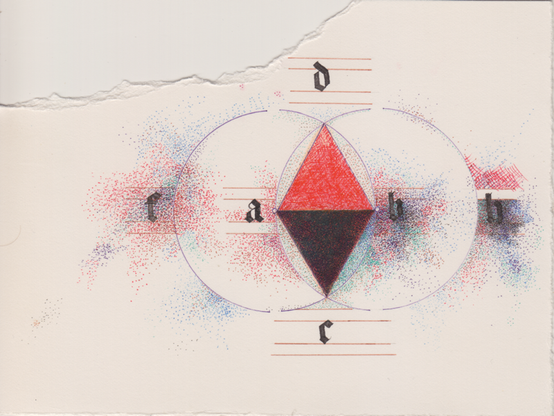
Proposition 5: The angles above the base of all triangles that are of two equal sides must be equal: that if its two equal sides are drawn out straight, the two angles beneath the base will likewise be mutually equal.

This paper is not playing nice with my dip pens & after much failure I decided to maybe not be so sentimental about proposition 5 and move on; so three cheers for Wilson Jones transfer letters. 🎉🎉🎉

The failure is just part of the art now.
#EuclideanGeometry #triangleThursdayLol

Proposition 6:
If two angles of a triangle are equal to the other, then the two sides respecting those angles will be equal. Quod est impossibile.
#EuclideanGeometry #triangleTuesday

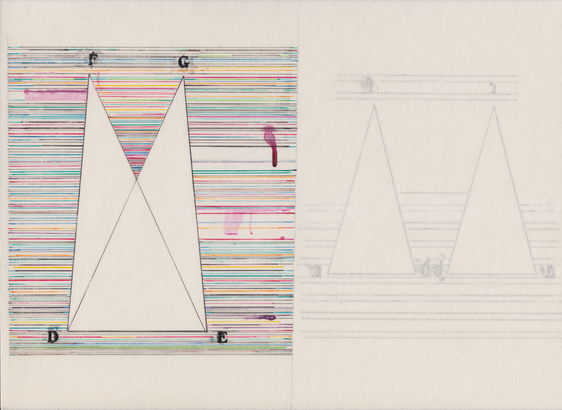
Proposition 7: If from two points which are terminating any line, two lines are to concurrently exit to one point, it is impossible to draw out from the same points other single lines that are equal to the other, which run concurrently to the same part.

Deciphering the Latin for proposition 7 was like trying to decipher dream-logic; honestly the entire thing felt a little belabored.

#EuclideanGeometry

& this is partially because of the subject matter, & partially because of the style (at the time), & partially because of how medieval Latin flows (or doesn’t flow) literally into English.

Describing Euclidean geometry from first principles is going to be knotty in any language, more so when that explanation has been subjected to a second-hand translation into c. 12th century Latin; & so is thereby awash with demonstrative, intensive, & reflexive pronouns and, as well, a vacillating verb tense.

But the problem here (if it is indeed a problem and not, say, a feature) is really how the subjunctive mood comes into English when doing a fairly literal third-hand translation.

That, along with an unusual favoritism towards passive voice verb tenses and, again, the aforementioned pronoun abuse, all naturally guide one who is doing a fairly literal English translation from circa 12th century Latin, into using (what I refer to as) The Biblical Voice. & that certainly reads a certain way.

The certain way by which that certainly reads, however, is probably the point. At this point, anyway.
The actual content of Elements would be much better served by later translations straight from the Greek into Latin—or English, even.
Additionally, subsequent printings of this same book dropped the manuscript-style #skeuomorphism--for obvious reasons. Here’s one from 1558, apparently,
https://www.google.com/books/edition/Euclidis_Elementorum_geometricorum_libri/1HkiZoBiFvsC?hl=en&gbpv=0
with much of the #scribalAbbreviation still intact--which is honestly very cool!
& so if the most distinctive attributes of the 1482 print-edition of Euclid’s Elements are that (1) it is a second-hand translation into 12th century medieval Latin &, (2) that it is masquerading as a handwritten manuscript (with all that that implies) then it naturally follows that one is actually obligated to produce the most stilted & the most formal-sounding translation into English that one can if one is to do so at all, & that to do otherwise would be a dissipation the source material.
Proposition 8: Of all two triangles of which the two sides of one are equal to the two sides of the other: and the base of one is equal to the base of the other: it is necessary that the two angles contained by the equal sides are equal.
#EuclideanGeometry #triangleTuesday