(mastodon only)

I was delighted to speak at the Northwest Commission on Colleges and Universities annual meeting this morning.

I talked about how science education has to adapt to a world of social media misinformation, and stressed two core topics: data literacy (as taught via my Calling Bullshit course, book etc), and the social nature of science.

Right now we teach what science found, but we don't teach how it works well enough for people to understand when and why it can be trusted.
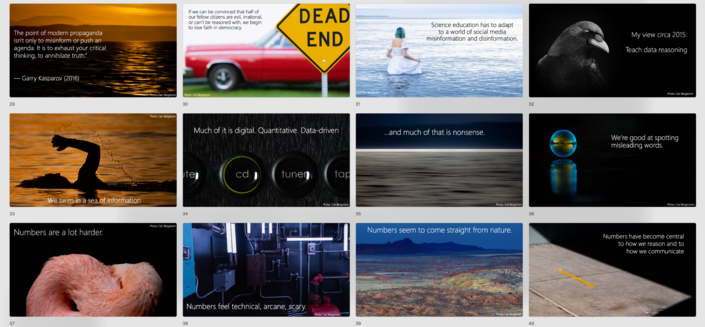
Here are the slides from the talk: https://www.slideshare.net/Carl_Bergstrom/transforming-science-education-in-an-age-of-misinformation

Of course it's hard to get the whole story from the slide deck alone, but at least there are pretty pictures.

Transforming Science Education in An Age of Misinformation

Keynote at theNorthwest Commission on Colleges and Universities annual meeting. I argue that if we want to address science misinformation on social media and b…

To learn more about what I was saying, you can look at

http://callingbullshit.org

for data reasoning and at

https://sciedandmisinfo.stanford.edu/about-report

for teaching the social nature of science.

Calling Bullshit.

@ct_bergstrom thank you for sharing. There are no many places on learn about data literacy, disinfo and raven at the same time
@ct_bergstrom the social nature of science is key, as all in #STS know (and many outside of the field too, of course)
@ct_bergstrom why can’t I follow you? Strange.
@ct_bergstrom Nice slides, but there is no conclusion. Got an article?
p.s. I live within 70 miles of the creation evidences museum, so countering misinformation in science is pretty much my life.
#science #scienceisreal

@Rozzychan

Here are a couple of places to start. This is basically what I was talking about:

https://mastodon.social/@ct_bergstrom/109288478969462751

@ct_bergstrom would love to know if there are notes of this meeting.

i am currently teaching english to a number of ESL students and i feel like this would be such a great subject.

so many of my students work to improve their english via podcast and social media, not fully understanding how to validate or judge the information that they are receiving.

@NotNowOrLater2 I don't think there are notes of this meeting, but there are many good resources that cover data literacy. I'm not going to remotely pretend these are the best out there, but we have videos from the initial pilot version of our course in 2017.

https://www.youtube.com/playlist?list=PLPnZfvKID1Sje5jWxt-4CSZD7bUI4gSPS

Calling Bullshit in the Age of Big Data

YouTube
@ct_bergstrom Hey Carl can your book be read as an audiobook or does it contain diagrams that make it better for physical reading? I'm studying data analytics rn and want to check it out.
@Lesueurii Hi there! The book is good as an audio book but it would be helpful to have the .pdf supplement that comes with it and has the associated diagrams, particularly for the chapter on data visualization.
@ct_bergstrom Cheers, I might get the physical version then for Christmas 🎁
@ct_bergstrom Tagging @hrheingold as he would probably enjoy seeing the slides etc.

@ct_bergstrom Agree with the two points offered, I would also think that teaching "social media literacy" is important too, from content ranking algorithms to influencer incentives to information combatants.

The problem is not only differentiating what is good vs bad info, but also understanding the design decisions and choice architectures that lead to bad info going viral and false equivalency reporting and so on.