 Dr. Halley Pontes
Our latest study on work addiction has now been published in the journal Assessment. Congratulations to Stephanie Towch and thanks to Dr. Paweł Atroszko for the collaboration!
Full study available from here: https://doi.org/10.1177/10731911261447068
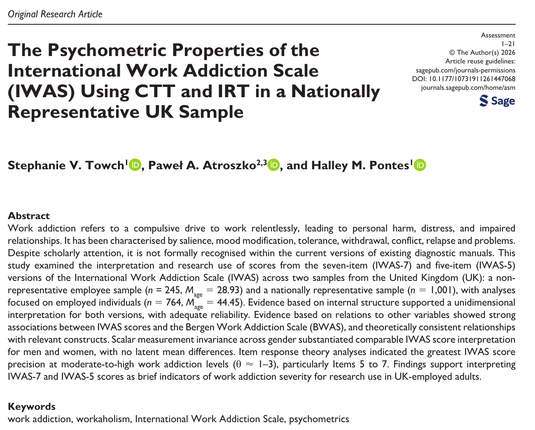
Our latest study on work addiction has now been published in the journal Assessment. Congratulations to Stephanie Towch and thanks to Dr. Paweł Atroszko for the collaboration!
Full study available from here: https://doi.org/10.1177/10731911261447068
Check out our latest study 'Perceived coworkers' work addiction: Scale development and associations with one's own workaholism, job stress, and job satisfaction in 85 cultures' available from here: https://doi.org/10.1556/2006.2025.00011
Thanks to Dr. Paweł Atroszko, Dr. Edyta Charzyńska and all other colleagues for the collaboration.
Our new cross-cultural psychometric study on work addiction is now live and can be freely downloaded from this link: https://doi.org/10.1556/2006.2025.00005
Thanks to all colleagues and in particular to Dr. Edyta Charzyńska and Dr. Pawel Atroszko.

Abstract Background and aims Despite the last decade's significant development in the scientific study of work addiction/workaholism, this area of research is still facing a fundamental challenge, namely the need for a valid and reliable measurement tool that shows cross-cultural invariance and, as such, allows for worldwide studies on this phenomenon. Methods An initial 16-item questionnaire, developed within an addiction framework, was administered alongside job stress, job satisfaction, and self-esteem measures in a total sample of 31,352 employees from six continents and 85 cultures (63.5% females, mean age of 39.24 years). Results Based on theoretical premises and psychometric testing, the International Work Addiction Scale (IWAS) was developed as a short measure representing essential features of work addiction. The seven-item version (IWAS-7), covering all seven components of work addiction, showed partial scalar invariance across 81 cultures, while the five-item version (IWAS-5) showed it across all 85 cultures. Higher levels of work addiction on both versions were associated with higher job stress, lower job satisfaction, and lower self-esteem across cultures. The optimal cut-offs for the IWAS-7 (24 points) and IWAS-5 (18 points) were established with an overall accuracy of 96% for both versions. Discussion and conclusions The IWAS is a valid, reliable, and short screening scale that can be used in different cultures and languages, providing comparative and generalizable results. The scale can be used globally in clinical and organizational settings, with the IWAS-5 being recommended for most practical and clinical situations. This is the first study to provide data supporting the hypothesis that work addiction is a universal phenomenon worldwide.
Many congratulations to Stephanie Towch for her very first published study on the important and rather timely issue of #workaddiction and #burnout. Great collaboration with Dr. Paweł Atroszko.
Study accessible from here: https://link.springer.com/article/10.1007/s11469-024-01397-8
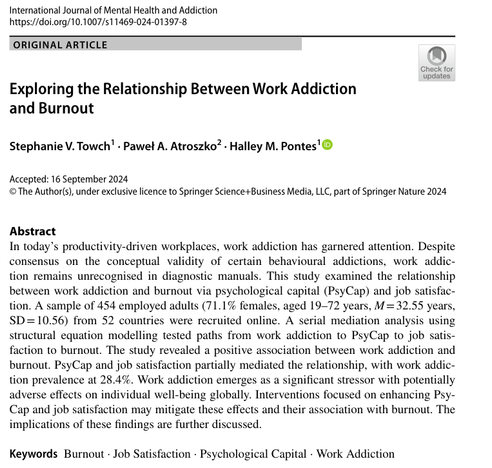

In today’s productivity-driven workplaces, work addiction has garnered attention. Despite consensus on the conceptual validity of certain behavioural addictions, work addiction remains unrecognised in diagnostic manuals. This study examined the relationship between work addiction and burnout via psychological capital (PsyCap) and job satisfaction. A sample of 454 employed adults (71.1% females, aged 19–72 years, M = 32.55 years, SD = 10.56) from 52 countries were recruited online. A serial mediation analysis using structural equation modelling tested paths from work addiction to PsyCap to job satisfaction to burnout. The study revealed a positive association between work addiction and burnout. PsyCap and job satisfaction partially mediated the relationship, with work addiction prevalence at 28.4%. Work addiction emerges as a significant stressor with potentially adverse effects on individual well-being globally. Interventions focused on enhancing PsyCap and job satisfaction may mitigate these effects and their association with burnout. The implications of these findings are further discussed.