Race Report: Tuscobia 80 Winter Ultra
As friends and family are aware, I’ve been trying to finish the Tuscobia 80 Winter Ultra for 3 years. After two failures in 2019 and 2021, this was the year I committed that it would happen no matter what. I knew I could do this race. I knew it was within my limits. I just needed to execute, and finally this year I felt more ready than I ever had before.
For the uninitiated, the Tuscobia 80 is a winter ultramarathon. You participate on foot, bike, or ski and have to traverse 80 miles (or 160 if you’re doing the big one) from Park Falls, WI to Rice Lake, WI. You have to carry all your survival gear with you such as food, water, sleep system, clothing, etc., as there is only one checkpoint in the entire race at mile 35.
Training
The first year my attempt was on foot, however my back didn’t agree with me and I dropped at the checkpoint. The second attempt was on bike and between lack of specific fitness and a mechanical issue, I only made it to mile 41. This year I decided to go back to my comfort zone on foot, but I needed to ensure success more than I had in the past. That meant doing specific training that would strengthen my back muscles and remove that factor from the equation. I also spent the first half of the year working with my chiropractor Gwen getting everything into alignment and where it was supposed to be.
As luck would have it, this year my friends Mike and Beth decided to give the event an attempt as well. Since I’m a race director of a winter ultra, and a two-time participant, they were looking to me for a lot of advice. The first thing I did was draft up a training plan that slowly built up our ‘pulling’ training, and built up our back strength to where I needed it to be.
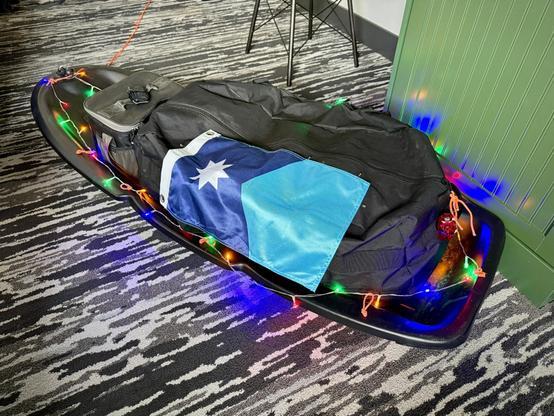
Due to lack of snow, the first half of our training runs were with tires on dirt. Even though my tire only weighed ~20-ish lbs the resistance on dirt/grass/gravel is much higher than snow. Our first pulls were rough, and I think there was a moment or two of doubt about how we were going to get up to our peak training goals. However, as the weeks went by and we extended our pulls longer and longer, things started to click. By the time we switched over to sleds in early December I was feeling great and my confidence level was higher than it’s ever been.
For those curious, we mixed in a slow ramp up of weekly long pulls, maxing out around 18 miles/6 hours, with occasional hill workouts while pulling a tire/sled. We only pulled once or twice a week, but we made sure to make it count with long workouts that tested our stamina. We did decide to peak at 6 hours, as the training benefit of going longer than that starts to become questionable. In addition to strength building, we also needed to “do no harm” before we got to race day. It’s too easy to over do it and end up with an injury before hitting a start line.
Race prep
One other goal of mine for this year was to do better at packing my sled and gear. In my last attempt I overpacked and suffered for it. This time I set a goal of 35-37 lbs fully loaded. That meant being thoughtful about the amount of clothing I was carrying, and being realistic about what food would actually work for me over the long haul.
The lead-up forecast for the race was predicting very warm temps; over 25°F as the low temp overnight and mid-30°F during the day. That meant a lot less emergency cold weather gear, but it also meant swapping in more changes of lightweight clothing to ensure I could stay dry (including 4-5 pairs of socks). The warmer temps also meant I could use different food that wouldn’t freeze into a brick in the milder temps. I even brought some bagels with peanut butter, something I’d think twice about in temps below 0°F as the bread would freeze solid.
I wasn’t sure how much water I would need to use in these temps, but opt’d to carry a bladder with 1.5 liters and two 32oz Nalgene bottles. I left one of the bottles empty at the start, knowing that there are a few gas stations to stop at in the first 30 miles if I started running out of water. It’s important to carry enough capacity for all the water you need, even if you don’t fill it right from the start. Thankfully, I never came close to running out of water, so this was pretty well dialed in.
Because of the wetter and warmer conditions I packed everything inside dry bags, inside the duffle bag on my sled. I had no idea how wet things were going to get, and dry bags provide protection as well as a good way to organize things into different areas. I had bags for specific purposes and was often able to open up my duffle and immediately see which bag I needed to grab. The only issue I ran in to was that a couple of my dry bags were the same color. This led to a couple points of confusion in the middle of the night when I was tired. Note to self: get more different colored dry bags.
I did make one mistake packing my dry bag that I had set aside for the 35 mile checkpoint, and so I ended up needing to bring in a couple of bags to fully do my change-out. It was a simple oversight, and not a huge deal in the grand scheme of things. However, it’s something I know I could correct in future efforts.
The race
The night before the race we settled into the AirBnB and continued fiddling with our gear one last time. Even though we didn’t launch until 10am on Saturday morning we had to be to the finish line around 6:30am to catch a bus to the start line, 2 hours away. The bus ride was pretty much as expected. Two hours on a school bus, in the dark, trying to catch a couple more moments of fitful sleep. By the last half an hour most people were pretty well awake and there were conversations happening everywhere. I got to meet a woman from Duluth who was biking the event with her son and husband, so we talked a lot about their effort this year. I also got to overhear people talking about getting ready for St Croix 40 (the race that my wife and I direct), which is always fun to listen in on and see what people are planning.
Eventually we arrived at the Butternut Lake Lodge where the race would begin (and the 160 milers do their turn-around). The usual morning race prep ensued; hitting the bathroom multiple times, grabbing a quick snack, nervously chatting with folks. Soon enough though it was time to launch and the day had begun. The first two miles of the race is across a frozen lake, which offers very mixed conditions. Sometimes it’s glare ice, and other times it’s drifted snow. We followed the markers to the other side as efficiently as we could and soon enough we were on the short singletrack section that connects us to the road, which then brings us to the Tuscobia trail.
It takes about 4.5 miles to get to the Tuscobia trail itself. Knowing that the rest of the next day and a half involves going straight forever, made the journey from the start a bit more interesting. It took me about an hour and 25 minutes to get to the trail, where I met up again with Mike and Beth and the pack of participants started to spread out a bit more as people settled into their pace.
The day was getting quite warm, but thanks to an overnight cooldown into the single digits (F) we got to enjoy a few hours of really packed down trail before things got soft. As the day got brighter the trees lost their layer of hoarfrost and we even got some peeks of sunshine to lift our spirits.
I was moving really well in these early sections, so much so that Mike even asked if I was pushing too hard. I felt great, but knew I should conserve some energy so I took his warning to heart and started to back off just a little bit, aiming for 18 minute miles instead of 17. During this first twenty mile segment we got to walk with lots of friends, some of which we haven’t seen in a long time. It was great to catch up and spend time with people, and the conversations helped make the time pass more quickly.
Mike, Beth, and I had mostly stayed together through this section but around mile 17 I realized I would need a bathroom break soon. I knew there was a vault toilet at the campground in Loretta that was open and stocked just for us, so I kicked it back into a higher gear and made my way there first to take care of my needs. When Mike and Beth arrived we did a quick sock change, since everything was getting wet quickly, and headed back out on the trail for the last few hours of daylight.
At the end of December the nights are over 14 hours long. That meant that we would soon be in darkness, and would stay that way for quite a while. Mentally preparing to be outside all night, when the night is so long, requires fortitude. You have to approach the coming darkness with a sense of calm acceptance and understanding that this will simply be your life for the next 14 hours. As the sun faded and my headlight came out of my pocket, I steeled myself for the long night ahead.
Between mile 20 and mile 30 I once again went on ahead so I could hit the gas station in the town of Winter (mile 30) and use a bathroom again (recurring theme I’ll talk more about later). As I came out of the gas station to head over to the historic train depot where the bathrooms were, Mike caught up to me and let me know that Beth was dropping.
We helped make a few texts to ensure she had a ride to safety and then the two of us pushed on to the mile 35 checkpoint at Ojibwa. Coming into Ojibwa is always fun. It’s a small old stone building at a park with a roaring fireplace and some of the friendliest and happiest volunteers you’ll ever find. It’s truly the all-night party in the woods type of place and as soon as I walked in the door I was greeted with an eruption of cheers. I found myself a spot at a table and went about changing my upper layers, another sock change, and eating some real food. We spent roughly 30 minutes getting re-organized and ready for the deepest part of the night, and then headed back out on trail.
Something that often happens at Ojibwa is that people will leave in groups, and this night was no exception. As we headed out we were a part of a train of people that spent the next few hours together talking and sharing stories of the previous day. One of the treats of the evening was getting to run into my friend Jeff L. who was back in town from California to run the 160 mile race. We had caught up to him, and he was feeling good enough to hang with us for a while so we got to catch up on life. In addition to other folks we spent occasional time with (Ken, Jim, Ron… and I’m forgetting some) we picked up Jodee, another friend who had moved away from Minnesota but that we now got to spend some trail time with.
As we traveled we took note of how close we were getting to midnight… on New Year’s Eve. Sure enough at 12:00 we heard some fireworks in the distance and that meant it was time to pause our journey and have a quick celebration. Both Jeff and I had come prepared with some whiskey to toast in the new year, so we pulled out our flasks and raised a glass to good friends, crazy ideas, and the joy of winter. After downing our libations we turned back down the trail, put our heads down, and got back to work.
Photo Credit: Jodee Mason
Shortly after midnight Jeff dropped back and so Mike, Jodee, and I continued on at a good pace around 19 minute miles. Our plan was to make one final stop for the night in the town of Couderay (mile 48-ish) where a bivy spot had been set aside for racers. We weren’t going to do a full sleep setup, but simply put our heads down for 10 minutes to try and get a little REM sleep. I can’t say that I actually slept, but the rest was welcome. We also got to use some nice vault toilets and prepare for the next section which would be long, dark, and desolate.
Once you leave Couderay there isn’t anything for 17 miles until the town of Birchwood. It’s one of the longest stretches of the course with nothing around it, and we were doing it in the dead of night. It was around 3am when we set out from our rest, and we still wouldn’t see the glimmers of daylight for another 3-4 hours. It also doesn’t help that this section consists of a 200 ft climb over a 6 mile stretch. It’s not steep at all, but when it takes you nearly two hours to go six miles, that very slight uphill gets really annoying.
We traded off taking the lead in our little group, trying to occasionally talk to keep our spirits up, but this is truly one of the most mentally taxing sections of the race. There’s really nothing to do except keep pushing forward and try to keep your mind active and alert until daylight. On a positive note, when you crest the top of the climb the entire rest of the race is net downhill. So we knew that once we hit the high point, the worst was behind us.
As we approached Birchwood we made another stop for a sock change. As we started moving again we were greeted by Chris Scotch on his snowmobile. Chris and his wife Helen are the race directors and Chris spends most of his time out on course making sure people are safe. He complimented us on how great we were looking, and how well we were moving, and told us to just keep on pushing forward. By this point daylight had come again and my spirits were feeling rejuvenated. I knew that in the town of Birchwood there was Ed’s Pit Stop which is a gas station with hot food, and my stomach was asking for breakfast.
As we arrived at the gas station we were greeted by a few volunteers who were hanging out there and we got a chance to do a calorie reset. I had been doing really well putting down around 200 calories per hour during the entire event, but I was just getting tired of eating. The idea of stocking up on a good meal so that I could take a couple hours off of eating sounded like a great idea. I got a breakfast sandwich, chips, and a cookie. I also grabbed another root beer to get some liquid calories and sugar going as well. We probably spent a little too much time at this gas station, but the pause was nice. We had just under 17 miles to go, so it was time to get back at it.
Photo Credit: Craig Mason
As we headed back on trail our threesome started to separate a little bit. I was still feeling really good and so I took the lead and started pushing the pace. With about 13 miles to go I realized that there was still a chance that I could finish in under 30 hours (4pm). That would ensure that I would be finishing in daylight and wouldn’t have to pull out the headlamp a second time. That’s all it took to light a fire under my butt and make me push even a little harder. Mike told me to just keep moving on ahead at my pace as I was moving stronger than he was at the time and so I did.
The next few miles were a blur of fast walking and coming to the realization that I would need one more bathroom stop. Thankfully, there was a bar and grill in the town of Brill and I was able to get in there quickly to take care of business. I had to turn down SEVERAL offers of free beer from the patrons who wanted to hear more about the race, but I was on a mission. I returned to the trail just as Mike was catching up again after my stop, but I put it back into gear and soon enough I was on my own again.
The final 4 miles of the race is on the Wild Rivers trail which brings you from the end of the Tuscobia trail, down into Rice Lake. As I got the the turn was was greeted by my friend Kari who leaped over a snowbank to come and give me a hug and cheer me on. Kari’s mom Rhende was there as well and the two of them once again complimented me on how well I was moving and how good I looked. I took the encouragement, shared some updates from when I passed Kari’s boyfriend Erik, and made the final turn towards home.
This final 4 mile stretch was long and tedious. My brain started to wander and my body started to slow. I put on a podcast through my iPhone speakers to keep my mind engaged and try and stave off the sleepies that were starting to set in. I also made the choice to not eat as much as I should in this final section because I didn’t want to deal with another bathroom break if things moved too quickly through the system. If I had gotten a bit more energy into my body I might have been a little bit perkier in this final push, but overall I was still in the 18-19 minute per mile range, and that was good enough for me.
Photo Credit: Angela Johnson
Eventually, I saw the end. With about two tenths of a mile to go I saw people waiting at the finish line, and managed my best impression of a “run” that I could muster. I crossed the final road and into the waiting arms of the finish line. I pushed as hard as I could and left everything I had out on the course. The final finish time: 29 hours and 43 minutes. I had smashed my goal and finally completed the Tuscobia 80.
Photo Credit: Helen Scotch
My friend Mike finished 3 minutes behind me and we celebrated together with a finish line pic. All the hard work and training that we had put in had paid off, and here we were celebrating at the end. I went inside the building and my wife went into gear taking care of me. I had some pop and beer and started airing out my feet a bit. Friends came up and congratulated us and we briefly talked about how the race went. Soon though it was time to crash and Lisa and Beth helped us load up into our vehicles and brought us back to the AirBnB.
The rest of the evening was spent hobbling around the house, showering, eating Mexican food, and taking naps, before finally crashing for the night. I went to bed with one of the biggest smiles on my face that I’ve ever had.
Aftermath
Despite all of the excellent execution during the race, I did end up with a couple small issues at the end. In the final 16 miles I started to develop a blister on the ball of my right foot. I considered stopping to try and do something with it, but decided to just try doing another sock change with cornstarch to dry things out and hope for the best. The issue is that I ended up favoring the outside of my right foot as I continued walking, and by the end of the race I had a very minor sprain of my ankle going from all the awkward movement. The soft and uneven snow didn’t help either. Thankfully, the pain from the ankle subsided within 2 days and a week later it feels perfectly fine.
The other issue was a complete rookie mistake. I forgot to check the state of my toenails before the race and my left foot had two toenails that were way too long, causing them to go black. They’ve already fallen off, and now I’m just dealing with the pain that goes along with that. However, that still means that running, and even wearing shoes, can be somewhat uncomfortable. A few more days of recovery are required to get that back to feeling good.
The only other issue that I encountered on the trail was dealing with my first ultra after my stomach surgery. I need to see if I can figure anything out to help with all the digestive and gas issues I’m dealing with. I had to use the bathroom far more often than a normal ultra and I’d like to see if I can figure out what else I can do to make things work better ‘down there’.
Final thoughts
This race was hugely important to me. As a winter ultra race director it was a point of pride that I actually complete one of these events. In 2019 when I decided to go for this I thought it would be a one-and-done type of thing. I would get it done and then go back to volunteering. Two failed attempts (and a pandemic) later and I knew I had to finally put a bow on this.
I was also dealing with expectations. Not just from myself, but from others. So many of my friends had seen me bash my head against this and fail multiple times that I felt a sense of obligation to prove to everyone that I was capable of this. Maybe this is why it felt like the cheers when I entered Ojibwa we just ever so slightly louder, or friends were leaping over snowbanks to congratulate me. Perceived or real, I felt a strong desire to do this for not just myself, but everyone who had supported me over the past few years.
Not only did I manage to meet those expectations, but I did it in the way that I wanted, executing as flawlessly as any endeavor like this can go (which usually involves a lot of flaws even on a good day). I trained the way I wanted to, and put in the work I needed to in order to be successful. I planned and adapted for as many possibilities as I could in the weeks leading up to the race. I pushed aside the mental demons that always visit before a big race saying, “Wouldn’t you just rather stay home and play video games?” I put everything into its place, and just got it done.
The end result was my best performance of any race that I’ve ever done. Not only did I meet my goal time, but I placed higher in the rankings than I ever have before, breaking into the top half of all participants. I’m always solidly at the end of the middle-of-the-pack or front of the back-of-the-pack. Finishing a race in the top 50% is pretty much unheard of for me. That’s going to be a source of pride for me for quite a while, and something that may never happen again in my athletic career.
As much as I hate to use the phrase, I’m proud of what I did. I dislike dwelling on things like pride, but in this case I feel justified in giving myself a pat on the back for a job well done. With that pride comes a healthy dose of realism of what it took to get there, and the hard work and sacrifice involved. This wasn’t easy, and it wasn’t intended to be. And that’s kinda the point.
#RaceReports #tuscobia #winterUltra
 Second Runnings