 Insights Into Imaging
Nataliia Moshina et al. find that screening with digital breast #tomosynthesis (DBT) did not result in a higher #BreastCancer detection rate compared to screening with digital #mammography (DM).
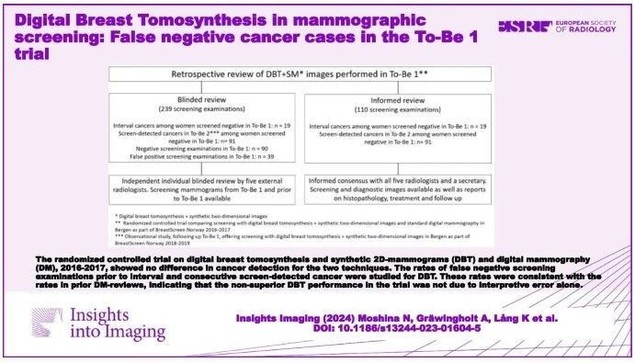

Digital breast tomosynthesis in mammographic screening: false negative cancer cases in the To-Be 1 trial - Insights into Imaging
Objectives The randomized controlled trial comparing digital breast tomosynthesis and synthetic 2D mammograms (DBT + SM) versus digital mammography (DM) (the To-Be 1 trial), 2016–2017, did not result in higher cancer detection for DBT + SM. We aimed to determine if negative cases prior to interval and consecutive screen-detected cancers from DBT + SM were due to interpretive error. Methods Five external breast radiologists performed the individual blinded review of 239 screening examinations (90 true negative, 39 false positive, 19 prior to interval cancer, and 91 prior to consecutive screen-detected cancer) and the informed consensus review of examinations prior to interval and screen-detected cancers (n = 110). The reviewers marked suspicious findings with a score of 1–5 (probability of malignancy). A case was false negative if ≥ 2 radiologists assigned the cancer site with a score of ≥ 2 in the blinded review and if the case was assigned as false negative by a consensus in the informed review. Results In the informed review, 5.3% of examinations prior to interval cancer and 18.7% prior to consecutive round screen-detected cancer were considered false negative. In the blinded review, 10.6% of examinations prior to interval cancer and 42.9% prior to consecutive round screen-detected cancer were scored ≥ 2. A score of ≥ 2 was assigned to 47.8% of negative and 89.7% of false positive examinations. Conclusions The false negative rates were consistent with those of prior DM reviews, indicating that the lack of higher cancer detection for DBT + SM versus DM in the To-Be 1 trial is complex and not due to interpretive error alone. Critical relevance statement The randomized controlled trial on digital breast tomosynthesis and synthetic 2D mammograms (DBT) and digital mammography (DM), 2016–2017, showed no difference in cancer detection for the two techniques. The rates of false negative screening examinations prior to interval and consecutive screen-detected cancer for DBT were consistent with the rates in prior DM reviews, indicating that the non-superior DBT performance in the trial might not be due to interpretive error alone. Key points • Screening with digital breast tomosynthesis (DBT) did not result in a higher breast cancer detection rate compared to screening with digital mammography (DM) in the To-Be 1 trial. • The false negative rates for examinations prior to interval and consecutive screen-detected cancer for DBT were determined in the trial to test if the lack of differences was due to interpretive error. • The false negative rates were consistent with those of prior DM reviews, indicating that the lack of higher cancer detection for DBT versus DM was complex and not due to interpretive error alone. Graphical Abstract