A Mars mineral has just shattered the rules of heat. Researchers at Columbia University have uncovered something extraordinary—tridymite, a mineral found both on Mars and in a 1724 meteorite, that completely defies conventional laws of thermal conductivity.

Typically, materials conduct heat differently depending on their temperature. Crystals allow heat to flow more easily at higher temperatures, while glasses scatter vibrations unpredictably. But tridymite behaves like neither—it maintains a constant thermal conductivity across a wide range of temperatures. Essentially, it acts like a crystal and a glass at the same time, maintaining stability even under extreme conditions.

This breakthrough, uncovered using AI-driven quantum physics analyses, allows scientists to peer deep into tridymite’s atomic structure and behaviour. What’s most remarkable is that this discovery isn’t just a cool find—it could reshape industries across the globe.

Controlling heat is one of the toughest challenges in engineering, whether in steel production, electronics, or computing. Tridymite’s ability to resist temperature fluctuations could revolutionize energy efficiency and durability in technologies that power our world.

And the excitement doesn’t stop there. The fact that this mineral exists on Mars ties planetary science to cutting-edge materials research, suggesting that extraterrestrial geology might hold the key to solving some of Earth’s toughest engineering problems.

From heat-resistant electronics to energy-efficient buildings, tridymite could unlock an entirely new frontier in material science. Imagine a world where the materials around us can handle temperature swings without losing their strength or efficiency—a future made possible by a mineral from Mars.

Space & planetary science
#MarsDiscovery #MartianMinerals #MeteoriteScience #PlanetaryScience #SpaceResearch

Materials & physics
#MaterialsScience #ThermalConductivity #QuantumMaterials #AdvancedMaterials

SK hynix has launched the industry’s first mobile DRAM using High-K EMC material, boosting thermal conductivity 3.5 times and reducing thermal resistance by 47%, aiming to expand its market share in the mobile sector.
#YonhapInfomax #SKHynix #MobileDRAM #HighKEMC #ThermalConductivity #FlagshipSmartphones #Economics #FinancialMarkets #Banking #Securities #Bonds #StockMarket
https://en.infomaxai.com/news/articleView.html?idxno=79038
SK hynix Begins Supply of Mobile DRAM with Enhanced Thermal Management

SK hynix has launched the industry’s first mobile DRAM using High-K EMC material, boosting thermal conductivity 3.5 times and reducing thermal resistance by 47%, aiming to expand its market share in the mobile sector.

Yonhap Infomax

Has anyone experiences with using a 3d printer bed to incubate tempeh, and/or any ideas for suitable vessel material?

#vegan #tempeh #3dPrint #thermalConductivity

Researchers tune thermal conductivity of materials 'on the fly' for more energy-efficient devices

A team led by University of Minnesota Twin Cities scientists and engineers discovered a new method for tuning the thermal conductivity of materials to control heat flow "on the fly." Their tuning range is the highest ever recorded among one-step processes in the field, and will open a door to developing more energy-efficient and durable electronic devices.

Too hot to handle: Study tests the thermal conductivity of metal organic frameworks

Metal organic frameworks, or MOFs, are kind of like LEGOs.

Phys.org

PCB Thermal Design Hack Gets Hot and Heavy

Thanks to the relatively recent rise of affordable board production services, many of the people reading Hackaday are just now learning the ropes of PCB design. For those still producing the FR4 equivalent of "Hello World", it's accomplishment enough that all the traces go where they're supposed to. But eventually your designs will become more ambitious, and with this added complexity will naturally come new design considerations. For example, how do you keep a PCB from cooking itself in high current applications?

It's this exact question that Mike Jouppi hoped to help answer when he hosted last week's Hack Chat. It's a topic he takes very seriously, enough that he actually started a company called Thermal Management LLC dedicated to helping engineers cope with PCB thermal design issues. He also chaired the development of IPC-2152, a standard for properly sizing board traces based on how much current they'll need to carry. It isn't the first standard that's touched on the issue, but it's certainly the most modern and comprehensive.

It's common for many designers, who can be referencing data that in some cases dates back to the 1950s, to simply oversize their traces out of caution. Often this is based on concepts that Mike says his research has found to be inaccurate, such as the assumption that the inner traces of a PCB tend to run hotter than those on the outside. The new standard is designed to help designers avoid these potential pitfalls, though he notes that it's still an imperfect analog for the real-world; additional data such as mounting configuration needs to be taken into consideration to get a better idea of a board's thermal properties.

Even with such a complex topic, there's some tips that are widely applicable enough to keep in mind. Mike says the thermal properties of the substrate are always going to be poor compared to copper, so using internal copper planes can help conduct heat through the board. When dealing with SMD parts that produce a lot of heat, large copper plated vias can be used to create a parallel thermal path.

Towards the end of the Chat, Thomas Shaddack chimes in with an interesting idea: since the resistance of a trace will increase as it gets hotter, could this be used to determine the temperature of internal PCB traces that would otherwise be difficult to measure? Mike says the concept is sound, though if you wanted to get an accurate read, you'd need to know the nominal resistance of the trace to calibrate against. Certainly something to keep in mind for the future, especially if you don't have a thermal camera that would let you peer into a PCB's inner layers.

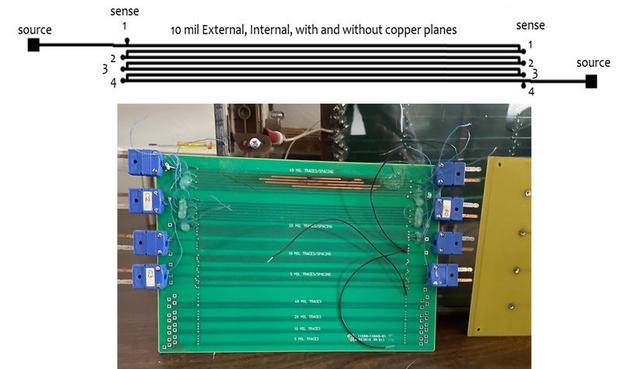
A rig used to test thermal properties of different trace configurations.

While the Hack Chats are often rather informal, we noticed some fairly pointed questions this time around. Clearly there were folks out there with very specific issues that needed some assistance. It can be difficult to address all the nuances of a complex problem in a public chat, so in a few cases we know Mike directly reached out to attendees so he could talk them through the issues one-on-one.

While we can't always promise you'll get that kind of personalized service, we think it's a testament to the unique networking opportunities available to those who take part in the Hack Chat, and thank Mike for going that extra mile to make sure everyone's questions were answered to the best of his ability.

The Hack Chat is a weekly online chat session hosted by leading experts from all corners of the hardware hacking universe. It 's a great way for hackers connect in a fun and informal way, but if you can't make it live, these overview posts as well as the transcripts posted to Hackaday.io make sure you don't miss out.

#hackadaycolumns #cooling #hackchat #pcbdesign #thermalconductivity #traces

PCB Thermal Design Hack Gets Hot And Heavy

Thanks to the relatively recent rise of affordable board production services, many of the people reading Hackaday are just now learning the ropes of PCB design. For those still producing the FR4 eq…

Hackaday