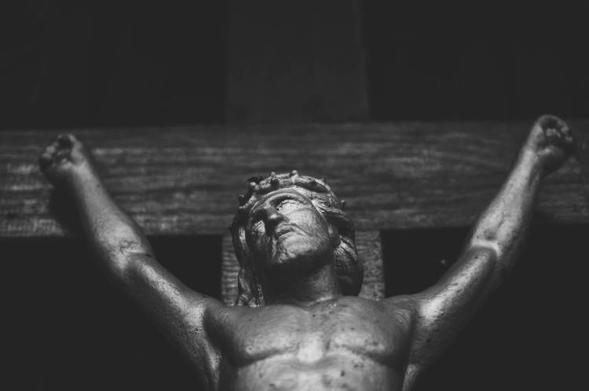
THE KING WHO STAYED ON THE CROSS
A Day in the Life of Jesus
This morning, as we open our hearts again to the story of Jesus’ passion, we approach one of the most sobering scenes in all Scripture. The Gospels tell it with a simplicity that almost startles us: “And when they had crucified him…” (Matthew 27:35). No embellishment. No dramatic description. Just the raw reality of the Son of God willingly placed upon a Roman cross. I often find myself pausing here, letting the quiet weight of those words settle over my spirit. For in that moment, the entire redemptive story reaches its turning point. As John Stott once wrote, “Before we can begin to see the cross as something done for us, we have to see it as something done by us.” Those words compel us not only to observe but to enter the scene with humility.
Matthew tells us that after nailing Jesus to the cross, the soldiers cast lots for His garments and then sat down to watch Him die. The indifference of that act stands in stunning contrast to the cosmic significance unfolding before them. Here was the Lamb of God, ho amnos tou Theou, the very One John the Baptist had announced, yet they saw “just another execution.” Over His head hung the placard, “Jesus of Nazareth, King of the Jews,” an inscription meant as mockery but which Heaven recognized as truth. Jesus does not correct them. He simply reigns—by staying where He is.
As I walk with the Gospel writers through this portion of Jesus’ day, I cannot ignore the hostility that surrounds Him. Passers-by shake their heads, repeating twisted versions of His teaching. Religious leaders taunt Him with a sneer: “He saved others, but he cannot save himself.” They unknowingly proclaimed the heart of the Gospel. He could not save Himself precisely because He was saving others. Their words become a commentary on substitutionary love. As the Greek text frames it, ouk dynatai sōsai heauton—“He is not able to save Himself”—not because of weakness, but because of mission.
Even the criminals crucified beside Him join in the abuse, a detail that reminds us how easily suffering can harden the spirit rather than soften it. Yet Luke later records that one of those men shifts from mockery to faith, whispering the prayer that has opened the door of paradise for millions: “Jesus, remember me when you come into your kingdom.” It is intriguing that the first person to recognize Jesus’ kingship at the cross is a dying thief. As commentator N. T. Wright observes, “This is a king whose power is revealed not in crushing His enemies but in forgiving them.”
The Gospel writers also record the offer of wine mixed with gall—an ancient anesthetic. Jesus refuses it. He chooses full awareness, unclouded pain, and an unimpaired mind. The One who earlier prayed in Gethsemane, “If it is possible, let this cup pass from me,” now chooses to drink it to the last bitter drop. His refusal should not be viewed as stoic heroism but as deliberate obedience. He embraces suffering with clarity because redemption requires nothing less.
Then comes the haunting irony embedded in Jesus’ earlier conversation with James and John. They had asked for places at His right and left when He entered His kingdom. They imagined seats of prestige, glory, and triumph. Jesus had warned them that they did not understand what they were requesting. And here, when the Kingdom is inaugurated—when the King is enthroned on a cross—the places at His right and left belong to condemned men. This is the Kingdom He spoke of: a Kingdom entered not through ambition but through surrender; not through ascending but through laying down one’s life.
As I reflect on this scene, I sense Jesus asking us the same question He asked those two brothers: “Are you able to drink the cup that I drink?” Discipleship is not an escape from suffering but a willingness to follow Jesus through it. The way to resurrection hope passes through cruciform obedience. When we take a stand for Christ, there may be misunderstanding, ridicule, or loss, but Jesus meets us in every place of pain. He is not the kind of Lord who watches from a distance; He is the King who suffers beside us.
Perhaps today you are walking through your own place of trial—a relationship strained, a burden you can no longer carry alone, a disappointment that has pierced you more deeply than you expected. Standing at the foot of the cross, you learn that Jesus does not ask you to endure anything He has not endured Himself. His wounds become the doorway through which all your wounds find meaning. When life whispers, “Save yourself,” Jesus whispers back, “Let Me save you.”
There is a reason Christians throughout history have spoken of the cross as both a scandal and a glory. Charles Spurgeon captured this tension when he wrote, “There is no easier way to become holy than to be near the Holy One.” And nowhere do we come nearer to Jesus than at the place where He loves us most openly. The cross unmasks the costliness of love and invites us to receive it without pretense.
As we move into the day ahead, allow this scene to shape your understanding of what it means to walk with Jesus. Following Him will not always be comfortable, but it will always be transformational. When you are tempted to grasp at comfort, remember that the King of glory chose a cross before He ever claimed a crown. And when you wonder whether He truly understands your suffering, remember that He did not numb His pain but bore it with full knowledge of your name.
May this vision strengthen you. May it steady you. And may it draw you nearer to the One who reigns from a cross so that we might reign with Him in life.
For further reflection, you may wish to read this related article from The Gospel Coalition on the meaning of Christ’s sacrifice:
https://www.thegospelcoalition.org/article/why-cross/
May the grace of the Lord Jesus walk beside you today, may His love sustain the hidden places of your heart, and may His courage steady your steps as you follow Him on the way of the cross.
FEEL FREE TO COMMENT, SUBSCRIBE, AND REPOST, SO OTHERS MAY KNOW
#crucifixion #discipleship #Matthew27 #Suffering #theWayOfTheCross
 Italian News by RSS
 Intentional Faith