 Josh Addison
Any excuse to use the word "squamous", frankly. #comic #webcomic #monkeyfluids #squamous https://www.monkeyfluids.com/2026/04/fuck-it-heres-lovecraft-reference.html
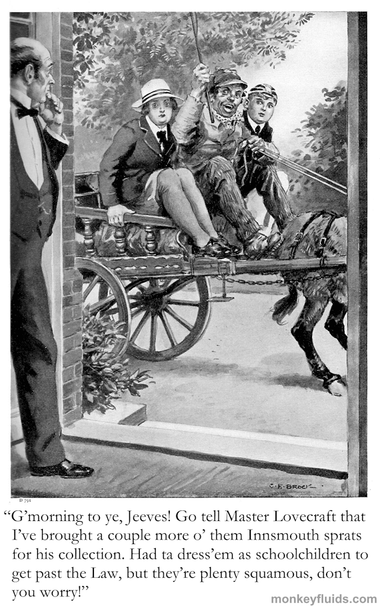
“What the hell do the love letters of that old fraud H.P. Lovecraft have to do with the Department for Environment, Food & Rural Affairs?”
A slight departure for National Unicorn Day – the Hugo Award-winning novella “Equoid” by Charles Stross @cstross
🦄 🐙
https://reactormag.com/equoid/
#Scottish #literature #unicorn #NationalUnicornDay #sciencefiction #scifi #lovecraft #horror #squamous #rugose #batrachian
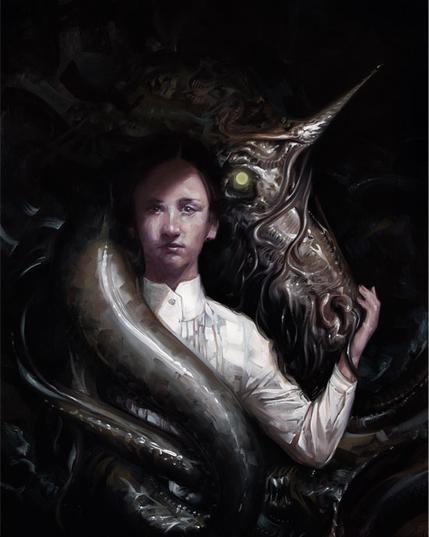
Winner of the 2014 Hugo Award for Best Novella. Charles Stross's "Equoid" is a new story in his ongoing "Laundry" series of Lovecraftian secret-agent bureaucratic dark comedies, which has now grown to encompass four novels and several works of short fiction. "The Laundry" is the code name for the secret British governmental agency whose remit is to guard the realm from occult threats from beyond spacetime. Entailing mastery of grimoires and also of various computer operating systems, the work is often nose-bleedingly tedious. As the front-cover copy line for Ace's edition of The Atrocity Archives noted, "Saving the world is Bob Howard's job. There are a surprising number of meetings involved." Previous "Laundry" stories on Tor.com are "Down on the Farm" and the Hugo Award finalist "Overtime."
“What the hell do the love letters of that old fraud H. P. Lovecraft have to do with the Department for Environment, Food and Rural Affairs?”
A slight departure for #NationalUnicornDay – the Hugo Award-winning novella “Equoid” by Charles Stross @cstross
🦄 🐙
https://reactormag.com/equoid/
#Scottish #literature #unicorn #sciencefiction #scifi #lovecraftian #horror #squamous #rugose
Winner of the 2014 Hugo Award for Best Novella. Charles Stross's "Equoid" is a new story in his ongoing "Laundry" series of Lovecraftian secret-agent bureaucratic dark comedies, which has now grown to encompass four novels and several works of short fiction. "The Laundry" is the code name for the secret British governmental agency whose remit is to guard the realm from occult threats from beyond spacetime. Entailing mastery of grimoires and also of various computer operating systems, the work is often nose-bleedingly tedious. As the front-cover copy line for Ace's edition of The Atrocity Archives noted, "Saving the world is Bob Howard's job. There are a surprising number of meetings involved." Previous "Laundry" stories on Tor.com are "Down on the Farm" and the Hugo Award finalist "Overtime."
Patients over 51.5 years old with #necrosis on the image of the primary #tumor in the #parotid gland could be more likely to be #squamous cell carcinoma than mucoepidermoid #carcinoma. (Xiaohua Ban et al.)
#InsightsIntoImaging #RadiologyHeadToToe
🔗 https://insightsimaging.springeropen.com/articles/10.1186/s13244-022-01256-x

Background Primary parotid squamous cell carcinoma (SCC) is a rare entity with a poor prognosis. Pathologically, the diagnosis of it requires the exclusion of parotid mucoepidermoid carcinoma (MEC). Currently, the imaging features of primary parotid SCC and the predictive indicators for differential diagnosis of the two entities have not been well reported. Our purpose was to identify the imaging characteristics of primary parotid SCC and to determine the predictive factors for its’ differential diagnosis. Results Thirty-one participants with primary parotid SCC and 59 with primary parotid MEC were enrolled. Clinical, CT and MRI features were reviewed and compared by univariate analysis. Then, multinomial logistic regression was used to determine the predictors to distinguish parotid SCC from MEC. Most primary parotid SCCs exhibited irregular shape, ill-defined margin, incomplete or no capsule, heterogeneous and marked or moderate enhancement, necrosis, local tumor invasiveness (LTI). Age, maximal dimension, shape, degree of enhancement, gradual enhancement, necrosis, and LTI were different between the primary parotid SCCs and MECs in univariate analysis (p < 0.05). While in multinomial logistic regression analysis, only age and necrosis were the independent predictors for distinguishing parotid SCC from MEC, and this model exhibited an area under curve of 0.914 in ROC curve analysis. Conclusions Primary parotid SCC has some distinct imaging features including the large tumor size, irregular shape, ill-defined margin, and particularly the marked central necrosis. Patients with age ≥ 51.5 years and necrosis on the image of the primary tumor in the parotid gland could be more likely to be SCCs than MECs.
 Assoc for Scottish Literature
 David Cantrell 🏏
 Kara Finance
 Insights Into Imaging
 Duncan Batey