Image 1:Piece of #WALDENSTEIN ore from Carinthia. Image 2: underground in the mine, the shiny Grey are the ore seams.
The ore is composed of dark Grey bladed hematite ( #specularite in English/ #Eisenglimmer auf Deutsch) and also contains pyrite (the yellow mineral in image 1). This ore is actually used as an industrial mineral and is the basis for rustproof paints, esp those used to on iron bridges. Can't rust that which is already rust😎
#MineralMonday

Before c.100,000 years ago, or the end of the #MiddlePleistocene say 130,000 years ago, the ONLY repeated material cultural evidence involving signaling behaviours in Homo is the #archaeological record of earth #pigment use.

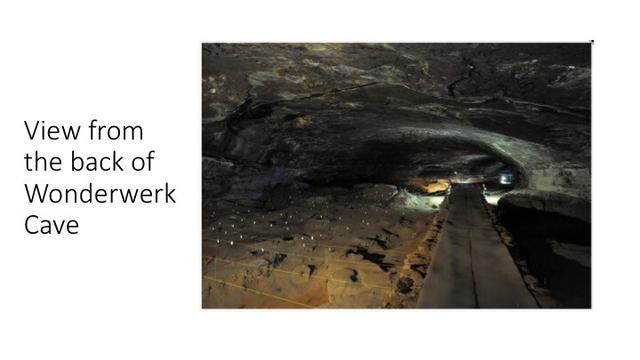
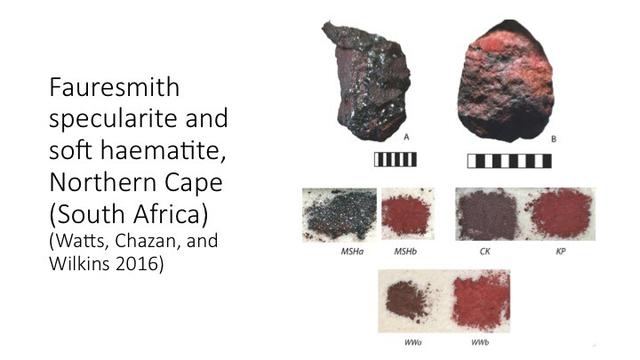
Going back c.500,000 years -- that is pre- Homo sapiens -- this overwhelmingly comprises blood-red iron oxides, known as ochre, including #haematite and the sparkly #specularite. Sites like #WonderwerkCave and #CanteenKopje in the Northern Cape have the oldest pigments which Ian Watts has analysed here
https://www.journals.uchicago.edu/doi/full/10.1086/686484

3/
Images: View from the back of Wonderwerk Cave, a huge space carved by an ancient river deep into the hillside. Pieces of sparkly specularite and blood-red haematite are some of the world's oldest pigments

Early Evidence for Brilliant Ritualized Display: Specularite Use in the Northern Cape (South Africa) between ∼500 and ∼300 Ka | Current Anthropology: Vol 57, No 3

Earth pigments figure prominently in debates about signal evolution among later Homo. Most archaeologists consider such behavior to postdate ~300 Ka. To evaluate claims for Fauresmith and Acheulean pigments in South Africa’s Northern Cape Province, extending back 1.1 Ma (Beaumont and Bednarik 2013), we reexamined collections from Kathu Pan 1, Wonderwerk Cave, and Canteen Kopje. We report and describe materials where we are confident as to a pigment status. We found (i) compelling evidence of absence in all but the youngest Acheulean contexts, (ii) definite but irregular use in Fauresmith contexts from at least 500 Ka, (iii) widespread and regular use within this limited area by ~300 Ka, coeval with circumstantial evidence for pigment transport over considerable distances and use in fire-lit environments. These findings are used to evaluate predictions derived from two competing hypotheses addressing the evolution of group ritual, the “female cosmetic coalitions” hypothesis (Power 2009) and the “cheap-but-honest signals” hypothesis (Kuhn 2014), finding that the former accounts for a greater range of the observations. The findings underscore the wider behavioral significance of the Fauresmith as an industry transitional between the Acheulean and the Middle Stone Age.

Current Anthropology