This just-accepted proceedings paper from last year's Oxford XIII/IAU Symposium 399 conference digs into a topic I have been thinking about for years: who really has the right to do exactly what in outer space, and what is the basis for any such 'right'?

What I found in researching it is that what one culture sees as benign might be deeply offensive to another, and that humans continue to ignore the lessons of #history (often flagrantly and deliberately).

https://arxiv.org/abs/2605.17706

#Space #SpacePolicy #Moon #Indigenous

'Unacceptable to our people': Diverse cultural beliefs, Indigenous rights, and the future of human activities on the Moon

The human presence in outer space is undergoing a transition from one in which nation states are the dominant actors to an emerging status quo in which states merely supervise the activities of private entities. Such largely commercial ventures include extracting natural materials from the Moon, a celestial body of great cultural and spiritual reverence for some Indigenous societies. However, the existing international legal framework governing activities in space focuses on its "exploration and use", centered in a Western worldview that attaches to a past history of colonialism. While that framework, articulated in the Outer Space Treaty (OST), claims to guarantee that outer space will remain "the province of all [hu]mankind," only entities with significant political power have to date decided the limits of the acceptable uses of space. This paper examines the historical record for clues about how states, private actors and Indigenous societies might interact in the future on matters of outer space governance to achieve more just ends. It analyzes a key case study: the dispute between the NASA and the Diné people of the American Southwest over the launches of human cremated remains to the Moon in 1998 and 2024, acts the Diné president called "deeply disturbing and unacceptable to our people and many other tribal nations." In a future in which space becomes increasingly commercialized and entities like NASA transform into mere contract-administering agencies, it is unclear how an impending, exploitative human presence on the Moon can simultaneously honor Indigenous rights and perspectives on lunar issues. The presentation concludes that best practices for future engagement with the Moon must transcend the mere "due regard" and "international consultations" required by the OST in favor of arrangements where participants co-create a human future in outer space.

arXiv.org
We Believed History Had Ended. They Didn’t: https://dmimoun.substack.com/p/we-believed-history-had-ended-they - Mars, Kardashev, the Golden Dome, and the cognitive distance keeping French #SpacePolicy stuck in another century (breathless essay, worth a read).
We Believed History Had Ended. They Didn’t.

Mars, Kardashev, the Golden Dome, and the cognitive distance keeping French space policy stuck in another century.

David Mimoun

The Number That Should Alarm You

One company owns 2/3s of every satellite currently in orbit.

That happened in 6 YEARS.

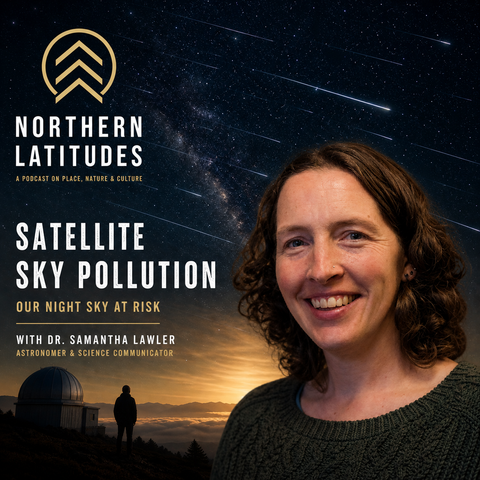
We sat down with the astronomer who's been tracking what that actually means.

New Northern Latitudes episode today.

https://rss.com/podcasts/northernlatitudes/2791123

#Satellites #SpacePolicy #Podcast

We’re Going Back

By Cliff Potts

Baybay City, Leyte, Philippines — May 4, 2026 — 07:05 AM PhST

Why This Moment Matters

There are moments in history when a decision does not belong to one nation.

It belongs to everyone.

This is one of those moments.

We’re going back to the Moon. Not as a flag-planting exercise, not as a Cold War rerun, and not as a national trophy case. This time, the goal is broader and more serious: to begin learning how humanity operates beyond Earth in a sustained way.

The program is called Artemis, and it represents the first real attempt in decades to move human presence off a single planet and keep it there (NASA, 2024).

Artemis II: The Door Reopened

That future is no longer theoretical.

Artemis II has already completed its mission.

The crew launched aboard the Space Launch System rocket and traveled in the Orion spacecraft on a free-return trajectory around the Moon. They conducted system checks in deep space, tested life-support systems with humans aboard, evaluated navigation and communication at lunar distance, and captured high-resolution imagery of both the lunar surface and Earth from deep space (NASA, 2025).

They orbited the Moon, passed behind it, and returned safely to Earth.

No drama. No failure.

Just proof.

Proof that we can send humans back to lunar distance and bring them home again.

That single fact changes everything. The question is no longer whether we can reach the Moon.

The question is whether we will finish the job.

Artemis III: The Step That Counts

The next mission, Artemis III, is the one that matters most.

That is the mission intended to land astronauts on the lunar surface for the first time since Apollo. It is designed not just as a visit, but as the beginning of a longer-term effort to operate on the Moon, particularly near the south pole where water ice may exist in permanently shadowed regions (NASA, 2024).

Water means survival.

Water means fuel.

Water means the possibility of staying.

That is the shift from exploration to presence.

The Argument We Always Hear

Every time humanity reaches for something like this, the same argument appears.

Why go to the Moon when there are problems on Earth?

It sounds responsible. It sounds grounded.

It is also incomplete.

We heard this argument when the Apollo program ended. We were told resources should be redirected toward fixing conditions on Earth. That was a reasonable claim at the time.

But those problems were not solved.

They did not disappear when exploration stopped. Many of them remain, decades later, largely unchanged.

Stopping exploration did not fix Earth.

It only limited what we were willing to attempt.

The Cost Reality

There is another misconception that deserves to be addressed clearly.

Space exploration is not what is draining national budgets.

NASA’s funding represents a small fraction of total government spending, often less than one percent (Office of Management and Budget, 2025). Even significant increases in that budget would not materially alter broader fiscal priorities.

This is not an either-or decision.

We can address problems on Earth and continue exploring beyond it.

We have the capacity to do both.

What Exploration Actually Does

Exploration is not separate from life on Earth.

It feeds into it.

Technologies developed through space programs contribute to advancements in communications, materials science, navigation systems, and medical research. These benefits return to Earth and become part of everyday infrastructure over time (National Research Council, 2011).

But beyond technology, exploration changes perspective.

It expands what people believe is possible.

It reminds us that progress is still an option.

A Species-Level Decision

This is not about the United States.

It is not about prestige.

It is about whether humanity chooses to remain confined to one planet or begins the process of becoming something more resilient.

A species that exists on a single world has a single point of failure.

A species that learns to operate beyond it does not.

That is the long-term meaning of this effort.

Where We Stand

We have already returned to lunar orbit.

We have already proven the path.

Now comes the harder part.

Landing. Operating. Surviving. Returning.

None of it is guaranteed. Timelines may shift. Systems may fail. Political priorities may change.

But those are not reasons to stop.

They are part of doing something difficult.

The Choice

We have been here before.

We reached the Moon, and then we chose to stop.

Now we are at that same decision point again.

Do we continue forward?

Or do we turn back and tell ourselves, once again, that there are more important things to do?

History suggests that waiting does not solve those other problems.

It only narrows what we attempt.

Closing

We have already gone back.

Now we decide whether we finish what we started.

Not as one country.

As a species.

We’re going back.

References

National Aeronautics and Space Administration. (2024). Artemis program overview. https://www.nasa.gov/artemis

National Aeronautics and Space Administration. (2025). Artemis II mission details and objectives. https://www.nasa.gov/artemis-ii

National Research Council. (2011). Recapturing a future for space exploration: Life and physical sciences research for a new era. National Academies Press.

Office of Management and Budget. (2025). Historical tables: Budget of the U.S. government. https://www.whitehouse.gov/omb

If this work helps you understand what’s happening, help me keep it going: https://www.patreon.com/cw/WPSNews

For more from Cliff Potts, see https://cliffpotts.org

#ArtemisIIMission #ArtemisIIILanding #ArtemisProgram #futureOfHumanity #MoonExploration #NASAProgram #spacePolicy
America needs a space alliance

America needs a space alliance

SpaceNews

The story of humanity in space is still being written, but the ink is drying fast.

CSE co-founders John Barentine and Aparna Venkatesan have published a new call to action in Frontiers in Space Technologies. They argue that we must look beyond outdated treaties to secure a just and sustainable future.

We have the agency to decide what happens next. Let’s build a future by design, not by default.

Read: https://www.frontiersin.org/journals/space-technologies/articles/10.3389/frspt.2026.1748406/full

#SpaceEnvironmentalism #SpacePolicy #Astronomy #Stewardship

Frontiers | The Outer Space Treaty won’t save us from ourselves

since 2020. 1 We argue here that this trajectory ignores history's lessons and will lead to failure to meet self-serving military/security goals of natio...

Frontiers

Is the Outer Space Treaty becoming a "League of Nations" for the cosmos?

In a new Opinion piece for Frontiers, we argue that existing space governance isn't fit for the era of private satellite megaconstellations. To protect our shared heritage, we need a shift toward "Space Environmentalism."

We still have the chance to build a future by design rather than by default—if we act before these norms are set in stone.

Read more: https://www.frontiersin.org/journals/space-technologies/articles/10.3389/frspt.2026.1748406/full

#SpacePolicy #Astronomy #SciencePolicy #SpaceEnvironmentalism

Frontiers | The Outer Space Treaty won’t save us from ourselves

since 2020. 1 We argue here that this trajectory ignores history's lessons and will lead to failure to meet self-serving military/security goals of natio...

Frontiers
La NASA passe à la vitesse supérieure sur la Lune : un premier document officiel détaille enfin la construction d’une base humaine dans le cadre d’Artemis www.journaldugeek.com/2026/04/23/b... #Space #Science #Innovation #Astrophysics #NASA #Artemis #MoonBase #LunarExploration #SpacePolicy #NewSpace

Base lunaire : la NASA publie ...
La NASA passe à la vitesse supérieure sur la Lune : un premier document officiel détaille enfin la construction d’une base humaine dans le cadre d’Artemis https://www.journaldugeek.com/2026/04/23/base-lunaire-nasa-publie-premier-document-officiel-construction-dun-avant-poste-humain/ #Space #Science #Innovation #Astrophysics #NASA #Artemis #MoonBase #LunarExploration #SpacePolicy #NewSpace
Arianegroup prévient les Européens : si Elon Musk décidait de couper l’accès aux lancements, certaines missions pourraient être immédiatement bloquées, révélant une forte dépendance aux acteurs privés https://www.lesechos.fr/industrie-services/air-defense/demain-si-elon-musk-decide-de-ne-pas-lancer-untel-ou-untel-il-fermera-le-robinet-lavertissement-du-pdg-darianegroup-aux-europeens-2227969 #Space #Science #Innovation #AerospaceEngineering #Arianegroup #SpaceX #ElonMusk #Ariane6 #EuropeanSpace #SpacePolicy