Experiments in the generation (across several timesteps) and advection of Lagragian passive tracers to track the propagation of gas matter in new cosmological simulations of clusters of galaxies.

(tracers code in #Julia language, on top of ENZO-MHD simulations)

#SimulatedUniverses #astrophysics #astronomy

So now colleagues have started asking me cover pictures for their press releases, even if I am not even in the paper and I do not know what the paper is about (embargo!) except that it has to do with intergalactic magnetism, so here we go with some new attempts to display the complexity of gas flows and magnetic fields in a cosmological MHD simulation...

#astronomy #astrophysics #science #SimulatedUniverses

A few central slices at different times showing the structure of the simulated magnetic field in a new 1e15Msol clusters of galaxies simulated with the ENZO code and 7 levels of Adaptive Mesh Refinement at CINECA, and using the Constrained Transport (CT) method.

So cool and clean!

#SimulatedUniverses #astrophysics #astronomy

Experiment in the propagation of ultra high energy (>1e18-1e21 eV) protons injected in a simulated cosmic volume at the very late redshift of z=0.02. In the left experiment their trajectories are deflected by the lorentz force (F=q (v x B)) on protons exerted by extragalactic magnetic fields, in the right case we assume for comparison that B=0 everywhere (so they just proceed in a straight line and loos energy by other processes).

#simulatedUniverses #astronomy #physics

Exciting map of the day for a cosmological simulation, first timestep at redshift 99.73, already a lot of problems comparing this to a parallel run done with another code....

#SimulatedUniverses #astrophysics

The large scale distribution of magnetic fields in a realistic (hopefully) simulation of the cosmic web, and what might be detected in the future using the low-frequency part of the Square Kilometre Array.

#SimulatedUniverses #astrophysics #astronomy

Testing a very small N-body simulation with a colleague, to introduce self-gravity in another code. Here are 32^3 dark matter particles, evolving from redshift 100 to 0.
As expected and I politely suggested, plotting them in intervals of equal redshift is a poor choice: each frame here is for an interval of Δz=10 starting from z=100, almost nothing happens until z=10, then we have the first caustics, then halos appear only at z=0.
#SimulatedUniverses #astrophysics #science

Can you do any science using fewer than the 32^3 dark matter particles in the left mage? (the other are 64^3 and 128^3 dark matter particles)
No, and this is also ridiculously small, yet this is the start of a potentially powerful comparison with another code, which did not use to have dark matter and self-gravity, so even a comparison with this tiny tiny N-body simulations may be opening something big in the future!

#SimulatedUniverses #astronomy #astrophysics

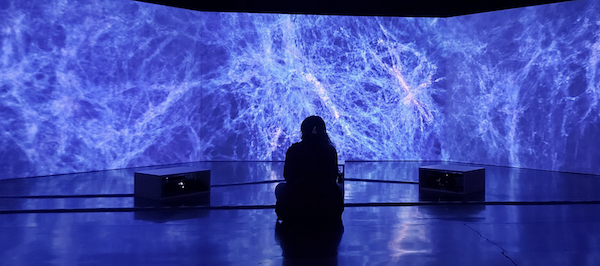
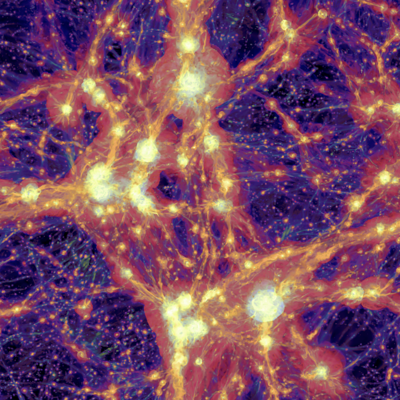
The rich texture of the dark matter cosmic web in one of the largest simulations I have run with the ENZO code, a few years ago (some material for incoming cycle of lectures).

#SimulatedUniverses #astrophysics #astronomy #science

Reviving a small simulation (2D in Julia) to show how the onset of cosmic structure formation can essentially be captured by the Zeldovich approximation - meaning you just keep displacing the initial distribution of particles following the path traced by the initial tiny gravitational perturbations, which are imprinted in the initial conditions.
Actual N-body dynamics will take place only at the first crossing of streams of particles (in filaments, halos..)
#simulatedUniverses #astrophysics