 alex luyckx unofficial
A Faded Glory – Aurora – Grand Trunk Railway (1900-Present)
When it comes to Aurora, Ontario, unless you take public transit regularly, the old train station may not even be in your mind. Even then, you may not realise the importance of this small community regarding the impact the community had on Ontario railway development, as in 1853, it was the first destination for the first steam train in the province.
With all the additional pillers and displays and security eyeing me this was the safest vantage point for the Aurora station.
Crown Graphic - Nikon Nikkor-W 1:5.6/180 - Ilford HP5+ @ ASA-200 - Pyrocat-HD (1+1+100) 9:00 @ 20C
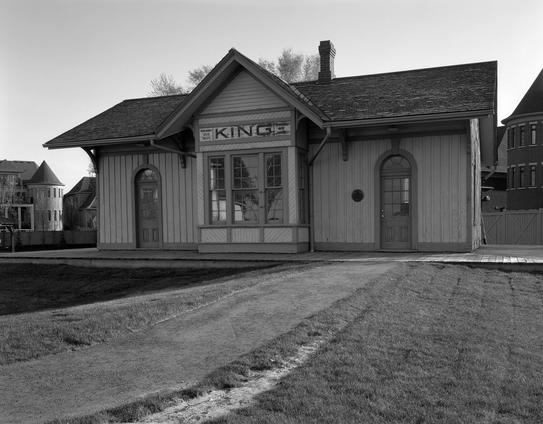
As I spoke of last week, Ontario, Simcoe & Huron faced plenty of problems in getting their line constructed. The biggest problem that came after securing the needed funding came to construction. Starting in October put them already at a disadvantage, running north from their railhead at Toronto's harbour at Front Street, the going was slow. The cold and frozen ground quickly gave way to the even poorer ground quality of the Oak Ridges Moran. But Ontario, Simcoe & Huron had another trick up their sleeves. Rather than import a locomotive from England, they contracted a Canadian firm to complete their first locomotive. The Toronto Locomotive Works would receive the contract to build that first engine. First opening in 1840 by Irish immigrant James Good, the foundry started constructing household goods before moving onto boilers and stationary steam engines. The jump to a railway locomotive was no easy feat, but the Toronto Locomotive Works completed the appropriately named "Toronto" with hundreds of workers on 16 April 1853. The Toronto was a 4-4-0 locomotive known as an American or Bogie class. For two days, the locomotive was displayed with pride outside the works for the public. Among those who came to see this was former Toronto Mayor and Rebel leader William Lyon MacKenzie. MacKenzie went on to say that the Toronto was a "Truly beautiful piece of machinery powerful and handsomely finished." It took five days to move the locomotive from the works at Queen and Yonge to the railhead on Front Street. And in May of 1853, with the Toronto in the lead, the first steam train, a mixed passenger and freight run, left the Toronto station and arrived a few hours later in the small community of Machell's Corners to cheering crowds and fireworks. The community had constructed a simple wooden station that same year following the standard design of F.W. Cumberland, who favoured function over form. While there are no surviving photographs or images of the first station, it is safe to assume it looked similar to the surviving King City Station. The railroad's arrival gave the community of Machell's Corner an economic boost, and soon a lot of businesses formed around the station, located a short distance from the village centre. And a year later, in 1854, the community took the modern name of Aurora. The station continued to serve under the banners of Northern Railway of Canada and North & North-Western Railway until coming under the control of Grand Trunk Railway in 1888 with little change.
The station name sign under the Porte-Coche.
Nikon D750 - AF-S Nikkor 28-70mm 1:2.8DExcellent cornice details along the station's exterior.
Nikon D750 - AF-S Nikkor 28-70mm 1:2.8D
But Grand Trunk, like Ontario, Simcoe & Huron, did not have the best financial track record, at least until the arrival of Charles Hayes in 1896. As Grand Trunk began to turn a profit, Hayes undertook a major modernization and standardization project at the turn of the century. One thing that was done is updating many older stations. Grand Trunk spoke poorly of the early Cumberland stations, one executive mentioning that the person who designed the stations should be jailed. The station followed the Queen Anne Revival architectural design, being off a major branch of the Grand Trunk network and in a smaller community, the station's footprint would be small. Construction was of board and batten with elegant wooden trim with a distinctive porte-cochere. Inside the station was a baggage and freight room, station master's office with a telegrapher bay that jutted onto the station platform with a ticket window and a single general waiting room. The station was painted in the traditional grey, green, and mauve colour scheme. The new station opened in 1900 and was among the first updated stations completed by Grand Trunk. The new station was completed right near the old station, which was quickly torn down. In 1923, Canadian National took over the Grand Trunk network. They continued to operate the Aurora station with little change. Canadian National covered over the original wood station with insulation material and painted the station a railroad red through the mid-century. Given Aurora's status, in 1953, Canadian National pulled two former GTR steam locomotives from their mothballs. It ran a special 100th Anniversary train from Toronto's Union Station to the Aurora Station, installing a plaque at both points to commemorate the occasion. The town also installed a former steam locomotive bell in a small parkette near the station. In 1971, with the possibility of ending passenger service, the station received a Provincial Heritage status. Canadian National passenger service slowly declined through the 1960s, and the final passenger train passed through in 1978.
Looks like the station could use a new coat of paint.
Nikon D750 - AF-S Nikkor 28-70mm 1:2.8DThe historic steam locomotive bell memorializing the first steam train through in 1853.
Nikon D750 - AF-S Nikkor 28-70mm 1:2.8D
Canadian National, however, continued to use the line for freight operations and continued to use the station for that purpose. When GO Transit decided to expand its commuter service, they leased a station section from Canadian National in 1982. When Canadian National ceased operations, the station fell under GO Transit in 1992. It received a Federal Heritage Status and through the mid-1990s underwent full restoration and renovation. Today most of the station is a general waiting room with a small ticket and security office. The outside was stripped of the coating and painted historic colours. Additionally, external screens allow for easy viewing of trains and buses. While the station has survived and still functions as a GO station, the locomotive Toronto met its end in 1881 and hit the scrap heap. The small parkette is also nearby the station that houses a provincial historic plaque and the steam bell memorial to that first railway trip.
#afadedglory #aurora #canada #canadianhistory #canadiannational #crowngraphic #gotransit #grandtrunk #history #ilfordhp5 #infrastruture #nikond750 #ontario #pyrocathd #railroad #railway #simcoehuron