 Fomka
Fomka
 Alyzabeth
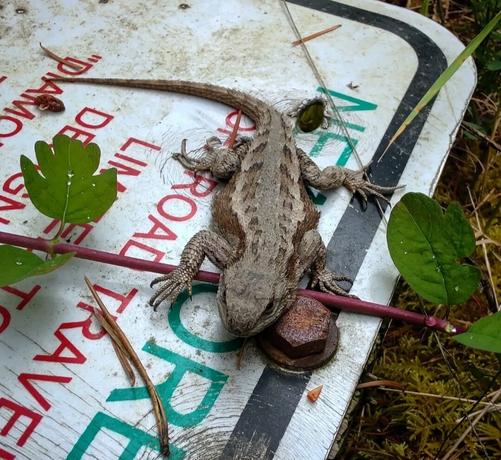
Western Fence Lizard (Sceloporus occidentalis).
#lizard #reptile #sceloporus #herptology
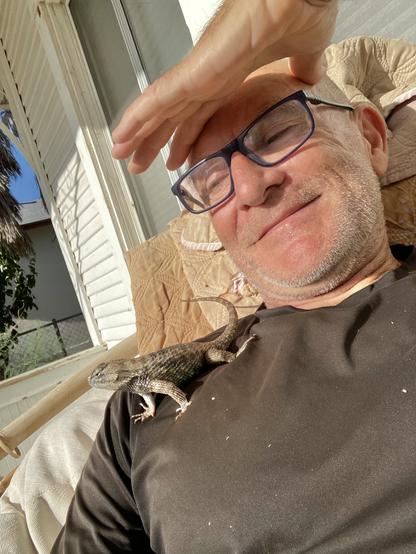
Bill The Lizard is completely whistle trained. With just a couple of whistles, he came running across the yard from the neighbor's wall to get his morning mealworms. Then when I ran out, he started climbing all over me.
Harriet The Lizard and I already had our morning coffee and mealworm time together.
Contrary to expectations based on #phylogeography (topleft, blue boxes) or habitat similarity (red boxes), undisturbed communicative behavior was more similar between the more distant S. consobrinus and S. u. undulatus, than between S. u. hyacinthinus and either of those two, suggesting that behavioral plasticity and local adaptation to different selective pressures in each population underlie interpopulation variation in behavior.
Read in full: https://doi.org/10.1111/eth.13402

Abstract. Human land transformation alters features of the landscape that may favor or eliminate biodiversity. Understanding habitat use among species in human-affected ecosystems can inform the management of habitats and conservation of species. The Trans-Mexican Volcanic Belt in central Mexico is a biological hot spot for lizard species diversity that is under considerable anthropogenic pressures including grazing, agriculture, urbanization, and climate change. Here, we used species-occupancy modeling to (1) identify habitat characteristics that are essential to predicting the presence of Sceloporus torquatus and S. grammicus lizards, (2) determine if disturbance predicts species occupancy, and (3) determine which features, if any, predict our ability to detect each species in the wild. We found that S. torquatus lizards were more likely to be present in areas with large boulders and abundant refuges, whereas S. grammicus lizards were more common in forests with leaf litter. Human disturbance and urban disruption did not predict the occupancy of either species, with lizards making use of artificial as well as natural refuges in human settlements as well as protected areas. Although we found only weak evidence that habitat and climate predicted detection probabilities, Sceloporus lizards (particularly S. grammicus) were somewhat more easily detected in high humidity, perhaps because of generally higher activity levels. Our results emphasize the importance of understanding the detailed physical characteristics that allow each species to persist, even in disturbed habitats. This can better inform conservation efforts so that resources are allocated to ensure that these characteristics, like rocks and trees, are readily available in both pristine and human-modified areas.
#Lizards in fire-prone ecosystems not only detect the #fires by smell it (https://doi.org/10.1093/beheco/arab010), they can also hear it!
*Lizards' response to the sound of fire is modified by fire history*
https://doi.org/10.1016/j.anbehav.2022.12.002 (#OA) in Animal Behaviour by Álvarez-Ruiz et al. (#CIDE #CSIC), https://jgpausas.blogs.uv.es/2023/01/09/lizards-hear-wildfires/
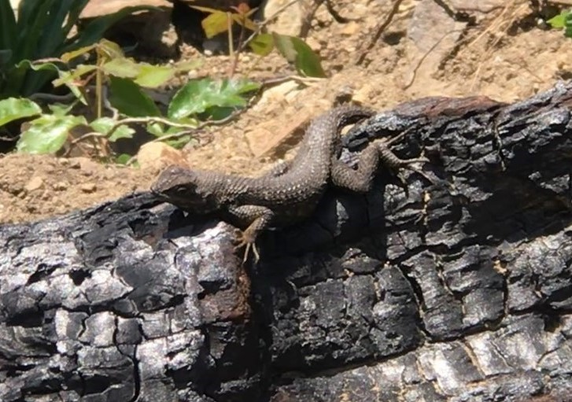
Fence lizard, #Sceloporus occidentalis, 2018 #WoolseyFire
#AnimalBehavior #fireecology #lizard @wildfirescience #openaccess

Abstract One of the most stunning patterns of the distribution of life on Earth is the latitudinal biodiversity gradient. In an influential article, Janzen (1967) predicted that tropical mountains are more effective migration barriers than temperate mountains of the same elevation, because annual temperature variation in the tropics is lower. A great deal of research has demonstrated that the mechanism envisioned by Janzen operates at broad latitudinal scales. However, the extent that the mechanism mediates biodiversity generally, and at smaller scales, is far less understood. We investigated whether climate overlap is associated with genetic similarity between populations within temperate regions using lizards in the Sierra Nevada mountain range of California as a study system. By comparing genetic differentiation between high- and low-elevation populations, we found that in addition to the expected strong pattern of isolation by distance, high climate overlap was negatively associated with genetic differentiation, indicating that population pairs that inhabit climatically similar environments are less genetically differentiated. Moreover, while climate overlap between high- and low-elevation sites is predicted to increase from the equator to temperate regions, we find that in adjacent mountain ranges at the same latitude in temperate regions, climate overlap values can vary widely. This study suggests that in addition to the well-studied main effect of latitude on climate overlap and population differentiation, local climate factors within bioclimatic regions can also influence genetic differentiation between populations and do so by the same general mechanism that operates at larger geographic scales.
 My camera shoots fascists
 Cristina Romero-Diaz
 juli g pausas
 Van Wishingrad