Did you know that there is a brand new R-Project Package for the Pan-European-Phenology Dataset?
Created by Matthias & Barbara Temple and very well documented for an easy start.
eg.: https://cran.r-project.org/web/packages/pep725/vignettes/getting-started.html

https://cran.r-project.org/package=pep725
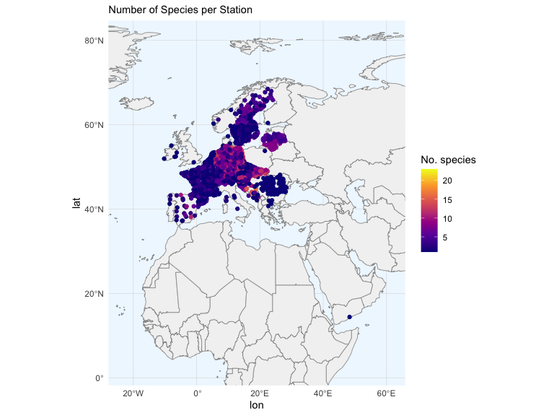
#pep725 #phenology #eumetnet #R #rproject

Part 2 of "Porting a Shiny App to Observable" is now up on our blog. If you missed part 1 we looked at the basics of how to construct an Observable app. In Part 2 we look at adding your own styles and at how to quickly deploy the app.

#RStats #RProject #Shiny #Observable

https://www.jumpingrivers.com/blog/shiny-to-observable2/

Porting a Shiny App to Observable Framework: Part 2

Description goes here.

The latest version of Posit PBC Package Manager allows you to add metadata to package pages. This means we can now directly link R and Python packages to diffify! Read more in our latest blog post!

#RProject #RStats #Python
https://www.jumpingrivers.com/blog/diffify-posit-package-manager/

Diffify & Posit Package Manager

The latest version of Posit Package Manager allows us to add metadata to package pages. This means we can now directly link R and Python packages to diffify.com!

Might be useful for screening #DNAmetabarcode datasets "VLF: An R package for the analysis of very low frequency variants in DNA sequences" https://bdj.pensoft.net/articles.php?id=96480&journal_name=bdj #biodiversity #highThroughputSequencing #bioinformatics #Rproject
VLF: An R package for the analysis of very low frequency variants in DNA sequences

Here, we introduce VLF, an R package to determine the distribution of very low frequency variants (VLFs) in nucleotide and amino acid sequences for the analysis of errors in DNA sequence records. The package allows users to assess VLFs in aligned and trimmed protein-coding sequences by automatically calculating the frequency of nucleotides or amino acids in each sequence position and outputting those that occur under a user-specified frequency (default of p = 0.001). These results can then be used to explore fundamental population genetic and phylogeographic patterns, mechanisms and processes at the microevolutionary level, such as nucleotide and amino acid sequence conservation.Our package extends earlier work pertaining to an implementation of VLF analysis in Microsoft Excel, which was found to be both computationally slow and error prone. We compare those results to our own herein. Results between the two implementations are found to be highly consistent for a large DNA barcode dataset of bird species. Differences in results are readily explained by both manual human error and inadequate Linnean taxonomy (specifically, species synonymy). Here, VLF is also applied to a subset of avian barcodes to assess the extent of biological artifacts at the species level for Canada goose (Branta canadensis), as well as within a large dataset of DNA barcodes for fishes of forensic and regulatory importance. The novelty of VLF and its benefit over the previous implementation include its high level of automation, speed, scalability and ease-of-use, each desirable characteristics which will be extremely valuable as more sequence data are rapidly accumulated in popular reference databases, such as BOLD and GenBank.

Biodiversity Data Journal
Great website for suggesting appropriate #visualisation for different data types (numeric, categoric, maps, networks, time series, etc). Even has code snippets in #RProject and #python.
https://www.data-to-viz.com/
From data to Viz | Find the graphic you need

A classification of chart types based on their input data format.

Occasionally, people write books about topics I deeply care about and I know a lot about. Some of those books are neat - the #Rproject book from the Austrian educational statistics bureau was ace. Some of those books are quite disappointing. Yes, I'm looking at you, early '00s Natalie Portman biography.

Sometimes I look at topics I like that do not yet have "a book" and I wonder: "Should I write it myself?"

I Love Free Software Day: Who would you like to say thank you to? - Linda Wagener

https://media.fsfe.org/w/2w4VhYEeEdxJj84hopqd27

I Love Free Software Day: Who would you like to say thank you to? - Linda Wagener

PeerTube