 PeterD 🇩🇪 🇨🇦
Dead #crustaceans washing up on England’s north-east coast may be victims of #industrial revival https://theconversation.com/dead-crustaceans-washing-up-on-englands-north-east-coast-may-be-victims-of-industrial-revival-193144
#pyridine
#pyridine
Attached: 1 image Graeme Bandeira on #TheresaCoffey avoiding scrutiny of mass crab die off! - political cartoon gallery in London original-political-cartoon.com
@anamckellar Here's the article, posted by the author #JenniRussell in a very informative thread/discussion relayed on #Nitter - shocking reading. The #UK "will poison food chains forever unless we change..."
https://nitter.net/jennirsl/status/1612873215566569473
#MarinePollution #Teesside #ecocide
#fisheries #DieOff #crabs #lobsters #seals #seabirds
#toxic #IndustrialWaste #dredging #toxin #pyridine
#DEFRA #Coffey #Houchen #UKpolitics
#EnvironmentalDisaster #FoodChain
@JugglingWithEggs
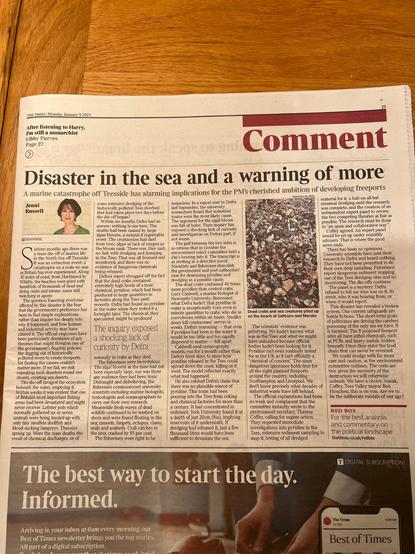
Please read; the most important piece I've written. Mass poisoning has suddenly killed off most sea life for 30 miles by the Tees. The govt claims it's natural; ind scientists warn it's manmade. The govt is desperate not to inquire too deeply as its freeport policy is at stake.
One of the greatest #EnvironmentalCatastrophes in Britain in recent times: a #MassExtinction of #MarineLife in the North Sea off #Teesside.
A 30-mile section of the coast has been turned into a marine desert by toxic #pyridine released by dredging.
Referenced link: https://phys.org/news/2022-11-problem-functionalizing-pyridine-meta-position.html
Discuss on https://discu.eu/q/https://phys.org/news/2022-11-problem-functionalizing-pyridine-meta-position.html
Originally posted by Phys.org / @[email protected]: https://twitter.com/physorg_com/status/1593347760698187777#m
Researchers solve the problem of functionalizing #pyridine in the #meta-position @WWU_Muenster @sciencemagazine https://www.science.org/doi/10.1126/science.ade6029 https://phys.org/news/2022-11-problem-functionalizing-pyridine-meta-position.html

In chemicals used in agriculture, as well as in pharmaceuticals and a variety of materials, pyridines are often found as so-called functional units that decisively determine the chemical properties of substances. Pyridines belong to the group of ring-shaped carbon-hydrogen (C-H) compounds ("heterocycles"), and they contain a nitrogen atom (N). For chemists, the direct functionalization of the carbon-hydrogen bonds (C-H bonds) of pyridines is a straightforward approach to designing and modifying complex molecules, including in the final stage of the synthesis sequence.

 Alan Matthews 🇬🇧 🇪🇺
 Claire Barnes
 Marverde
 Phys.org