 Frontend Dogma
The Three Pillars of JavaScript Bloat, by @43081j.com:
https://43081j.com/2026/03/three-pillars-of-javascript-bloat
#javascript #dependencies #complexity #runtimes #architecture #polyfills
The Three Pillars of JavaScript Bloat, by @43081j.com:
https://43081j.com/2026/03/three-pillars-of-javascript-bloat
#javascript #dependencies #complexity #runtimes #architecture #polyfills
Por fin me he quitado de encima un potencial problema que me traía de cabeza. El tema de una aplicación crítica ahora se visualiza decentemente y es operativo en el #Webview que usa Microsoft en sus aplicaciones.
La solución es algo enrevesada: incluye un pipeline complejo con #gulp y #webpack usando #SASS, #PostCSS, transpilación de módulos JavaScript, un par de #polyfills, un #ponyfill, una pizca de magia arcana y varios artificios quirúrgicos. Dista de ser perfecta pero por lo menos es funcional.
A Polyfill for the HTML “switch” Element, by @tomayac:
https://blog.tomayac.com/2026/01/12/a-polyfill-for-the-html-switch-element/
Updates to Popover and CSS Anchor Positioning Polyfills, by @jamessw (@OddBird):
Polyfilling CSS With CSS Parser Extensions, by @bramus:

In April I attended #BlinkOn, the conference for web platform contributors in the Chromium open source project. At the conference I gave a presentation about “CSS Parser Extensions”, a wild idea I have to fix CSS polyfilling once and for all. If you didn’t know, polyfilling CSS features is extremely hard, mainly because the CSS Parser discards what it does not understand. So what if, instead of having authors write their own parser and cascade to polyfill a CSS feature, they could teach the parser some new tricks?
How to Think About Baseline and Polyfills, by @malchata (@developers):
#Development #Guidelines
Baseline and polyfills · When should you use a polyfill for a web feature? https://ilo.im/162wl8
_____
#Baseline #Polyfills #Browser #Interoperability #WebDev #Frontend #Backend #HTML #CSS #JavaScript
#Development #Guides
Baseline with fallback strategies · How to decide on polyfills and progressive enhancement https://ilo.im/161j7k
_____
#Baseline #BrowserSupport #Polyfills #ProgressiveEnhancement #Browser #WebDev #Frontend #HTML #CSS #JavaScript
 Oscar Cubo Medina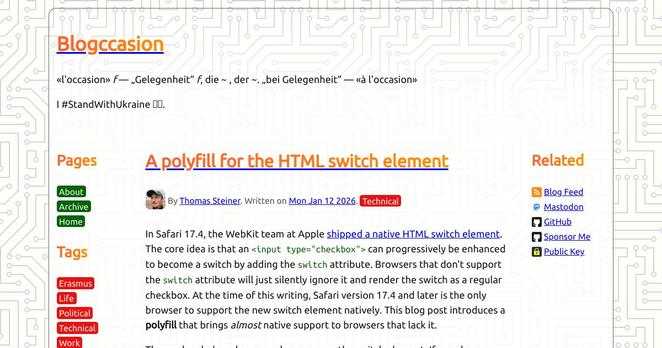
 Peta
Peta  foppa
foppa HackerNoon


 Inautilo