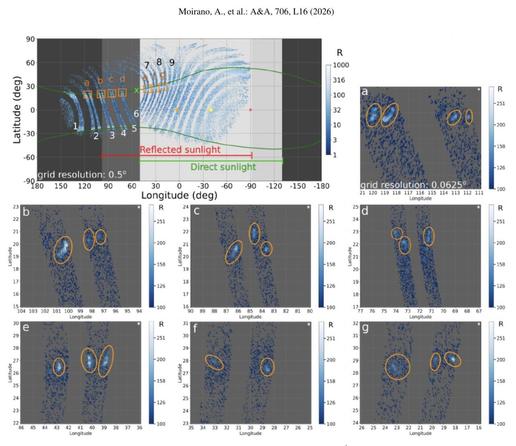
✨🔭 New observations of #Ganymede 🌖reveal a surprising similarity between the #auroras 🌌 on the #SolarSystem's largest #moon and those on #Earth 🌍. A team of space physicists has obtained new results suggesting that the fundamental physical processes that generate auroras are common to different celestial bodies.

🌍 https://www.researchgate.net/publication/400351529_Juno's_high-spatial-resolution_ultraviolet_observations_of_Ganymede's_auroral_patches_Constraints_on_the_magnetospheric_source_region

#auroq #SpacePhysics #Jupiter #PlasmaPhysics #Juno #JunoSpacecraft #magnetosphere

Thanks @Umbertogaetani for sharing 🙏 https://mastodon.uno/@Umbertogaetani/116113873863038999

Using joint observations from the #Tianwen-1 in the #solarwind and #MAVEN in the induced #magnetosphere, Lin et al. identified a magnetic barrier between #Mars#ionosphere and shocked solar wind under the radial #IMF for the first time.

📄 https://doi.org/10.1016/j.xinn.2026.101312

#SpacePhysics #PlasmaPhysics #SolarSystem

Weekly Update from the Open Journal of Astrophysics – 31/01/2026

It’s Saturday once more so time for another update of activity at the Open Journal of Astrophysics. Since the last update we have published a further three papers, bringing the number in Volume 9 (2026) to 18 and the total so far published by OJAp up to 466.

I will continue to include the posts made on our Mastodon account (on Fediscience) to encourage you to visit it. Mastodon is a really excellent service, and a more than adequate replacement for X/Twitter which nobody should be using; these announcement also show the DOI for each paper.

The first paper to report this week is “Probing Stellar Kinematics with the Time-Asymmetric Hanbury Brown and Twiss Effect” by Lucijana Stanic (University of Zurich, Switzerland) and 13 others based in Zurich, Lausanne and Geneva (all in Switzerland). This was published on Monday 26th January 2026 in the folder Instrumentation and Methods for Astrophysics. This research demonstrates that intensity interferometry can reveal internal stellar kinematics, providing a new way to observe stellar dynamics with high time resolution.

The overlay is here:

You can find the officially accepted version on arXiv here and the announcement on Fediverse here:

https://fediscience.org/@OJ_Astro/115961234375736584

The second paper is “DIPLODOCUS I: Framework for the evaluation of relativistic transport equations with continuous forcing and discrete particle interactions” by Christopher N Everett & Garret Cotter (University of Oxford, UK). This was published on Tuesday January 27th 2026 in the folder High-Energy Astrophysical Phenomena. DIPLODOCUS is a new framework for mesoscopic modelling of astrophysical systems, using an integral formulation of relativistic transport equations and a discretisation procedure for particle distributions.

The overlay for this one is here:

The official version of the paper can be found on arXiv here and the Fediverse announcement here:

https://fediscience.org/@OJ_Astro/115966199181415094

Next, also published on Tuesday January 27th but in the folder Cosmology and Nongalactic Astrophysics we have “The Atacama Cosmology Telescope: DR6 Sunyaev-Zel’dovich Selected Galaxy Clusters Catalog” by M. Aguena et al. (101 authors altogether), on behalf of the ACT-DES-HSC Collaboration. This article reports on the discovery of 10,040 galaxy clusters in the Atacama Cosmology Telescope data, including 1,180 clusters at high redshifts, using the Sunyaev-Zel’dovich effect.

The overlay is here:

The official version can be found on arXiv here and the Fediverse announcement is here:

https://fediscience.org/@OJ_Astro/115966458299870033

And finally for this week we have a paper published yesterday, Friday 30th January 2026, in the folder Astrophysics of Galaxies. This is the paper I blogged about yesterday: “A Cosmic Miracle: A Remarkably Luminous Galaxy at zspec = 14.44 Confirmed with JWST” by Rohan Naidu (MIT Kavli Institute) and an international cast of 45 others. This article reports on the discovery by the James Webb Space Telescope (JWST) of a bright galaxy, MoM-z14, located 280 million years post-Big Bang, that challenges models of galaxy formation and the star-formation history of early galaxies.

The overlay is here:

The accepted version can be found on arXiv here, and the fediverse announcement is here:

https://fediscience.org/@OJ_Astro/115982837486159819

And that concludes the update for this week. I will do another next Saturday.

#ACTDESHSCCollaboration #arXiv250511263v2 #arXiv250721459v3 #arXiv250813296v4 #arXiv250913152v2 #AstridSimulations #AstrophysicsOfGalaxies #CosmologyAndNonGalacticAstrophysics #DiamondOpenAccess #DiamondOpenAccessPublishing #DIPLODOCUS #galaxyClusters #galaxyFormation #HanburyBrownAndTwiss #HighEnergyAstrophysicalPhenomena #InstrumentationAndMethodsForAstrophysics #JWST #largeScaleStructureOfTheUniverse #MoMZ14 #OpenAccess #OpenAccessPublishing #OpenJournalOfAstrophysics #PlasmaPhysics #relativisticTransportEquations #starFormation #StellarKinematics #SunyaevZeDovichEffect #TheOpenJournalOfAstrophysics

BETA: Trình mô phỏng phản ứng nhiệt hạch FUSION CIRCUS – học plasma vật lý qua trò chơi! Tự tay điều khiển từ trường, kiểm soát nhiệt độ >100 triệu độ, tránh sụp đổ plasma & đạt ngưỡng Lawson. Dựa trên dữ liệu thực từ JET, ITER, KSTAR. Có AI hướng dẫn, 28 module vật lý, 16 tokamak. Trải nghiệm ảo nhưng kiến thức thật! 🌞🧲💥
#NuclearFusion #PlasmaPhysics #CleanEnergy #ITER #ScienceEducation #VậtLýHạtNhân #NăngLượngSạch #GiáoDụcKhoaHọc #FusionCircus

https://www.reddit.com/r/SideProject/comment

Vera Chernogorova – Conversations About The Atomic Nucleus (Eureka Series)

The book discusses issues related to the study of the atomic nucleus and its structure, nuclear forces, and the components of the nucleus. It also describes the achievements of Soviet scientists in the field of nuclear energy.

About the Author

After graduating from the Faculty of Physics and Mathematics at university, Vera Aleksandrovna entered postgraduate studies and later became a research fellow at the Joint Institute for Nuclear Research in the town of Dubna. For nearly twelve years, she participated in experiments conducted on a particle accelerator — the synchrocyclotron. Vera Aleksandrovna is a co-author of many scientifi c papers on the study of the properties of mu-mesons.

In recent years, she has published over ten articles in journals such as Znanie — Sila (Knowledge Is Power), Science and Life, Technology for the Youth, and others.

The topics of these articles include problems in nuclear physics, high-energy physics, astrophysics, controlled thermonuclear fusion, the application of scientific achievements in The human practice, and the future of science. Many of these articles have been reprinted in foreign journals.

In 1973, our publishing house released her book Mysteries of the Microworld, which discussed some current problems in the physics of elementary particles. Conversations About the Atomic Nucleus is the author’s second book to appear in the Eureka series.

Illustrations: K. Moshkin
Translated from the Russian & typeset in LaTeX by Damitr Mazanav

You can get the book here and here

This book is an Open Educational Resource (OER).

Released under Creative Commons by ShareAlike 4.0


Twitter: @MirTitles
Mastodon: @[email protected]
Bluesky: mirtitles.bsky.social

#Ccbysa #Oer #elementaryParticles #eurekaSeries #nuclearPhysics #physics #plasmaPhysics #popsci #popularScience #scipop #structureOfMatter

🚀 Exciting news! I’m thrilled to share that my latest research article, "Cylindrical Dust Acoustic Shock Waves in a Self‐Gravitational Magnetized Dusty Plasma Compared With Black‐Hole Plasma," has been published!

🔗 Read it here:
https://doi.org/10.1002/mma.

https://www.researchgate.net/publication/395650490_Cylindrical_Dust_Acoustic_Shock_Waves_in_a_Self-Gravitational_Magnetized_Dusty_Plasma_Compared_With_Black-Hole_Plasma

I’d love to hear your thoughts and discuss the implications of these findings! 🌌

#BlachHole #Astrophysics #PlasmaPhysics #NewPublication #NuclearReactorPlasma

#Zoomposium with Prof. Dr. #Thomas #Klinger: “The sun on earth - #nuclearfusion as an #energy source”

This time we talk with Thomas Klinger, who has been a “Scientific Member” of the #MaxPlanckSociety since 2001 and is Director of the “#Stellarator #Dynamics and #Transport” division at the Institute for #PlasmaPhysics in Greifswald. There he heads the highly successful #Wendelstein7X project.

Podcast: https://open.spotify.com/episode/6tMyMXrcZSMhubETvq1Thr?si=65am_bW3R7GHtS9EfjIwjQ

Blog: https://philosophies.de/index.php/2024/04/06/kernfusion-als-energiequelle/

« On tient l’énergie infinie » : le stellarator Wendelstein 7-X dompte l’hélium-3 et ouvre la porte d’une fusion nucléaire éternelle - Innovant

Dans le domaine de la recherche sur la fusion nucléaire, le stellarator Wendelstein 7-X (W7-X) représente une avancée significative. Ce dispositif, situé en Allemagne et géré par l'Institut Max Planck pour la physique des plasmas, joue un rôle crucial dans le développement des technologies de fusion. Récemment, une expérience a permis de générer pour la

Innovant - L'actualité des innovations
Les électrons proches des trous noirs sont étonnamment froids. Et bien ça remet en cause nos idées sur leur environnement extrême.
https://www.techno-science.net/actualite/ces-electrons-froids-remettent-question-connaissances-trous-noirs-N27379.html
#Space #Science #Innovation #Astrophysics #BlackHoles #ElectronCooling #EHT #PlasmaPhysics
⚫ Ces électrons froids remettent en question nos connaissances des trous noirs

Les premières images d'un trou noir en 2019 ont marqué un tournant dans l'astrophysique. Elles montraient une...

Techno-Science.net