Perkins&Will reimagines Camp Lakota after fire in southern California

Architecture studio Perkins&Will has used prefabricated components and mass timber to create a series of A-framed cabins and a dining hall at a California campground that was partly destroyed by fire.

Camp Lakota is located in the mountain community of Frazier Park, which lies about 70 miles (113 kilometres) northwest of Los Angeles.

Perkins&Will has designed a camp for the Girl Scouts of Greater Los Angeles

Operated by the Girl Scouts of Greater Los Angeles, the 57-acre (23-hectare) camp is part of Los Padres National Forest and features hills, pine trees and open fields.

After the camp was partly destroyed by a fire in 2010, Perkins&Will's LA studio was tasked with designing new sleeping cabins, restroom facilities and a dining hall.

Camp Lakota is in Los Padres National Forest

The team drew up four "villages", each with six cabins and a bathroom facility. The site also has two villages designated for tent camping.

The campground – which is tied into public utilities for water and electricity – is designed to be environmentally conscious and to embody a sense of "rustic comfort".

The camp is made up of bunks, facilities and a dining hall

"Our biggest challenge in this serenely forested site was to complement its beauty rather than destroy its more sensitive elements, even during the construction process," said firm principal Leigh Christy.

The site's 24 cabins are shaped like an A, and its lavatory buildings resemble an A cut in half. The simple, pointy shape alludes to traditional camping tents used by scouts and mimics the form of pine trees.

The A-frame cabins have windows that frame the forest

The team added that the A-frame cabin has deep roots in Southern California, having emerged in the 1930s, when Rudolph Schindler designed the pioneering Bennati Cabin in Lake Arrowhead.

The 360-square-foot (33-square-metre) cabins have walls made of self-supporting structural insulated panels (SIPs). Exterior surfaces are clad in western red cedar siding and planks.

The interiors of the cabins are lined with mass plywood panels

Inside, the team used mass plywood panels for the flooring and left the exterior surface of SIPs – made of oriented strand board – exposed. The boards were finished with all-natural oil.

The architects incorporated operable windows, along with an operable vent at the top of each cabin.

A large dining hall was built on the site

"Every cabin has a stick with a hook on the end that can be used to open a flap just below the ridge, which provides natural cross ventilation through the cabin," said Yan Krymsky, a design director at Perkins&Will.

The walls and floors were prefabricated and transported to the camp via flat-pack containers – helping limit the amount of on-site construction work.

The dining hall is made with glue-laminated timber

To further minimize site disturbance, the team positioned buildings to avoid the removal of healthy trees and "floated" the cabins above the site.

The cabins are lifted above the ground via supports made of mass timber rather than concrete, which significantly reduced the project's embodied carbon.

"We floated the cabin floors, allowing stormwater to flow naturally across the ground and greatly reducing excavation and regrading," said Christy.

The dining hall was also built using an A-frame design

Like the cabins, the 11,000-square-foot (1,022-square-metre) dining hall is shaped like an A.

Glue-laminated timber makes up the frame, and corrugated metal covers the roof.

Western red cedar was also used on the exterior – in the form of planks for wall cladding and slats for a window wall that "frames a panorama of the forest ecosystem".

[

Read:

The Dezeen guide to mass timber in architecture

](https://www.dezeen.com/2021/11/12/dezeen-guide-mass-timber-architecture/)

Interior walls are made of gypsum boards and acoustic panels, and a large hearth is made of concrete masonry units. The floor is a concrete slab with a radiant heating system.

"The dining hall volume couples passive cooling techniques with radiant floor heating, providing energy-efficient warmth throughout the year," the team said.

The dining hall uses a radiant heating system

Outside, marking the entrances, are hand-washing stations with concrete walls and Girl Scouts trefoil logos in relief. Additional branding elements found in the camp include accents coloured with Girl Scout Green.

Other American campsites include an Oregon luxury campground by OfficeUntitled that features comfy cabins and an indoor saltwater pool, and a glamping site in Northern California by Anacapa Architecture and Geremia Design that has cabins filled with upscale decor.

The photography is byHere and Now Agency.

Project credits:

Architect: Perkins&Will
Team leaders: Leigh Christy (principal) and Yan Krymsky (design director)

The post Perkins&Will reimagines Camp Lakota after fire in southern California appeared first on Dezeen.

#all #architecture #cultural #california #usa #cabins #camping #perkinswill #masstimber

Perkins & Will uses wind direction to shape LA low-income housing complex

Architecture firm Perkins & Will has released designs for a three-building, low-income housing complex in Los Angeles that includes permanent supportive housing.

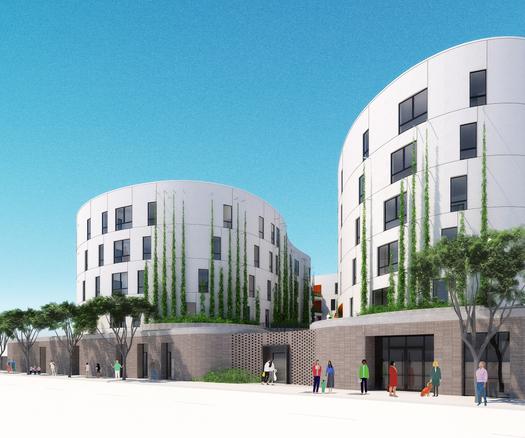
Sited in the San Fernando Valley northwest of the city proper, Corazón del Valle will consist of three curved masses that the studio described as "fluid".

The shape, according to Perkins & Will, was dictated by the southwesterly winds that flow through the valley.

Each of the three structures has its own courtyard in addition to the open space between the buildings, and the whole complex sits a storey above street level, with a perforated concrete block wall encasing parking areas and retail.

Perkins & Will designed Corazón del Valle based on the prevailing winds of the San Fernando Valley

"Funnelled through the massing into the landscape and drawn through the courtyards to bring fresh air into the shared spaces, gardens, and units," said the studio. "This negative space drives the design of the project and shapes the landscape."

Of the three structures, two will be smaller and rounded while the other will stretch out across the length of the site.

The surrounding neighbourhood is made up of a Goodwill facility, car parks and a high school.

Gates will lead up from the street to the elevated first floor

This urban placement and a large amount of concrete, in addition to the usually arid climate of Los Angeles' interior, increased the necessity of utilising the cooling winds.

The long volume will guide the wind to cool the public outdoor areas between the masses and the courtyards within the three structures.

In turn, this air supply will be used to ventilate the interiors.

The public spaces will be filled with greenery

To increase energy efficiency, the design has plants that will be irrigated with greywater from on-site laundry to mitigate the often dire water shortages in southern California, as well as an array of solar panels on the rooftops.

The project, with an anticipated completion date of 2024, will have 90 large family units and 90 permanent supportive housing units.

Permanent supportive housing (PSH) is a model "that combines low-barrier affordable housing, health care, and supportive services to help individuals and families lead more stable lives" according to the National Healthcare for the Homeless Council.

A central courtyard will run between the buildings

The PSH will include both studio and one-bedroom apartments.

The affordable aspects of the remainder of the accommodation will be two- and three-bedroom apartments.

In LA, as in most of the US, affordable housing is considered rent that costs less than 30 per cent of the household income, monthly, with the low-income bar in LA set to $66,000 (£50,000) per year.

[

Read:

Marc Thorpe designs Kampala houses made from local soil bricks

](https://www.dezeen.com/2022/01/26/marc-thorpe-kampala-houses-90-per-cent-local-soil/)

"At the beginning of the project, the Clifford Beers team met with the Supervisorial and Council District staff to discuss community outreach efforts and have coordinated with both offices ever since," said Yan Krymsky, design principal for Perkins & Will. "They continue to have monthly updates."

Krmysky also noted that the building started out as a 120-unit project but "increased in density due to support for affordable housing in the community".

Each building will also include retail as well as carved-out, covered public spaces, and indoor communities rooms on the first floor. Rooftop spaces will also be included and renderings show them coated in a bright orange paint with sail shading.

"Each massing contains a smaller courtyard that defines a smaller community and flows into the larger public spaces, naturally scaling from public to private, from communal to one’s own," said Perkins & Will.

Carved-out public spaces will provide shaded spots to gather

The ground floor of the project will include 2,000 square feet (186 square metres) of what the studio called "community supportive offices".

"The commercial space on the ground floor of Corazón del Valle will be occupied by the San Fernando Community Health Center, which will provide medical, dental, and lab services to residents as well as the community at large," said Krymsky.

A ground-breaking ceremony will take place in late April 2022 with LA's city council president planned to be in attendance.

Other housing complexes in the city include Brooks + Scarpa's recently completed 11 NOHO block in North Hollywood, as well as a project where shipping containers were used to build a community for the homeless.

The post Perkins & Will uses wind direction to shape LA low-income housing complex appeared first on Dezeen.

#all #residential #architecture #news #losangeles #california #usa #solarpower #housing #lowcosthousing #perkinswill

Perkins & Will uses wind direction to shape LA low-income housing complex

Architecture firm Perkins & Will has released designs for a three-building, low-income housing complex in Los Angeles that includes permanent supportive housing.

Sited in the San Fernando Valley northwest of the city proper, Corazón del Valle will consist of three curved masses that the studio described as "fluid".

The shape, according to Perkins & Will, was dictated by the southwesterly winds that flow through the valley.

Each of the three structures has its own courtyard in addition to the open space between the buildings, and the whole complex sits a storey above street level, with a perforated concrete block wall encasing parking areas and retail.

Perkins & Will designed Corazón del Valle based on the prevailing winds of the San Fernando Valley

"Funnelled through the massing into the landscape and drawn through the courtyards to bring fresh air into the shared spaces, gardens, and units," said the studio. "This negative space drives the design of the project and shapes the landscape."

Of the three structures, two will be smaller and rounded while the other will stretch out across the length of the site.

The surrounding neighbourhood is made up of a Goodwill facility, car parks and a high school.

Gates will lead up from the street to the elevated first floor

This urban placement and a large amount of concrete, in addition to the usually arid climate of Los Angeles' interior, increased the necessity of utilising the cooling winds.

The long volume will guide the wind to cool the public outdoor areas between the masses and the courtyards within the three structures.

In turn, this air supply will be used to ventilate the interiors.

The public spaces will be filled with greenery

To increase energy efficiency, the design has plants that will be irrigated with greywater from on-site laundry to mitigate the often dire water shortages in southern California, as well as an array of solar panels on the rooftops.

The project, with an anticipated completion date of 2024, will have 90 large family units and 90 permanent supportive housing units.

Permanent supportive housing (PSH) is a model "that combines low-barrier affordable housing, health care, and supportive services to help individuals and families lead more stable lives" according to the National Healthcare for the Homeless Council.

A central courtyard will run between the buildings

The PSH will include both studio and one-bedroom apartments.

The affordable aspects of the remainder of the accommodation will be two- and three-bedroom apartments.

In LA, as in most of the US, affordable housing is considered rent that costs less than 30 per cent of the household income, monthly, with the low-income bar in LA set to $66,000 (£50,000) per year.

[

Read:

Marc Thorpe designs Kampala houses made from local soil bricks

](https://www.dezeen.com/2022/01/26/marc-thorpe-kampala-houses-90-per-cent-local-soil/)

"At the beginning of the project, the Clifford Beers team met with the Supervisorial and Council District staff to discuss community outreach efforts and have coordinated with both offices ever since," said Yan Krymsky, design principal for Perkins & Will. "They continue to have monthly updates."

Krmysky also noted that the building started out as a 120-unit project but "increased in density due to support for affordable housing in the community".

Each building will also include retail as well as carved-out, covered public spaces, and indoor communities rooms on the first floor. Rooftop spaces will also be included and renderings show them coated in a bright orange paint with sail shading.

"Each massing contains a smaller courtyard that defines a smaller community and flows into the larger public spaces, naturally scaling from public to private, from communal to one’s own," said Perkins & Will.

Carved-out public spaces will provide shaded spots to gather

The ground floor of the project will include 2,000 square feet (186 square metres) of what the studio called "community supportive offices".

"The commercial space on the ground floor of Corazón del Valle will be occupied by the San Fernando Community Health Center, which will provide medical, dental, and lab services to residents as well as the community at large," said Krymsky.

A ground-breaking ceremony will take place in late April 2022 with LA's city council president planned to be in attendance.

Other housing complexes in the city include Brooks + Scarpa's recently completed 11 NOHO block in North Hollywood, as well as a project where shipping containers were used to build a community for the homeless.

The post Perkins & Will uses wind direction to shape LA low-income housing complex appeared first on Dezeen.

#all #residential #architecture #news #losangeles #california #usa #solarpower #housing #lowcosthousing #perkinswill

Perkins&Will completes Singing Hills recreation facility in Dallas

Large expanses of glass feature in a multi-generational community centre designed by architecture firm Perkins&Will for a neglected neighbourhood in Dallas, Texas.

The Singing Hills Recreation and Senior Center is located in a historically underserved neighbourhood in southern Dallas, next to a rail station. Perkins&Will completed the facility for a newly expanded commuter line.

Large expanses of glass make up the facade of the recreation centre

The multi-generational centre is described as the first of its kind in the city and "a symbol of a more equitable future for the area" by the Dallas studio of Perkins&Will.

"The centre was developed as a much-needed response to efforts in oft-neglected South Dallas for a recreation centre for their minority community," the team said.

Perkins&Will designed the project in southern Dallas

"The facility's design is a true reflection of the needs and desires of those using it on a day-to-day basis," they added.

Encompassing 23,000 square feet (2,137 square metres), the building is long and rectangular in plan and stretches along an east-west axis. It sits on a natural limestone outcropping – a perch that offers views of downtown Dallas.

Different shades of glazing are featured at Singing Hills' recreation facilities

Its design was influenced by the geological evolution of the site over time.

"By abstracting the natural characteristics of the site, the building integrates itself as part of the landscape and enhances the human connection to nature," the architects said.

A flat roof with deep overhangs helps shade the building

Facades consist of charcoal-grey metal panels, limestone and large stretches of glass. Extensive glazing on the north ushers in ample in daylight and allows the natural terrain "to visually flow through the building".

A flat roof with deep overhangs helps shade the facility. Soffits are sheathed in honey-toned pine that was certified by the Forest Stewardship Council.

[

Read:

Perkins&Will develops sustainable materials database for interior fit-outs

](https://www.dezeen.com/2021/05/13/now-database-perkinswill-circular-materials-interiors/)

The entrance is marked by a double-height, glazed volume, and a the building has a simple, fluid layout.

The west end encompasses the senior centre, while the east side holds a large gymnasium that is partly sunken into the ground.

The building's gymnasium is partly sunken into the ground

The central portion holds a range of spaces – a fitness room, a dance/yoga studio, a game room, two multipurpose rooms and a tech lab.

Rooms are fitted with durable finishes and decor. Flooring ranges from terrazzo in corridors to rubber and maple in exercise areas. Splashes of colour were informed by the native wildflowers that dot the surrounding landscape.

Terrazzo covers some of the centre's floors

A variety of activities are hosted at the centre, from sporting games to coronavirus vaccinations.

"The centre is a place the community can go for support of all kinds," the team said. "When Covid-19 vaccinations first became available, the centre quickly set up a vaccination site and served those in need."

A variety of activities are hosted at the facility

Perkins&Will has more than two dozen studios around the world. Other Texas projects by the firm include an office interior for a healthcare provider that is organised around a large steel staircase and a tiered wooden platform for meetings.

The photography is byJames Steinkamp.

The post Perkins&Will completes Singing Hills recreation facility in Dallas appeared first on Dezeen.

#all #architecture #publicandleisure #usa #communitycentres #texas #dallas #perkinswill #pine

SOM designs the first tower for foster + partners' atlanta megaproject


designboom | architecture & design magazine

AIA reveals winners of 2022 Architecture Awards

The American Institute of Architects has named 11 winners of its 2022 Architecture Awards, which include Olson Kundig's Space Needle renovation, Kieran Timberlake's US Embassy in London and Diller Scofidio + Renfro's The Shed.

Aiming to "celebrate the best contemporary architecture" designed by US architects, this year's AIA Architecture Awards winners include projects that were completed as far back as 2017 due to the impact of Covid.

The Shed was one of 11 winning projects. Photo is by Iwan Baan

The winning projects can be located anywhere in the world, but the only project not in the US to win was Kieran Timberlake's US embassy in London.

Completed in 2017, the glass cube on the banks of the Thames river sparked controversy in 2018 when former president Donald Trump cancelled his visit to open the building.

According to the AIA, the "embassy embodies the country's relationship with the United Kingdom and the central tenets of democracy".

Olson Kundig's renovation of the Space Needle also won an award. Photo is by Hufton+Crow

Another extremely high-profile project to win an award was The Shed in New York, which was designed by by Diller Scofidio + Renfro in collaboration with Rockwell Group.

Built as part of the city's Hudson Yards development, the building was named one of the world's 100 greatest places of 2019 by Time magazine.

The renovation of Seattle landmark the Space Needle by Olson Kundig was also recognised.

The Menil Drawing Institute by Johnston Marklee was one of several educational projects to win awards. The photo is by Richard Barnes

Alongside these landmark structures, four educational facilities were recognised. The Menil Drawing Institute in Houston by Johnston Marklee, noteworthy for its multiple courtyards and steel roof, and the Marine Education Center at the University of Southern Mississippi by Lake|Flato both won awards.

The Billerica Memorial High School by Perkins & Will and the Home building at the Thaden School designed by EskewDumezRipple were also among 2022's winners.

Andlinger Center for Energy & The Environment was another winner. Photo is by Michael Moran

Several projects designed to focus on sustainability were also named winners. These include the Kendeda Building for Innovative Sustainable Design at the Georgia Institute of Technology by Miller Hull Partnership in collaboration with Lord Aeck Sargent and the Andlinger Center for Energy & The Environment by Tod Williams Billie Tsien Architects in New Jersey.

[

Read:

Mies van der Rohe Award 2022 finalists revealed

](https://www.dezeen.com/2022/02/16/mies-van-der-rohe-award-2022-finalists-revealed/)

The final winners were the Owsley Brown II History Center by de Leon & Primmer Architecture Workshop and Deborah Berke Partners's transformation of Richardson Omsted Campus in Buffalo into a boutique hotel.

The Marine Education Center was a winner that crosses education and environmentalism. Photo is by Casey Dunn

The AIA was founded in 1857 and includes more than 200 chapters that advocate for excellence in architecture and work towards public policy.

In 2019 the AIA began using a new set of criteria for evaluating structures called the Framework for Design Excellence. According to the AIA, this framework presents a "holistic approach addressing the interdependence among people, buildings, infrastructure, and the environment".

Previous winners of the AIA Architecture Awards include Patkau Architects Inc. and Beyer Blinder Belle.

The main photo of the US Embassy is by Richard Bryant.

The post AIA reveals winners of 2022 Architecture Awards appeared first on Dezeen.

#all #news #architecture #usa #kierantimberlake #aia #olsonkundigarchitects #perkinswill

foster+partners to transform a long-neglected and underutilized area in atlanta

the city of atlanta has announced the approval of the foster + partners-designed centennial yards project.

designboom | architecture & design magazine

Perkins&Will designs interiors with "sense of connectivity" for healthcare office in Texas

Architecture firm Perkins&Will has completed an office interior in Dallas, Texas for healthcare provider Signify, centred around a large steel staircase and tiered wooden platform for meetings.

The global practice, which has an office in Dallas, was approached to create a 13,700-square-metre workplace that would emphasise collaboration, connectivity and transparency while catering to a wide variety of workspace requirements.

The office design is for Signify healthcare

To achieve this, the office's six floors have been divided into a series of "workplace neighbourhoods" around a central core housing the lifts and storage spaces.

This arrangement provides everything from private meeting rooms, boardrooms and impromptu meeting areas to more communal spaces, including a large area on the seventh floor with a tiled kitchenette, games, projection screen and sofas.

A metal staircase creates a focal point for the office

"The intention was to create transparency and accessibility, similar to a 'living organism', thereby tying the design theme back to healthcare and the company's dedication to well-being," said the studio.

Alongside this communal area is a large metal staircase created in collaboration with Dallas metalworking firm Big D Metalworks, wrapped at its base by a tiered seating to create a focal point not only for the floor but for the entire office.

"A must-have feature for the renovation was the monumental staircase, conceptualised in collaboration with Big D Metalworks, to physically and metaphorically represent connectivity throughout the firm," said the practice.

"The staircase promotes access to the executive team, while the tiered wooden platform at the foot of the stairway serves as additional seating space, thereby enabling large town hall meetings."

Blue and orange colours dominate the office design

A range of furniture types is provided across the more open office areas, designed to be adaptable depending on the type of meeting – from cafe-style seating and bar stools to softer armchairs and more private booths.

Each level of the office is unified by wayfinding in orange and blue – Signify's brand colours – that has been applied to the walls and extends onto the sealed concrete floors in the lift core area and fire escapes.

Bars and booths create meeting spaces

All of the materials used in the interiors were vetted by Perkins&Will's material health programme, which aims to reduce and eliminate "substances of concern" in the built environment that have a negative impact on health.

The London office of Perkins&Will has recently developed the Now Database – a directory specifying products that support the studio's pledge to make all of its interior fit-outs net-zero embodied carbon by 2030.

The firm also recently revealed plans to revive a vacant 1970s office building in Alaska, re-cladding it with a glazed facade to mimic a glacier.

The photography is byPeter Molick.

The post Perkins&Will designs interiors with "sense of connectivity" for healthcare office in Texas appeared first on Dezeen.

#all #interiors #instagram #usa #staircases #texas #dallas #perkinswill #officeinteriors

Perkins&Will designs interiors with "sense of connectivity" for office in Texas

Perkins&Will has completed an office interior for healthcare provider Signify, centred around a steel staircase and tiered wooden platform for meetings.

"Taking credit for trees planted elsewhere is a whole lot of embodied irony"

Architecture firm Perkins&Will has gone too far with claims that a luxury timber home on a Canadian mountain removes more atmospheric carbon than it emits, argues Fred A Bernstein.

For much of last winter, Perkins&Will, an architecture firm with 25 offices from San Francisco to Singapore to Sao Paulo, used a photo of a wooden house in British Columbia as one of the "hero images" on its website.

The house, which sits alone on a mountaintop overlooking the Soo Valley 90 miles north of Vancouver, is certainly beautiful, but the firm had other reasons for splashing it across its homepage. The 321-square-metre dwelling, known as the SoLo House, is meant to be a model of sustainability.

Entirely off the grid, it is designed to operate with power from 103 solar panels on its south facade, a 96-kilowatt-hour battery pack to store electricity for nights and cloudy days (both of which are frequent in British Columbia), and a hydrogen fuel cell for winter.

With all that equipment, the house may well be able to function without utility hook-ups. But Perkins&Will has made a far more surprising and audacious claim: that the building's structure is "beyond carbon neutral," meaning that it will remove more carbon from the atmosphere than it emitted in the first place.

It seemed to be giving its clients permission to build willy-nilly at a time of climate crisis

In a slickly produced video on the firm's website, Perkins&Will architect Alysia Baldwin says the house "proves that buildings can counteract their negative consequences and act as a source of repair."

The claim is important because people listen to Perkins&Will, a firm that has positioned itself as a leader in green building. "For nearly a quarter of a century, we've been at the vanguard of the sustainability movement," its website declares. Journalists have tended to repeat its claims.

But this time it had gone too far. By constructing a showplace of a house on an otherwise pristine mountaintop, and claiming it had helped the environment by doing so, it seemed to be giving its clients permission to build willy-nilly at a time of climate crisis.

Looking at SoLo House, with its cathedral ceilings, its comfortable sectional sofas and its giant picture windows, then listening to Perkins&Will claim that its structure reduces atmospheric carbon, I'm reminded of the old punchline: "Who are you going to believe – me, or your lying eyes?"

Reducing a building's contribution to atmospheric carbon means making it small, keeping it simple, building it near existing infrastructure, avoiding the need for heavy equipment such as batteries and fuel cells and using the lowest-embodied-energy building materials.

Reducing a building's contribution to atmospheric carbon means making it small

Perkins&Will, normally an excellent firm, has done those things on other projects. But with SoLo House, it seems not to have even tried.

According to experts, 40 per cent of atmospheric greenhouse gases come from buildings. Some emissions are attributable to running appliances and systems – so-called operational energy. The rest comes from the power needed to produce the building in the first place, known as embodied energy.

Incredibly, Perkins&Will is claiming there is "no embodied energy" in the house's structure (by which they mean the elements that keep the building standing). To its credit, the firm answered requests for information promptly, providing facts, figures and charts prepared by Baldwin and her colleague Cillian Collins, a senior architect.

Here's how Baldwin and Collins arrived at their no-embodied-energy claim: First they estimated the amount of structural wood, steel and concrete in SoLo House. And then they turned to Athena Impact Estimator for Buildings, an app that approximates the amount of energy needed to produce given amounts of each building material and the amount of carbon released into the atmosphere as a result of that energy use.

Athena told them that producing the steel and concrete, harvesting the wood and so on in SoLo House released 122 tonnes of CO2 (sometimes called CO2e, for CO2 and its equivalents) into the atmosphere.

That should have been the beginning – not the end – of the process of calculating the building's embodied energy. There are hundreds of other items that needed to be counted. Start with the roof. The walls. The windows (a massive item, given the need for triple glazing). The solar panels, the batteries, the hydrogen fuel cells. The furniture. The appliances. The plumbing. The heating and cooling systems. Lots and lots of insulation.

The list goes on. Each of those items has significant embodied energy. Transporting all of those materials to a remote mountaintop site adds more.

Perkins&Will failed to account for those sources of embodied energy. Baldwin was clear, in a letter to me, that the calculations were limited to the structure. But why would anyone stop there? According to Baldwin, it's because structure "represents the largest contribution to a typical building's embodied carbon impacts."

It may also be because Athena only applies to structure. (Athena is meant primarily for comparing how the choice of a structural material affects a building's embodied energy. An architect might enter plans for the same building, once with a concrete frame and once with a steel frame, and see how the embodied carbon figures differ.)

Of course, there are other ways to estimate the house's total embodied energy; one method is to use an online tool called Tally, which provides information on the embodied energy of numerous building components. Counting everything isn't easy, but other firms have done it.

Perkins&Will had a way of making it vanish, if not from the atmosphere then from the balance sheet

Even so, according to Athena, the house emitted 122 tonnes of carbon into the atmosphere. That sounds like a lot of carbon, but Perkins&Will had a way of making it vanish, if not from the atmosphere then from the balance sheet.

Much of SoLo House is made of wood. Wood, like all plants, is produced by photosynthesis from ingredients that include carbon dioxide. Thus trees are said to store (or sequester) carbon. They do, but probably not as much as people think, as I learned by studying the question at length.

Here's Perkins&Will's theory: If you cut down a tree and use the wood as a building material, that carbon sequestered in that tree becomes part of the building. Then, if you plant a new tree in place of the one you cut down, the new tree will sequester additional carbon as it grows. Thus the process (cutting down one tree, planting another) results, net-net, in carbon being removed from the atmosphere.

There are so many problems with that theory it's hard to know where to begin. To name a few:

  • You have to be sure a new tree will be planted in place of the one you cut down; will get to be as big as the one you cut down; and will live a long, healthy life. (If a tree burns, or decomposes, as billions of trees do every year, its embodied carbon is released right into the atmosphere.)

  • You can't waste any of the wood. That's a problem because converting a tree into lumber usually turns half the wood into sawdust or chips, which could end up being burnt or allowed to decompose. This problem alone suggests carbon sequestration figures should be cut in half.

  • The wood has to stay in or on the building for a very long time. If the building needs repairs, and lumber is removed, it may be recycled, but it may also be burnt or allowed to decompose. And who'll be watching in 20 or 50 years?

  • Let's be honest: You could have planted the new tree somewhere else, and not cut down the first tree to begin with. For that reason, no number of trees excuses a wasteful building.

  • Even if the new trees do sequester carbon, the process will take decades. Scientists who study global warming warn of tipping points and thresholds, some of which could be reached within the next ten years. If new buildings help push atmospheric carbon levels to a point of no return, the sequestration accomplished by newly planted trees will be too little, too late.

  • It's a logical impossibility. If you really believe SoLo House repairs the atmosphere, all you have to do is build enough SoLo Houses and climate change will go away. Now for our next trick ...

  • No number of trees excuses a wasteful building

    No wonder the theory is highly controversial. A whole lot of things have to happen just right for it to become a reality. As Baldwin wrote in an email: "We acknowledge that not all timber sources perform equally in the realm of embodied carbon reduction."

    "Much of the embodied carbon reduction achieved by timber is directly attributed to sustainable forestry management practices that ensure forestry operations are carried out in a way that allows forests to remain healthy and viable for future generations," she added. "These practices include conservation and protection, land use planning, regulation of timber harvesting, establishing practices to ensure forest regrow, and continuous monitoring and reporting to government."

    She went on to admit that the tool used to determine the building's sequestered carbon, WoodWorks Carbon Calculator, a product of the Washington-based Wood Products Council, considers "much of this storage to be temporary and therefore [does] not give the building a carbon credit for the carbon dioxide that will eventually be released from this wood some time down the road, through decay or incineration."

    But that didn't stop the firm from banking on the theory when it performed its embodied energy calculation. Using the Carbon Calculator, it determined that the amount of lumber in the building would result in the removal – through the planting of new trees – of 145 tonnes of carbon from the atmosphere. That's a bit more than the 122 tonnes the firm says the building's establishing, concrete, and steel released into the atmosphere.

    Converting a tree into lumber usually turns half the wood into sawdust or chips

    So in this case, reducing E (embodied carbon) by S (sequestered carbon) produces a negative number – minus 22 tonnes, meaning that building the house decreased the amount of carbon in the atmosphere. (Indeed, the house's owner, Delta Land Development, refers to it as "climate positive.")

    Perkins & Will firm produced a chart to make this clear:

    As Baldwin puts it, SoLo House "is able to store more carbon in its structure than was released during the production, manufacturing, and construction of the project."

    That's a highly suspect statement. Based on everything I've learned, E (embodied energy) may be much greater than Perkins&Will says it is, and S (sequestered carbon) much lower.

    In a letter responding to points in this article prior to publication, Perkins&Will wrote the following (the client, Delta Land Development, did not respond to requests for comment):

    "Through careful selection of low embodied carbon and locally sourced materials, the project prioritized a mass timber structure. The design team used industry-accepted LCA [life cycle assessment] tools to quantify the carbon sequestration potential of the structure, and the timber structure is modelled to sequester 145 tonnes of CO2e as biogenic carbon."

    Reusing/recycling is always the greenest strategy

    "Structural elements typically represent the largest embodied carbon profile of [a] project, and as such, the structure was prioritized from an embodied carbon perspective."

    "As designers, we rely on reputable industry tools to estimate the impact of projects. We used the Athena Impact Estimator for Buildings to complete this assessment. Athena uses ongoing research by the Athena Institute and complies with ISO 14040 (environmental management, life cycle assessment, and principles and framework) and ISO 14044 (environmental management, life cycle assessment, and requirements and guidelines)."

    "Per our previous correspondence, we shared the Athena Institute's definition of biogenic sequestered carbon, which considers the whole life cycle of the material, including extraction, manufacturing, forms of transportation, installation, repair and maintenance, and end of life (assuming reuse of the wood)."

    However, if Perkins and Will had really wanted to reduce embodied carbon, it would have thought about some of these strategies:

  • Putting the house in an easily accessible location, thus cutting out hundreds or thousands of trips by delivery people and construction workers. (Perkins&Will points out "that the wood was sourced from within British Columbia, and the building panels were manufactured in Pemberton, BC, which is located 30 minutes from the site.")

  • Renovating an existing house. Reusing/recycling is always the greenest strategy. Renovation typically generates 50 to 75 per cent less atmospheric carbon than new construction.

  • Choosing a site where there are no trees to cut down. According to Perkins&Will, "A clearing was required for a driveway, solar access, and fire protection. It required harvesting 180m³ of second-growth hemlock timber. This wood was put into the BC forestry chain, becoming useful lumber." Taking credit for sequestration by trees that may have been planted elsewhere, while cutting down enough trees on site to fill a five-meter by six-meter by six-meter container, is a whole lot of embodied irony.

  • Making the house a lot smaller. When it comes to saving energy, less is definitely more.

  • Choosing versions of steel and concrete with the lowest embodied energy (a lot of research is being done on ways of making those materials less "carbon-intensive").

  • Perkins&Will appears not to have done these things — the actual work required to reduce carbon emissions. The danger is that people will believe its claims.

    Fred A Bernstein studied architecture at Princeton and law at NYU and writes about both subjects. He has published articles about embodied energy – a significant component of the climate crisis – in Oculus (a primer), in Architect Magazine (an admonition to architecture critics) and in the Architect's Newspaper (a warning that efforts to make buildings resilient are often detrimental from an embodied energy standpoint).

    Carbon revolution

    This article is part of Dezeen'scarbon revolution series, which explores how this miracle material could be removed from the atmosphere and put to use on earth. Read all the content at: www.dezeen.com/carbon.

    The sky photograph used in the carbon revolution graphic is byTaylor van Riper via Unsplash.

    The post "Taking credit for trees planted elsewhere is a whole lot of embodied irony" appeared first on Dezeen.

    #carbonrevolution #all #architecture #residential #opinion #houses #canada #perkinswill

    "Taking credit for trees planted elsewhere is a whole lot of embodied irony"

    Perkins&Will has gone too far with claims that a timber home on a Canadian mountain removes more atmospheric carbon than it emits, argues Fred A Bernstein.

    Perkins&Will develops sustainable materials database for interior fit-outs

    The London office of architecture and design firm Perkins&Will is developing a searchable directory of sustainable and circular products to help minimise the carbon footprint of its interior design projects.

    Named Now Database, the directory will allow Perkins&Will to specify products that support its recent pledge to make all of its interior fit-outs of buildings net-zero embodied carbon by 2030.

    Embodied carbon refers to the emissions that result from the manufacturing, construction, maintenance and disposal of materials. According to the firm, this can account for as much as 40 per cent of a building's total embodied energy.

    The pledge will also ensure all of its internal fit-outs of buildings are 100 per cent circular by 2025, meaning the materials are continually reused as part of a circular economy.

    Database to become publicly accessible

    The database is currently primarily used by designers and architects at Perkins&Will's London and Dublin studios.

    However, it is being continually developed with the aim of it becoming a go-to tool for other industry professionals working on interior fit-outs and refurbishments.

    "The Now Database brings our firm one step closer to achieving the ambitious but necessary targets set out within our net-zero pledge," said Perkins&Will's sustainability director Asif Din.

    "We aim to eventually make this database accessible to all, to allow the whole construction supply chain, from designers to installers, to collectively tackle the climate challenges ahead," he added.

    Materials given individual performance scores

    The database features products and materials from a number of suppliers of all sizes and remains open for others to input their products, too.

    Each material in the directory has a unique performance score given by the firm's in-house sustainability team, which takes into account factors such as carbon footprint and potential for reuse after service life.

    It also assesses the suppliers' approaches to workers rights and the diversity of the company.

    While the database is not yet publicly accessible, it is expected to adopt a similar form to Transparency – the firm's existing website that sheds light on the impact of building material ingredients and encourages the specification of healthy materials in the sector.

    Database will contribute to "circular construction industry"

    In the future, the firm hopes the Now Database and Transparency website will be used in tandem to "enable a circular construction industry".

    Adam Strudwick of Perkins&Will recently shared his thoughts on designing for the circular economy in a live Dezeen talk about architecture and the circular economy.

    "Rather than thinking of buildings or interiors as the end product, we have to think about every building as a kind of DIY store for the next project and the next project and the next project," he said.

    Feilden Clegg Bradley Studios is another firm that is addressing the embodied carbon of its projects. It recently launched a free tool called FCBS Carbon to help architects estimate and reduce the whole-life carbon emissions of a building proposal.

    The tool takes the form of a spreadsheet that can be used throughout the design process to predict a building's carbon emissions over its lifespan.

    Main image is courtesy of Perkins&Will.

    The post Perkins&Will develops sustainable materials database for interior fit-outs appeared first on Dezeen.

    #all #interiors #news #uk #sustainabledesign #perkinswill #carbon

    Perkins&Will develops sustainable materials database for interior fit-outs

    The London office of architecture and design firm Perkins&Will is developing a searchable directory of sustainable and circular products to help minimise the carbon footprint its interior design projects.