AI tackles one of math's most brutal problems: Inverse PDEs
https://phys.org/news/2026-05-ai-tackles-math-brutal-problems.html
https://openreview.net/forum?id=6mFVZSzyev

https://en.wikipedia.org/wiki/Partial_differential_equation

Important math/problem: equation which involves a multivariable function and one or more of its partial derivatives. The function is often thought of as an "unknown" that solves the equation. However, it is often impossible to write down explicit formulas for solutions of partial differential equations ...

#AI #PDE

📢 MOSS Season 2 continues next week Thursday!

🎙️ Speaker: Claudia García (Universidad de Granada, Spain)

🗣️ Talk title: Patterns and equilibria in incompressible fluids

🗓️ Thursday, 9 April 2026 • 🕓 16:00 CEST • Online

A talk on 2D Euler/Navier–Stokes, relative equilibria, and coherent vortex patterns through bifurcation theory.

👉 Scan the QR code in the image to join the mailing list and receive the online access link.

#Mathematics #FluidDynamics #NavierStokes #EulerEquations #PDE

Surrogate accuracy isn’t the same as verification. When you need credibility, analytical/manufactured solutions act like unit tests.
We’ve released an updated preprint (SIGS v3): grammar-valid symbolic candidates → latent-manifold exploration → residual-validated refinement (incl. coupled PDE systems).
For project page click here: https://oroikono.github.io/sigs-paper-site/#benchmarks
#SciML #PDE #NeuroSymbolicAI #eth-ai-center #eth #ai #ml
SIGS Interactive

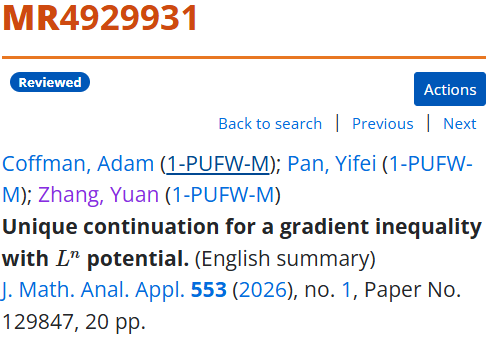
The #MathReviews math review of my latest joint paper 🐘 in analysis has appeared! 📙
link for subscribers=
https://mathscinet.ams.org/mathscinet/article?mr=4929931
#RealAnalysis #PDE #PurdueFortWayne

I PASSED PDE!!!!!

LETS GOOOOOOOO 😭😭😭😭
(I ONLY GOT 67 THO)

#pde #mathstudent
#cry

This year, Simon Prince, Professor of Computer Science at UCL, published a series of tutorials on ordinary differential equations (ODEs) and stochastic differential equations (SDEs) in machine learning for RBC Borealis. These are intended for readers with no background in these areas and require only basic calculus.

Article 1 describes what ODEs and SDEs are and their applications in machine learning.

https://rbcborealis.com/research-blogs/odes-and-sdes-for-machine-learning

Article 2 describes ODEs, vector ODEs and PDEs and defines associated terminology. They develop several categories of ODE and discuss how their solutions are related to one another. They discuss the necessary conditions for an ODE to have a solution.

https://rbcborealis.com/research-blogs/introduction-ordinary-differential-equations

Article 3 describes methods for solving first-order ODEs in closed form. They categorise ODEs into distinct families and develop a method to solve each family.

https://rbcborealis.com/research-blogs/closed-form-solutions-for-odes

For many ODEs, there is no known closed-form solution.

Article 4 considers numerical methods, which can be used to approximate the solution of any ODE regardless of its tractability.

https://rbcborealis.com/research-blogs/numerical-methods-for-odes

This concludes their treatment of ODEs. In the coming weeks, we will focus on SDEs. They will describe stochastic processes and SDEs, and show how to solve SDEs using either direct stochastic integration or Ito's lemma. They will introduce the Fokker-Planck equation, which transforms a stochastic differential equation into the PDE governing the evolving probability density of the solution. They also consider Andersen's theorem, which allows us to reverse the direction of SDEs.

#ODEs #PDEs #SDEs #ODE #PDE #SDE #Calculus #ML #DL #VectorCalculus #LectureSeries #Tutorials

My talk on "A gradient inequality for continuous functions" at the AMS Sectional meeting in St. Louis is scheduled for Sunday, Oct. 19, 2:45. 🧑‍🏫
#MathConference #RealAnalysis #PDE

Samsung ujawnia, jak chroni prywatność w dobie AI. Nowe technologie w smartfonach Galaxy

Samsung przedstawił szczegóły dotyczące technologii, które mają zapewnić bezpieczeństwo danych użytkowników w dobie rosnącej popularności sztucznej inteligencji.

Kluczową rolę w ekosystemie Galaxy AI odgrywają dwa nowe rozwiązania: Personal Data Engine (PDE) oraz Knox Enhanced Encrypted Protection (KEEP), które analizują i chronią dane bezpośrednio na urządzeniu, bez wysyłania ich do chmury.

Aby sztuczna inteligencja mogła oferować w pełni spersonalizowane i pomocne funkcje, musi „poznać” preferencje i nawyki użytkownika, co wymaga dostępu do jego danych. Odpowiedzią Samsunga na to wyzwanie jest Personal Data Engine (PDE), technologia po raz pierwszy zaprezentowana w serii smartfonów Galaxy S25. Działa ona dyskretnie w tle, ucząc się zachowań użytkownika, by zasilać takie funkcje jak inteligentne podsumowania dnia w Now Brief czy wyszukiwanie głosowe zdjęć w Galerii. Co najważniejsze, cały proces analizy i przetwarzania danych przez PDE odbywa się lokalnie, na urządzeniu, co gwarantuje, że prywatne informacje nie opuszczają smartfona.

W celu dodatkowego zabezpieczenia najbardziej wrażliwych danych, Samsung opracował nową, lokalną warstwę ochrony o nazwie Knox Enhanced Encrypted Protection (KEEP). Dostępna na urządzeniach z interfejsem One UI 8 lub nowszym, technologia ta tworzy bezpieczną, wydzieloną przestrzeń dla poszczególnych aplikacji, takich jak Personal Data Engine. Działa to na zasadzie prywatnego, chronionego apartamentu wewnątrz systemu operacyjnego – dane są bezpieczne, ale funkcja pozostaje zintegrowana z codziennym użytkowaniem, w przeciwieństwie do całkowicie odizolowanego Mój Sejf (Secure Folder). Początkowo stworzona dla PDE, technologia KEEP zabezpiecza teraz także inne funkcje Galaxy AI, w tym Smart Suggestions i Samsung Moments.

Nowe rozwiązania są częścią wielowarstwowego podejścia Samsunga do ochrony prywatności. Podczas gdy Mój Sejf (Secure Folder) służy do przechowywania szczególnie poufnych aplikacji i plików w całkowitej izolacji , KEEP zapewnia bezpieczeństwo danym przetwarzanym w czasie rzeczywistym przez zintegrowane funkcje AI. Dzięki temu użytkownicy otrzymują różne poziomy zabezpieczeń, dostosowane do różnych potrzeb.

Przedstawione technologie mają na celu wyznaczenie nowego standardu w mobilnej inteligencji, w którym zaawansowana personalizacja idzie w parze z ochroną prywatności. Samsung podkreśla, że w miarę jak Galaxy AI staje się coraz inteligentniejsza, najbardziej wrażliwe dane użytkowników pozostają bezpieczne tam, gdzie ich miejsce – na ich własnym urządzeniu.

Sztuczna inteligencja i nowe funkcje w telewizorach Samsung QLED na 2025 rok. Co oferują modele Q7F i Q8F?

#Bezpieczeństwo #GalaxyAI #KEEP #KnoxEnhancedEncryptedProtection #MójSejf #news #OneUI8 #PDE #PersonalDataEngine #prywatność #Samsung #SamsungKnox #SecureFolder #smartfony #technologia