Intermezzo:

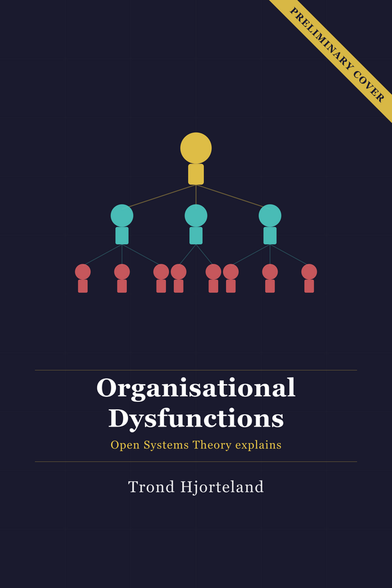
The Organisational Dysfunction of the Day series is becoming a book. 63+ dysfunctions explained through Open Systems Theory — why they keep happening and what the structure underneath them is.

Launching July 2026. Follow along on Leanpub: https://leanpub.com/organisationaldysfunctions

#opensystemstheory #sociotechnical #agile

Organisational Dysfunctions

A catalogue of organisational dysfunctions explained through Open Systems Theory. For everyone who has felt the friction of broken structures but lacked the language for it.

Organisational Dysfunction of the Day

Doing the wrong thing right

Context: The organisation is focused on improvement. There are efficiency drives, process optimisations, restructuring programmes, and culture initiatives. Each quarter brings a new priority. The internal machinery is constantly being tuned. Meanwhile, the environment is changing. A new technology is reshaping customer expectations. A regulatory shift is coming. A competitor is doing something nobody has quite figured out yet. The people closest to these signals mention them in meetings, raise them in retrospectives, and flag them in Slack. The organisation processes them slowly, if at all. The improvement programmes continue. The internal machinery gets more refined. The gap between the organisation and its environment quietly widens.

OST explains: Open systems theory makes a distinction that most management frameworks miss. The health of a system depends not only on its internal functioning but on the quality of its relationship with its environment. An organisation can be internally coherent, well-managed, and efficiently run while simultaneously drifting away from the environment it depends on. Emery and Trist's turbulent fields insight is relevant here: in a Type IV environment, the environment itself is in motion. An organisation that looks inward while the field moves becomes misaligned, not through any internal failure but simply through the passage of time. DP1 (bureaucracy) accelerates this, concentrating perception and decision-making at the top, seeing the environment through a narrow aperture. DP2 distributes that perceptual capacity across the whole system. Every group at the boundary imports a signal. All hands on deck. The organisation stays coupled to its environment not through a strategy process but through its structure. Peter Drucker distinguished between efficiency and effectiveness: there is nothing so useless as doing efficiently that which should not be done at all. Most improvement programmes are efficiency projects. OST asks the effectiveness question first. You cannot tune your way into relevance. The environment does not wait.

#OpenSystemsTheory #SocioTechnical #OrgDesign #SystemsThinking

Organisational Dysfunction of the Day

The product owner trap

Context: The team has a product owner. She sits with the team, attends the standups, writes the user stories, and manages the backlog. She is good at her job, but she is not really making product decisions. She is translating decisions made by a business stakeholder who sits outside the team and controls the budget. The team builds what she tells them to build, being the proxy for the business which tells her to tell them. She does not really have the mandate to decide much. When the team raises a concern about direction, it goes to the PO, who raises it with the business, who considers it and comes back three weeks later with a modified brief. The team is a feature factory. Everyone knows it. Nobody knows what to do about it.

OST explains: The product owner role, as conceived in Scrum, places a single person in charge of deciding what the team builds. That person is formally part of the team but functionally a conduit for management, the ordering-supplier divide between business and IT given a new job title. In OST terms, this is pure bureaucracy (DP1): responsibility for goal-setting sits above the work, even if it sits only one step above rather than many. A genuinely self-managing group in DP2 owns its whole task, not just how the work is done, but what work is done and why. That means the team has a genuine relationship with the customer and the business context, not a mediated one through a proxy. Marty Cagan's distinction between feature teams and empowered product teams maps almost exactly onto DP1 and DP2: in the former, the team is handed a solution to build, in the latter, it is given a problem to solve. The difference is not about process or methodology. It is about whether goal-setting lives inside or outside the group. Until that changes, the product owner is not empowering the team; she is the most visible evidence that it is not empowered.

#OpenSystemsTheory #SocioTechnical #OrgDesign #agile

Organisational Dysfunction of the Day

Outsourcing the future

Context: The organisation wants a new strategy. Leadership does not have the bandwidth, or perhaps the confidence, to lead the process internally. A consulting firm is brought in. They are smart, experienced, and methodologically rigorous. They interview the leadership team, benchmark against competitors, analyse market trends, and run workshops with selected stakeholders. A few months later, a strategy document arrives. It is well-structured and credible. The organisation begins implementing it. Some things work. Others do not land the way the consultants predicted. The people doing the implementation have questions that the document does not answer. The consultants are gone. Two years later, a new consulting firm is brought in to develop the next strategy.

OST explains: Strategy is not a document. It is a shared understanding of where a system is, where it needs to go, and why. That understanding cannot be imported from outside because it depends on knowledge that only exists inside the system, distributed across the people who operate it, the relationships they hold, and the environment they transact with daily. A consulting firm can bring analytical frameworks, comparative data, and an external perspective. What they cannot do is replace the participative process through which an organisation develops genuine strategic ownership. The Search Conference exists because Emery understood this. An effective strategy requires the whole system in the room, not a representative sample interviewed by outsiders. A strategy people helped build is one they will adapt when reality diverges from the plan. A strategy handed down, however well-researched, will be executed literally until it fails and then replaced by the next one. The cycle is not a strategy problem. It is a participation problem.

#OpenSystemsTheory #SocioTechnical #OrgDesign #strategy

Organisational Dysfunction of the Day

Empowerment

Context: Leadership has announced that teams are now empowered. There are communications about it, a new set of principles, perhaps even a manifesto. The manager has been rebranded as a coach or a servant leader. Controls have been loosened, warm and friendly communication is encouraged, and people are told they have more autonomy. For a brief moment, there is energy. Then people try to actually use this empowerment, run into the existing approval processes, budget controls, and management expectations, and quietly conclude that nothing has really changed. The word starts to feel like a joke. And then something goes wrong — a missed deadline, a budget overrun, a production incident — and the coach suddenly starts acting a lot more like a manager. The mask slips, and everyone realises it was always there.

OST explains: Research on organisations that have adopted agile and similar approaches identified a specific and common structural form: the trainer, leader, or coach (TLC) model, where controls are loosened and warm communication encouraged, but the design principle has not actually changed. Workers often prefer this form as it can provide greater autonomy, until things go wrong, at which point the legal DP1 bureaucracy structure kicks back into life. This is not bad faith on the part of the manager; it is the structure asserting itself. The design principle was never changed, so in a crisis, it reasserts the only legitimate authority available. Empowerment in OST terms is not a communication style or a management philosophy; it means the team genuinely controls the coordination and the goals of its own work. That is a structural change, not a cultural one. Announcing empowerment without changing the structure does not create DP2; it creates laissez-faire. The confusion of appearing to have freedom while the real constraints remain exactly where they were, waiting for the next thing to go wrong.

#OpenSystemsTheory #SocioTechnical #OrgDesign #leadership

Organisational Dysfunction of the Day

People resist change

Context: The transformation programme has stalled. Change management consultants are brought in. Their diagnosis is familiar: the organisation has a change resistance problem. People are comfortable with the status quo, risk-averse, and slow to adopt new ways of working. The solution involves communication campaigns, stakeholder management, and training to help people become more comfortable with uncertainty. Leadership frames the resistance as a cultural issue — the organisation needs to become more adaptive. The change programme continues to stall.

OST explains: A survey of the software industry found that 82.6% of people who had not experienced any organisational change were dissatisfied with the lack of it. They wanted change. What people consistently object to is not change itself but having change imposed on them — a completely different thing. When people are invited to participate in designing the change they need to make, the resistance largely disappears because there is nothing to resist; the change is theirs. OST's methods, i.e. the Search Conference and the Participative Design Workshop, are built entirely on this insight. The change management industry, with its stakeholder maps and communication cascades, often reflects a reluctance to involve people in designing their own work. It is treating the symptom of DP1 with more DP1.

#OpenSystemsTheory #SocioTechnical #OrgDesign #changeManagement

Organisational Dysfunction of the Day

The Sunday email

Context: The organisation has a genuine commitment to work-life balance. It is in the values mentioned in onboarding, and comes up regularly in all-hands meetings. Flexible working is encouraged. Mental health is taken seriously. And then the email arrives. Sunday evening, 21:47, from the director. Not urgent. Just something they wanted to get out of their head. No response expected, of course. Nobody says that, though. By Monday morning, three people have replied. Others noticed and said nothing. Over time, the pattern becomes clear. The people who get ahead are the ones who are always available. The policy says one thing. The calendar says another.

OST explains: In the bureaucratic DP1, the person at the top carries personal responsibility for outcomes they do not fully control. The higher the position, the larger the gap between accountability and agency. That gap produces anxiety, and anxiety produces overwork. Not because leaders are workaholics by nature, but because the structure places an unreasonable individual burden at every level of the hierarchy. The Sunday email is not a character flaw. It is a structural symptom. The deeper problem is that modelled behaviour always outcompetes stated values. People read the environment, not the handbook. What the boss does on Sunday communicates more about what is expected than any well-being policy. In DP2, responsibility is distributed across the group. No single person carries the weight of outcomes alone, so the chronic anxiety that drives performative overwork largely disappears. Work-life balance stops being a value that needs defending and becomes a natural consequence of a structure that does not place impossible individual burdens on anyone. The Sunday email stops because nobody needs to send it.

#OpenSystemsTheory #SocioTechnical #OrgDesign #leadership

Organisational Dysfunction of the Day

The customer we never met

Context: Context: The team is building a product. They have a backlog, a product owner, and a roadmap. A user story describes what users need. Personas represent who those users are. Analytics track what people do. Every few months, there is a user research report from the UX team. The team works hard, ships regularly, and hits their sprint goals. They have never spoken directly to a customer, though. The product owner does that, and the UX researcher. But the engineers, the people making hundreds of small decisions every day that shape the product, have not. They are building for an abstraction. A persona on a wall, a ticket in Jira, a data point in a dashboard.

OST explains: An open system maintains its health by actively engaging with its environment. For a product team, the primary environment is the people using what they build. The DP1 bureaucracy is a closed system and mediates that relationship through roles: the product owner translates customer needs into requirements, the UX researcher translates behaviour into insights, and the engineer receives the output of both translations. Each translation loses something. The judgment, the context, the friction, the moment when a real person says something that changes how you understand the problem entirely. In DP2, the group owns the whole task, which includes understanding who it is for. Teams with direct customer access make qualitatively different decisions than teams working from second-hand accounts. Not because engineers are better researchers, but because unmediated contact with the environment is not a nice-to-have. For an open system, it is the condition for staying alive.

#OpenSystemsTheory #SocioTechnical #OrgDesign #agile

Organisational Dysfunction of the Day

The collaboration that isn't

Context: Two teams decide to work together. A shared initiative, a joint project, a problem neither can solve alone. There is enthusiasm on both sides, and a genuine excitement about what they might build together. Everyone has a picture in their head of what that looks like and what they want to get out of it, and everyone assumes the others have the same one. Who owns what, and what success looks like for each of them, is left open. Good intentions and regular syncs will be enough. For a while, they are. Then something goes wrong. Credit lands unevenly. Decisions get made by the louder team. One side feels their contribution has been absorbed rather than shared. Trust erodes quietly. The collaboration continues in name but not in spirit.

OST explains: Two teams are two social systems, each with its own purpose, its own design principle, its own internal logic. The shared purpose is assumed rather than agreed upon. There are two clean ways to work across that boundary. A clear transactional relationship: a contract, explicit deliverables, arm's length. Or deliberately create a new, shared system with a common purpose both sides have actually agreed to, a structure for how the collaboration works and is coordinated, and a design principle governing the joint work. What tends to happen instead is neither. The teams proceed as if goodwill substitutes for structure. The result is laissez-faire more often than not. No clear location of responsibility, no purpose anyone has committed to, no shared system. DP1 (bureaucracy) fills the vacuum, as it always does: the team with more power, more visibility, or a stronger brand quietly starts setting the terms. The other finds itself inside someone else's system without ever agreeing to join it. The same dynamic plays out between companies, just with invoices adding a harder edge to the same underlying confusion. The collaboration was real. The shared system never was.

#OpenSystemsTheory #SocioTechnical #OrgDesign #systemsThinking
Organisational Dysfunction of the Day

Working alone together

Context: The pandemic forced a global experiment nobody had planned. Offices emptied overnight, and something unexpected happened. People managed. Many thrived. The commute nobody missed, the open-plan office nobody pined for, the meetings that turned out to work fine as calls. When offices reopened, a significant number of people simply did not want to come back, at least not every day. The debate that followed framed this as a question of productivity, collaboration, or work-life balance. It missed the more uncomfortable signal. When given the choice, a large number of people revealed they prefer to work alone. That is not a statement about remote work. That is a statement about what going to the office actually felt like.

OST explains: In DP1, the bureaucratic structure, work is individualised by design. Tasks are broken into minimal parts, each assigned to one person, with coordination handled above. The office under DP1 is not a place of genuine collaboration; it is a place of proximity without connection. People sit near each other, manage their own tasks, protect their own position, and attend meetings where decisions have usually already been made. The six psychological requirements for productive work include mutual support and respect, and continual learning through real feedback from people you work with as peers. DP1 delivers neither. Of course, people prefer to stay home. Home is quieter, the coffee is better, and nobody is watching. In DP2, the group is the unit of work. Coordination, learning, and support all happen in the group, not above it. People in genuine DP2 structures report wanting to be with their colleagues because the group is where the work actually lives. The WFH debate is really a DP1 debate. The office stopped being worth the commute long before the pandemic. The pandemic just made it impossible to pretend otherwise.

#OpenSystemsTheory #SocioTechnical #OrgDesign #teams