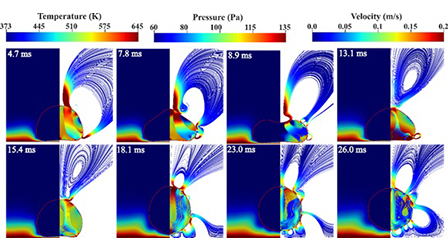
How surface microstructures affect Leidenfrost droplets.

Numerical results show that pillar size and spacing control vapour escape under the drop, which can delay or suppress the Leidenfrost state and modify droplet rebound.

🔗 https://pubs.aip.org/aip/pof/article/38/3/032007/3382441/Numerical-study-of-bouncing-Leidenfrost

#Leidenfrost #DropletDynamics #HeatTransfer #FluidDynamics #NumericalSimulation

Numerical study of bouncing Leidenfrost viscoplastic drops

As the droplet impacts a surface heated above the dynamic Leidenfrost temperature, it levitates on a self-generated vapor cushion, leading to rebound without di

AIP Publishing

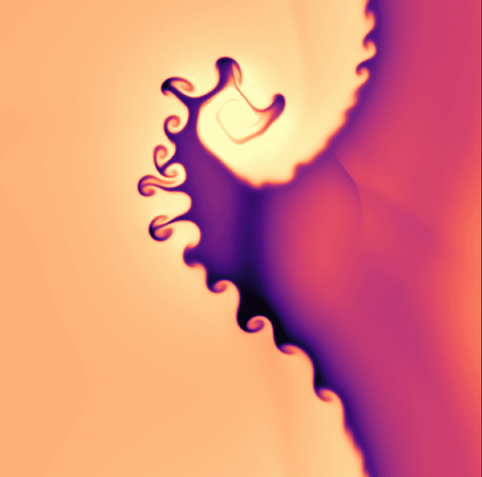
Richtmyer-Meshkov Instability

If you send a shock wave through a magnetized plasma–something that happens in both supernova explosions and inertial confinement fusion–it can trigger an instability known as the Richtmyer-Meshkov instability. The image above shows a form of this, taken from a simulation. Rather than treating the plasma as a single idealized fluid, the researchers represented it as two fluids: an ion fluid and an electron fluid. This allowed them to better capture what happens when certain components of the plasma react to changes faster than others do.

The image itself shows the electron number density across the fluid, where darker colors represent higher electron number density. The interface between high and low-densities shows a roll-up instability that resembles the Kelvin-Helmholtz instability, but there are also regions of mushroom-like plumes that more closely resemble Rayleigh-Taylor instabilities.

The authors note that these structures don’t appear in simulations that represent a plasma as a single fluid; you need the two-fluid representation to see them. (Image and research credit: O. Thompson et al.)

#CFD #computationalFluidDynamics #fluidDynamics #instability #KelvinHelmholtzInstability #magnetohydrodynamics #numericalSimulation #physics #plasma #RayleighTaylorInstability #RichtmyerMeshkovInstability #science #shockwave

Improving Turbulence Models

Calculating turbulent flows like those found in the ocean and atmosphere is extremely expensive computationally. That’s why forecasting models use techniques like Large Eddy Simulation (LES), where large physical scales are calculated according to the governing physical equations while smaller scales are approximated with mathematical models. Researchers are always looking for ways to improve these models–making them more physically accurate, easier to compute, and more computationally stable.

In a new study, researchers used an equation-discovery tool to find new improvements to these models for the smaller turbulent scales. They started by doing a full, computationally expensive calculation of the turbulent flow. The equation-discovery tool then analyzed these results, looking to match them to a library of over 900 possible equations. When it found a form that fit the data, the researchers were then able to show analytically how to derive that equation from the underlying physics. The result is a new equation that models these smaller scales in a way that’s physically accurate and computationally stable, offering possibilities for better LES. (Image credit: CasSa Paintings; research credit: K. Jakhar et al.; via APS)

#CFD #computationalFluidDynamics #fluidDynamics #geophysics #largeEddySimulation #machineLearning #mathematics #numericalSimulation #physics #science #turbulence

Icy or Rocky Giants?

On the outskirts of our solar system, two enigmatic giants loom: Uranus and Neptune. In terms of mass and size, both resemble many of the exoplanets discovered in recent years. Within our own solar system, these planets are known as “icy giants,” but a new study suggests that moniker may be wrong.

Pinning down the interior composition of a planet is tough on limited measurements. In the case of these outer planets, our main data is gravitational, recorded from visiting spacecraft. That information cannot tell us directly what the composition of a planet is, but it gives constraints for what materials could produce such a gravitational field.

In their simulation, researchers began with random interior configurations for Uranus and Neptune, then had the model iterate through configurations to simultaneously match the gravitational measurements while satisfying the thermodynamic and physical constraints of a stable planet. By repeating the process several times, the researchers created a catalog of potential interiors for Uranus and Neptune. And while some were water-rich–consistent with the “icy giant” title–others were remarkably rocky.

The team suggests that we may need to retire that moniker and consider the possibility that these worlds are more like our own than we thought. To find out which is true, we will need more spacecraft to visit our frigid neighbors, to provide new gravitational measurements and other observations. (Image credit: NASA/ESA/A. Simon/M. Wong/A. Hsu; research credit: R. Morf and L. Helled; via Physics World)

#fluidDynamics #geophysics #Neptune #numericalSimulation #physics #planetaryScience #science

Inside Cepheid Variable Stars

Cepheid variable stars pulsate in brightness over regular periods. That’s one reason astronomers use them as a standard candle to judge distances–even for stars well outside our galaxy. In this image, researchers display a simulation of convection inside a Cepheid eight times more massive than our sun. The colors represent vorticity, with zero vorticity in white.(Image credit: M. Stuck and J. Pratt)

#2025gofm #astrophysics #CFD #computationalFluidDynamics #convection #flowVisualization #fluidDynamics #numericalSimulation #physics #science

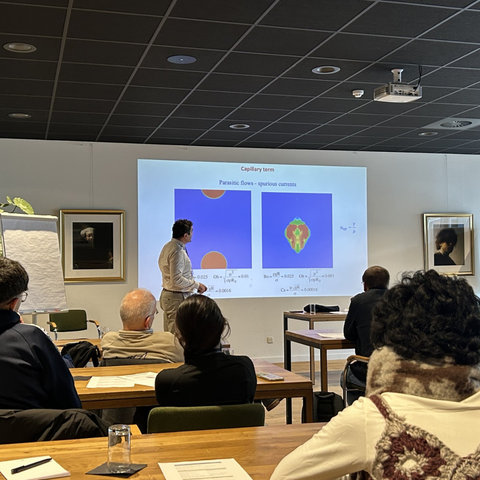
Day 3 #LeidenForce Winter School afternoon:

Benoît Scheid @ULBruxelles on antibubbles & heat/mass transfer toward encapsulated Leidenfrost droplets.

Christian Diddens @utwente on sharp-interface finite element simulations for #Leidenfrost droplets.

#MultiphaseFlows #DropletPhysics #NumericalSimulation

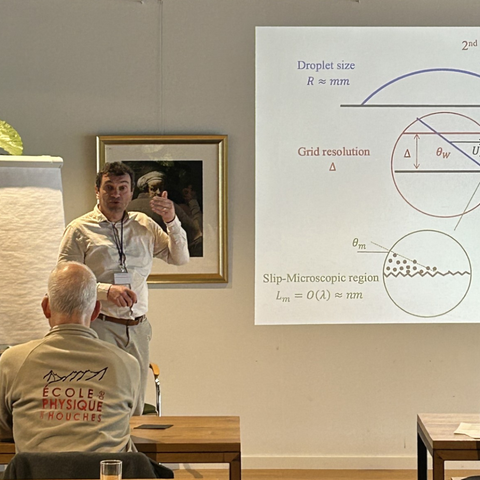
Day 2 #LeidenForce Winter School @utwente

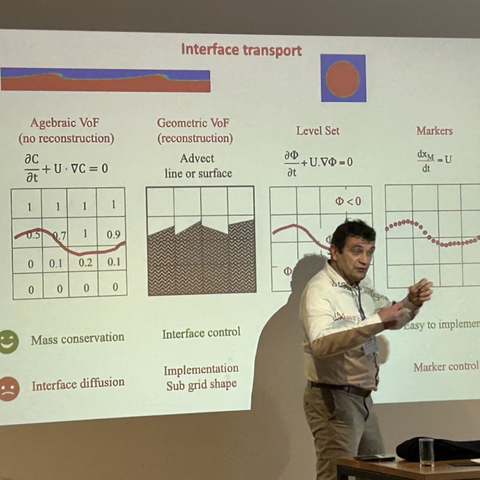
Dominique Legendre (IMFT) on numerical modeling of moving contact lines, linking microscopic mechanisms to macroscopic spreading laws via CFD (VoF).

🔗 https://www.leidenforce.eu/partners

#Leidenfrost #DropletPhysics #CFD #NumericalSimulation

Thermal Tides Drive Venusian Winds

Venus is a world of extremes. A full rotation of the world takes 243 Earth days, but winds race around the planet at a speed that makes a Category 5 hurricane look sedate. Just what drives these winds has been an ongoing question for planetary scientists. A recent study suggests that tides are a major contributor to this superrotation.

Unlike Earth’s tides, Venus’s are not gravitational in origin. Instead, Venusian tides are thermal, driven by heating in the sunward side of the atmosphere. This creates a diurnal tide, which cycles once per Venusian day and pumps momentum toward the tops of Venus’s clouds. The new analysis–rooted in both observations and numerical simulation–finds that diurnal tides are the primary driver behind the planet’s incredibly fast winds. (Image credit: NASA/JPL-Caltech; research credit: D. Lai et al.; via Eos)

#atmosphericScience #fluidDynamics #numericalSimulation #physics #planetaryScience #science #superrotation #venus

ExaWind Simulation

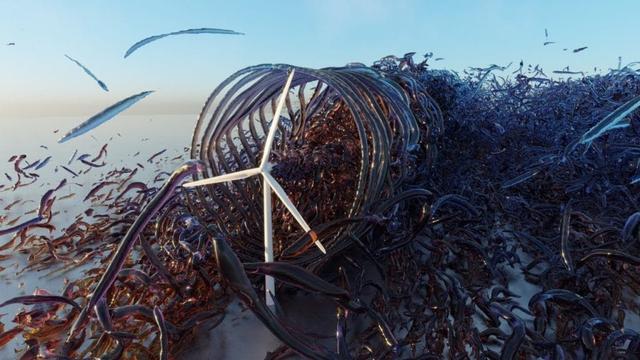
Large-scale computational fluid dynamics simulations face many challenges. Among them is the need to capture both large physical scales–like those of Earth’s atmospheric boundary layer–and small scales–like those of tiny eddies moving around a wind-turbine blade. Capturing all of these scales for a problem like four wind turbines in a wind farm requires using the full computing power of every processor in a large supercomputer. That’s the level of power behind the simulation visualized in this video. The results, however, are stunning. (Video and image credit: M. da Frahan et al.)

#2025gofm #CFD #computationalFluidDynamics #exascaleComputing #flowVisualization #fluidDynamics #numericalSimulation #physics #science #turbulence #windTurbine

Oceans Could “Burp” Out Absorbed Heat

Earth’s atmosphere and oceans form a complicated and interconnected system. Water, carbon, nutrients, and heat move back and forth between them. As humanity pumps more carbon and heat into the atmosphere, the oceans–and particularly the Southern Ocean–have been absorbing both. A new study looks ahead at what the long-term consequences of that could be.

The team modeled a scenario where, after decades of carbon emissions, the world instead sees a net decrease in carbon–which could be achieved by combining green energy production with carbon uptake technologies. They found that, after centuries of carbon reduction and gradual cooling, the Southern Ocean could release some of its pent-up heat in a “burp” that would raise global temperatures by tenths of a degree for decades to a century. The burp would not raise carbon levels, though.

The research suggests that we should continue working to understand the complex balance between the atmosphere and oceans–and how our changes will affect that balance not only now but in the future. (Image credit: J. Owens; research credit: I. Frenger et al.; via Eos)

#CFD #climateChange #computationalFluidDynamics #fluidDynamics #geophysics #heatTransfer #numericalSimulation #ocean #physics #science