Finally think I have the thank you cards done. I think the smiley face is a cute touch and can't wait to start sending them out with orders. I also have regular note cards, which I need to make bigger, business card sized was too small.
#smashingpennies #thankyoucards #elongatedcoins #smileyface #orders #notecards
What strategies can be employed to describe a problem and converge on an appropriate hypertext representation? This 1987 paper explored such representation issues with NoteCards, the hypermedia system written in Interlisp.

https://dl.acm.org/doi/abs/10.1145/317426.317445

https://dl.acm.org/doi/pdf/10.1145/317426.317445

#hypertext #NoteCards #interlisp #retrocomputing

Every now and then I think about NoteCards, an early hypertext application developed at Xerox PARC, and dream about having something similar. But today, it dawned on me that GNU Emacs with Denote is already quite close to what I would probably do with NoteCards.

By the way: did you know it was written in Lisp? And its source code is available on GitHub!

#NoteCards #Lisp #KnowledgeBase

NoteCards - Wikipedia

What helped me deliver my RetroChallgence 2024 project on time? Prior experience with the Interlisp API of NoteCards and the nature of Lisp and Lisp systems.

https://journal.paoloamoroso.com/how-lisp-helped-my-retrochallenge-2024-project

#RC2024 #RetroChallenge #retrocomputing #interlisp #NoteCards

How Lisp helped my RetroChallenge 2024 project

RetroChallenge announced the results of RC2024/10 and I'm honored to be among the winners. Written in Interlisp, the WebCard project I e...

Paolo Amoroso's Journal

RetroChallenge announced the results of RC2024/10 and I'm honored to be among the winners. I entered with the WebCard project written in Interlisp, a NoteCards extension for visiting websites.

Thanks to the organizers, voters, and judges and congrats to all the entrants, especially @psychotimmy who won the Grand Prize.

https://www.retrochallenge.org/2025/10/rc202410-resultsless-than-year-late.html

https://github.com/pamoroso/webcard

https://journal.paoloamoroso.com/tag:WebCard

#RC2024 #RetroChallenge #retrocomputing #interlisp #NoteCards

RC2024/10 Results...Less than a Year Late!

With so many entries for RC2024/10 (a record, i'm sure!), and having already put in so much work during the month, I really let things slide...

We retrieved from an old archive "NoteCards User’s Guide" V2.0 and added it to the source tree. Published in 1991, this manual better matches the NoteCards code that comes with Medley Interlisp but some of the information the document provides is now only of historical value.

https://files.interlisp.org/medley/notecards/docs/user-guide-v2.0

#interlisp #NoteCards #hypertext #retrocomputing

Index page for {MEDLEY}/notecards/docs/user-guide-v2.0/

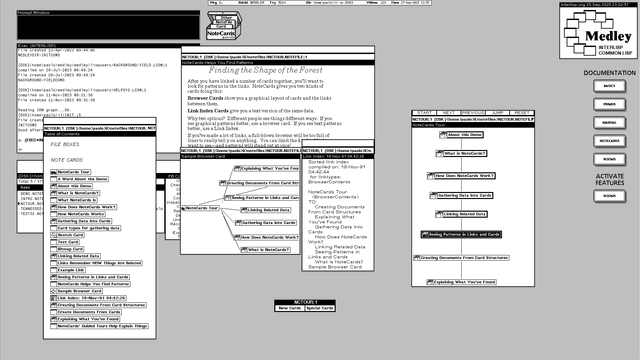
In NoteCards a "tabletop card" is an arrangement of cards (hypertext nodes) on the screen, such as the 3 cards at the center.

A "guided tour" is a graph whose nodes are tabletop cards (table icons) and whose edges are links connecting the cards. You traverse a guided tour with the control panel at right and the result is a "slide show" of tabletops.

For more on tabletop cards and guided tours see:

https://dl.acm.org/doi/abs/10.1145/58566.59299

#NoteCards #interlisp #hypertext #retrocomputing

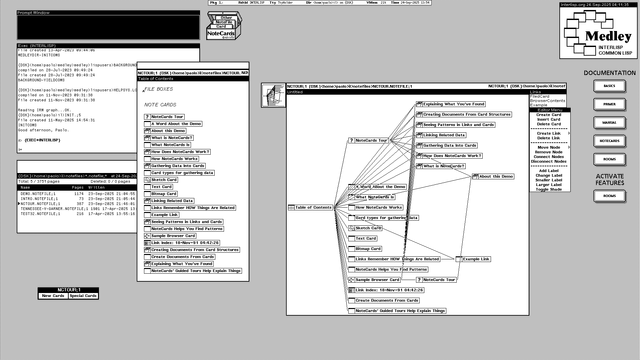
A NoteCards "browser" is a type of card that shows a hypertext network as a graph structure, i.e. a graph view like in this example. The thumbnail at the top left corner lets you pan and scroll the graph.

#NoteCards #Interlisp #hypertext #retrocomputing

Although NoteCards predated the WWW, in the early days of the web the hypermedia system developed with Interlisp-D was also used for research on the design, analysis, and documentation of web sites such as the projects described in these papers.

https://dl.acm.org/doi/pdf/10.1145/268820.268861

https://scholarworks.lib.csusb.edu/jiim/vol10/iss1/3

#NoteCards #web #hypertext #interlisp #retrocomputing

Vision and Reality of Hypertext and GUIs: 2.1.6 NoteCards @mprove

mprove.de