#Australia #NoNuclear #TheGuardian
Economists issue letter calling for clean energy, not nuclear
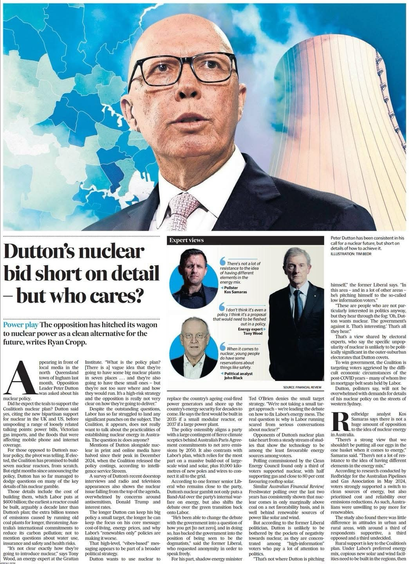
An open letter from 60 Australian economists has rejected the Coalition’s nuclear energy plan, promoting instead the subsidising of household clean energy policies, including incentives for home battery storage.
The organiser of the letter, Gareth Bryant, an associate professor in political economy at the University of Sydney, says the letter is intended as an intervention in the election campaign, reports AAP.
“As economists, energy analysts and policy specialists we strongly support government investment in household clean energy and industrial electrification and not in nuclear energy,” the letter says.
It says simple household clean energy upgrades can deliver immediate cost-of-living benefits and reductions in carbon emissions, and electrification can safeguard the future of industrial jobs and the communities that rely on them.
The economists, from a range of Australian universities and other tertiary institutions, said the construction of nuclear power plants would take at least 15 years at a cost of at least $330bn:
It would result in higher household energy costs, drain investment away from renewable energy and energy-intensive manufacturing, and leave the Australian economy precariously over-dependent on increasingly automated mineral extraction.
The economists said they support a nationwide program to upgrade homes and industry with clean renewable energy.
They said the technologies to fund should include large-scale home electrification with smart appliances to provide bill savings, energy-efficiency upgrades and battery storage, which can save surplus solar for night-time use, and hot water retrofits for more efficient water heating.
 Droppie
 Just Tired Anymore
 Milo Dide
 Grahame Gardner 🏴
 SydneyJim
 Simon Duffy
 Протест и сопротивление
 Morpheus Being
 ridicol 🍉🇵🇸 🏳️🌈💚
 Mojo ♻️