 Diego Pastor
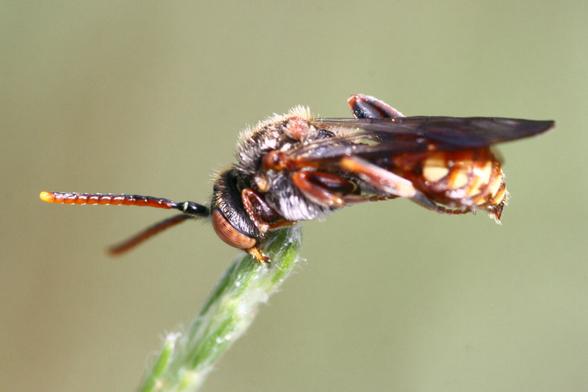
Nomada sp? (fam. Apidae)
[ES] Una foto difícil, con mucho viento y con el sol "de culo". Ha quedado regu, pero me encantan las abejitas que duermen agarradas con las mandíbulas a la vegetación. No estoy seguro, pero por comparación de fotos me parece del género Nomada; de la especie ya ni idea.
Tienen una biología interesante: se parecen a avispas y no recolectan polen, por lo que tienen poco pelo (la mía es bastante peluda comparada con tras especies). Son cleptoparásitas (como el cuco): ponen un huevo en una celda abierta de nidos de Andrena sp (otra abeja). Cuando la larva nace, mata a su compañera de celda y se zampa el acopio de néctar y polen que le dejó su madre (¡qué cabrona!).
Más información (en inglés): https://www.nhsn.org.uk/nomad-bees/
[EN] This photo was difficult to take, with a strong wind and the sun hitting from the back, so it didn't turn out well, but I like how it hangs on the twig with its mandibles. I'm not sure, but I think it belongs to the genus Nomada.
These bees have a very interesting biology: they look like wasps and they don't collet pollen, so they haven't got much hair (mine is hairy compared to other species from the genus). They are cleptoparastes (like the cuckoo): they lay one egg in an open cell of the nest of Andrena sp (another bee) and when it hatches, the larva kills its cellmate and eats all the pollen and nectar its mother collected for it.
More information: https://www.nhsn.org.uk/nomad-bees/
2026/05/10, provincia de/province of Cáceres (Spain).
Equipo/Equipment: Canon EOS 400D + Tamron SP 90 mm f/2.8 Di MACRO 1:1
ISO 800, s 1/200, f/8,0. A pulso/Handheld.
#hymenoptera #apocrita #apidae #nomada
#abeja #bee #nomadbee
#insecto #insect #bicho #bug
#macro #macrofotografía #macrophotography
#nature
[ES] Una foto difícil, con mucho viento y con el sol "de culo". Ha quedado regu, pero me encantan las abejitas que duermen agarradas con las mandíbulas a la vegetación. No estoy seguro, pero por comparación de fotos me parece del género Nomada; de la especie ya ni idea.
Tienen una biología interesante: se parecen a avispas y no recolectan polen, por lo que tienen poco pelo (la mía es bastante peluda comparada con tras especies). Son cleptoparásitas (como el cuco): ponen un huevo en una celda abierta de nidos de Andrena sp (otra abeja). Cuando la larva nace, mata a su compañera de celda y se zampa el acopio de néctar y polen que le dejó su madre (¡qué cabrona!).
Más información (en inglés): https://www.nhsn.org.uk/nomad-bees/
[EN] This photo was difficult to take, with a strong wind and the sun hitting from the back, so it didn't turn out well, but I like how it hangs on the twig with its mandibles. I'm not sure, but I think it belongs to the genus Nomada.
These bees have a very interesting biology: they look like wasps and they don't collet pollen, so they haven't got much hair (mine is hairy compared to other species from the genus). They are cleptoparastes (like the cuckoo): they lay one egg in an open cell of the nest of Andrena sp (another bee) and when it hatches, the larva kills its cellmate and eats all the pollen and nectar its mother collected for it.
More information: https://www.nhsn.org.uk/nomad-bees/
2026/05/10, provincia de/province of Cáceres (Spain).
Equipo/Equipment: Canon EOS 400D + Tamron SP 90 mm f/2.8 Di MACRO 1:1
ISO 800, s 1/200, f/8,0. A pulso/Handheld.
#hymenoptera #apocrita #apidae #nomada
#abeja #bee #nomadbee
#insecto #insect #bicho #bug
#macro #macrofotografía #macrophotography
#nature