Think of the smartphone. It didn't appear out of nowhere. First came batteries, chips, camera, mp3, etc developed independently for years. Then came integration into one single entitity! The same happened with animals: unicellular ancestors already had most of the mechanisms to be #multicellular

Billions of years ago, #life crossed a threshold. Single cells started to band together, and a world of formless, unicellular life was on course to evolve into the riot of shapes and functions of multicellular life today, from ants to pear trees to people.

It's a transition as momentous as any in the history of life, and until recently we had no idea how it happened.

But the momentous transition to #multicellular life may not have been so hard after all.

The evidence comes from multiple directions. The evolutionary histories of some groups of organisms record repeated transitions from single-celled to multicellular forms, suggesting the hurdles could not have been so high.

Genetic comparisons between simple multicellular organisms and their single-celled relatives have revealed that much of the molecular equipment needed for cells to band together and coordinate their activities may have been in place well before multicellularity evolved.

And clever experiments have shown that in the test tube, single-celled life can evolve the beginnings of multicellularity in just a few hundred generations—an evolutionary instant.

#biology #evolution
https://www.science.org/content/article/momentous-transition-multicellular-life-may-not-have-been-so-hard-after-all
The afternoon of the eighth day of the Konstanz School of Collective Behaviour 2025 (#KSCB2025) is devoted to a #keynote by Naama Brenner on #biophysics of #cells, either in #unicellular or #multicellular #organisms

@cbehav.bsky.social

https://www.exc.uni-konstanz.de/kscb/

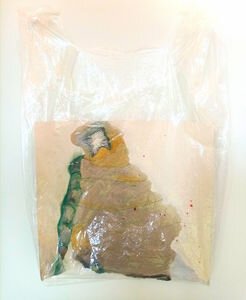
Verbinding, daar draait het toch allemaal om?
Deze 'Pieces of Multicellullar Organism in Plastic' proberen hun verbinding te behouden ondanks hun verscheurd zijn.

#art #kunst #visualart #mixedmediaart #experimentalart #artinplastic #rorchach #cellularworld #multicellular #creature #academieberchem #terpentijn #olieverf #oilpainting #paper #paperart #antwerpen

Prototaxites represents the first giant organisms to live on the terrestrial surface, reaching sizes of 8 metres in the Early Devonian.

It was an extinct lineage of #multicellular terrestrial #eukaryotes.

Assignments to groups of multicellular algae or land plants have been repeatedly ruled out leaving two major alternatives: #Prototaxites was either a #fungus or a now entirely extinct lineage.

The latter hypothesis seems more plausible based on nrw evidence.

https://astrobiology.com/2025/03/ancient-prototaxites-dont-belong-to-any-living-lineage-possibly-a-distinct-branch-of-multicellular-earth-life.html

Ancient Prototaxites Don’t Belong To Any Living Lineage - Possibly A Distinct Branch of Multicellular Earth life - Astrobiology

Prototaxites was the first giant organism to live on the terrestrial surface, reaching sizes of 8 metres in the Early Devonian

Astrobiology
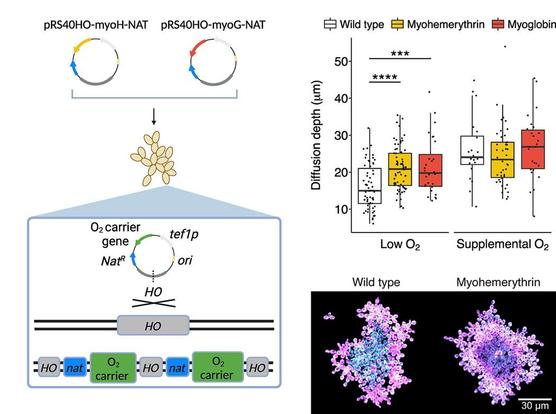
How did early #multicellular organisms exploit rising O2 levels? By expressing animal O2-binding proteins in snowflake yeast, this study shows that myoglobins & myohemerythrins circumvent anatomical limits to O2 diffusion in multicellular organisms #plosbiology https://plos.io/3Ejt16N
Oxygen-binding proteins aid oxygen diffusion to enhance fitness of a yeast model of multicellularity

How did early multicellular organisms manage to exploit rising oxygen levels? By modeling facilitated diffusion and expressing animal oxygen-binding proteins in snowflake yeast, this study shows that myoglobins and myohemerythrins circumvent anatomical limits to oxygen diffusion in multicellular organisms.

Mysterious New Organism Found in Mono Lake Could Rewrite the History of Life

Berkeley scientists have discovered a new choanoflagellate species in Mono Lake that forms multicellular colonies and hosts a microbiome, offering new perspectives on the evolution of multicellular organisms. The salty, arsenic- and cyanide-laced waters of the Eastern Sierra Nevada’s Mono Lake is

SciTechDaily
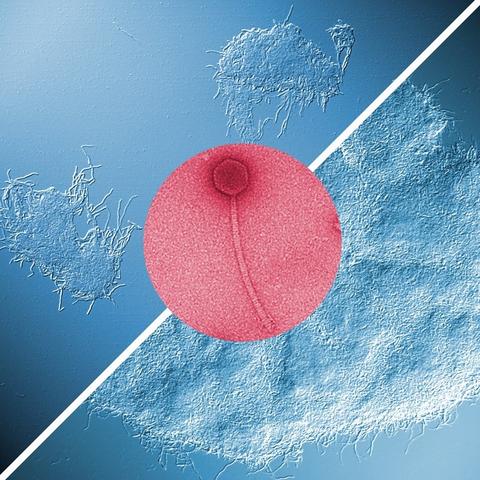
How do #phages impact #Streptomyces physiology? @BuryMone &co show that induction of the #prophage 'Samy' enhances dispersal of #multicellular aggregates of S. ambofaciens #bacteria in response to stress, likely promoting lineage propagation #PLOSBiology https://plos.io/3LDRNib
Prophage induction can facilitate the in vitro dispersal of multicellular Streptomyces structures

Little is known about the impact of phages on Streptomyces physiology. In this study, induction of the prophage ’Samy’ was found to enhance the dispersal of multicellular aggregates of Streptomyces ambofaciens bacteria in response to stress, likely promoting lineage propagation.

Once upon a time, long ago, the world was encased in #ice. Hundreds of millions of years ago, glaciers and sea ice covered the globe. The most extreme scenarios suggest a layer of ice several meters thick even at the equator.

But when seawater gets cold, it gets viscous.

This fact could explain how single-celled ocean creatures became #multicellular when the planet was frozen during “Snowball Earth,” according to experiments.

#evolution #biology https://www.quantamagazine.org/the-physics-of-cold-water-may-have-jump-started-complex-life-20240724/

The Physics of Cold Water May Have Jump-Started Complex Life

When seawater gets cold, it gets viscous. This fact could explain how single-celled ocean creatures became multicellular when the planet was frozen during “Snowball Earth,” according to experiments.

Quanta Magazine
.@KaylaStoy & @wc_ratcliff explore a #PLOSBiology study which shows that #multicellular #magnetotactic #bacteria form obligately multicellular consortia of genetically diverse cells with rudimentary division of labor Paper: https://plos.io/460zcGC Primer: https://plos.io/3LnqVD1
Multicellular magnetotactic bacteria are genetically heterogeneous consortia with metabolically differentiated cells

Multicellular magnetotactic bacteria (MMB) are unique in having no unicellular stage in their life cycle. This study characterizes the genomics and physiology of MMB consortia at single cell resolution, revealing that individual cells are not genetically identical and exhibit significant metabolic differentiation, highlighting their level of complexity.