How will sea‑level rise affect global economy? 🌊📈 #MPI_scientist Lennart Ramme et al. have developed a new process‑based model, FRISIA, that treats the coastal zones' response to SLR as a dynamic system with socioeconomic feedbacks. Coupled with the integrated assessment model FRIDA, it shows that a 0.8 m rise by 2100 could cut global GDP by 1.5–6.2% without & 0.5–3.2% with adaptation measures. FRISIA is #OpenSource and can be linked to other IAMs.💡
📝https://doi.org/10.5194/gmd-18-10017-2025
📸©W.Mobilo/AdobeStock

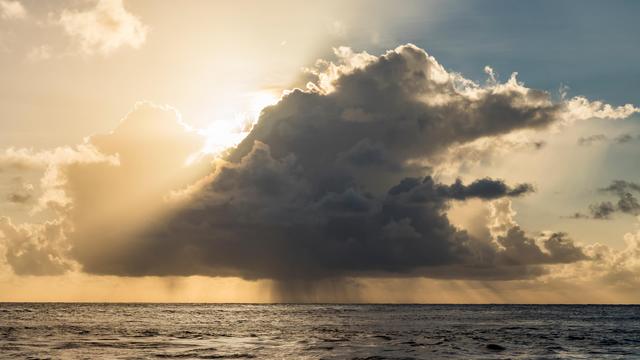
Is tropical rain belt variability driven by self-organization of #clouds? ⛅️

We're proud to welcome Dr. Tomoro Yanase at #MPIM to investigate this question, together with #MPI_Scientist Cathy Hohenegger. 🌅

They aim to use both idealized & realistic simulations, & #ORCESTRA observations to understand how variations in SST patterns may cause variability in cloudiness across the #ITCZ 🌧️🌊🌍

Dr. Yanase’s #ResearchStay is supported by the @HumboldtStiftung & will last for 1 year from Oct 2025 🙌

☔ Regnet es immer irgendwo auf der Welt?

Diese Frage, gestellt von der fünf Jahre alten Pauline, hat #MPI_Scientist Julia Windmiller für die Zeitung wochentaz beantwortet. Sie sagt: „Seit die Erde so aussieht, wie wir sie heute kennen, ist es wohl noch nie vorgekommen, dass es zu irgendeinem Zeitpunkt nirgendwo geregnet hat. Vollkommen sicher sein können wir uns da nicht, aber es ist sehr, sehr wahrscheinlich.“ Lest die ganze Antwort hier: https://taz.de/Kinder-fragen-die-taz-antwortet/!6114895/
#Kinderfragen #ScienceforKids

Looking for something cool to do in #Hamburg on the upcoming long weekend? ⚓️ How about visiting the "Breaking the Surface" exhibition at the International Maritime Museum? The #MPIM Social Media team recently went & was inspired by these women, many of whom we know personally (e.g. #MPI_scientist Jin-Song von Storch & Johanna Baehr, deputy head of #IMPRS_ESM). Make sure to visit before the end of the year or check out the website: www.breaking-the-surface.com
#WomenInSTEM @cenunihh
🛰️ #WIVERN has officially been selected for ESA’s 11th #EarthExplorer Mission! It's scheduled to launch in the early 2030s!🌪️WIVERN will provide the first-ever global measurements of winds within #clouds. It was proposed by scientists f. Polytechnic University of Turin& University of Reading. #MPI_scientist Cathy Hohenegger is a member of the scientific Mission Advisory Group & will continue to contribute her expertise to developing the scientific plan for the mission. https://mpimet.mpg.de/en/communication/detail-view-news-homepage/wivern-is-esas-11th-earth-explorer-satellite-mission
©ESA
🌎How Does a Planet's Rotation Rate Affect Its Climate? By simulating an aquaplanet &varying its rotation rate, #MPI_Scientist Abisha Gnanaraj et al. found that a slower rotation than Earth's leads to a colder+drier climate, while a faster rotation results in a warmer+moister climate. The changes arise from alterations in atmospheric circulation aimed at conserving angular momentum which impact humidity💦, cloud cover☁️, & radiant energy fluxes ↑↓.
📗https:/doi.org/10.5194/wcd-6-489-2025
🖼️A.Gnanaraj
🌊💨 The #ocean shapes the atmosphere in surprising ways!
A new study by #MPI_scientist Putrasahan & von Storch shows the Vertical Mixing Mechanism(VMM), where sea surface temperature gradients drive wind changes, is not only active on ~100 km scales, but can span up to 1,000 km 🌍.
Even more surprising: VMM works not just monthly, but also daily & hourly ⏱️.
This multi-scale process is key for improving #climate &weather models.
📄 https://doi.org/10.1029/2025GL114856
🖼️ CC BY-NC 4.0 Putrasahan & von Storch 2025.

☁️ Do changes in cloud altitude impact climate sensitivity?

A new study led by #MPI_scientist Lukas Kluft using an idealized radiative transfer model shows:
Positive radiative effects from unchanged high cloud temperatures cancel each other out with a reduction of the greenhouse effect of added CO₂.
📌 Therefore climate sensitivity stays nearly the same as without radiative effects of high cloud altitude – around 2.2°C per CO₂ doubling.

📖 Read the full story now at: https://doi.org/10.5194/acp-25-9075-2025

🌬️ What keeps the surface winds blowing across the equatorial oceans?
A new study by #MPI_scientist Marius Winkler & colleagues using ICON at 5 km resolution suggests that classical approaches fall short and that vertical and horizontal momentum transport are essential to maintaining equatorial winds. They develop a revised wind model that captures these dynamics and outperforms classical approaches.
📖 https://doi.org/10.1002/qj.4998

#EquatorialWinds #AirSeaInteraction #ClimateScience

🎉 Fantastic news: The Advisory Committee for #EarthObservation has recommended the WIVERN satellite mission 🛰️as the 11th “Earth Explorer” of the European Space Agency! 🙌 We are extremely excited about this, as our #MPI_scientist Cathy Hohenegger was involved in the proposal & is a member of the scientific Mission Advisory Group of WIVERN. 🤞 Now we are waiting for the final decision by the ESA member states in September! 🔗More info: https://mpimet.mpg.de/en/communication/detail-view-news-homepage/expert-committee-recommends-the-selection-of-the-wivern-satellite-mission-as-the-11th-earth-explorer
Credit: ESA