 Star Cat Books
Wesley is a year old now & I’ve been busy with new health issues, including #microvascularangina #anemia & the #moyamoya. Here he is posing with the new Corey series book 1. #bookstore #CatsOfMastodon #jamessacorey #theexpanse

Study finds that artierial wall enhancement in #moyamoya disease (MMD) varies by age, location of arteries, and disease progression, and may be used as an imaging biomarker of MMD. (Hiroshi Tagawa et al.)
🔗 https://link.springer.com/article/10.1007/s00330-023-10251-9


Objective To investigate the relationship of followings for patients with moyamoya disease (MMD): arterial wall enhancement on vessel wall MRI (VW-MRI), cross-sectional area (CSA), time-of-flight MR angiography (MRA), age, locations from intracranial internal carotid artery (ICA) to proximal middle cerebral artery (MCA), disease progression, and transient ischemic attack (TIA). Methods Patients who underwent VW-MRI between October 2018 and December 2020 were enrolled in this retrospective study. We measured arterial wall enhancement (enhancement ratio, ER) and CSA at five sections of ICA and MCA. Also, we scored MRA findings. Multiple linear regression (MLR) analysis was performed to explore the associations between ER, age, MRA score, CSA, history of TIA, and surgical revascularization. Results We investigated 102 sides of 51 patients with MMD (35 women, 16 men, mean age 31 years ± 18 [standard deviation]). ER for MRA score 2 (signal discontinuity) was higher than ER for other scores in sections D (end of ICA) and E (proximal MCA) on MLR analysis. ER in section E was significantly higher in patients for MRA score 2 with TIA history than without. ER significantly increased as CSA increased in section E, which suggests ER becomes less in decreased CSA due to negative remodeling. Conclusion Arterial wall enhancement in MMD varies by age, location, and disease progression. Arterial wall enhancement may be stronger in the progressive stage of MMD. Arterial wall enhancement increases with history of TIA at proximal MCA, which may indicate the progression of the disease. Clinical relevance statement Arterial wall enhancement in moyamoya disease varies by age, location of arteries, and disease progression, and arterial wall enhancement may be used as an imaging biomarker of moyamoya disease. Key Points It has not been clarified what arterial wall enhancement in moyamoya disease represents. Arterial wall enhancement in moyamoya disease varies by age, location of arteries, and disease progression. Arterial wall enhancement in moyamoya disease increases as the disease progresses. Graphical abstract

The #moyamoya progresses; I’m finding executive function organization (I was the Martha Stewart as far as that goes in the field of production mgrs for mainstream publishing) is waning. This is alternately disturbing to me & meh I don’t notice but other ppl sure as hell suffer bc of it.
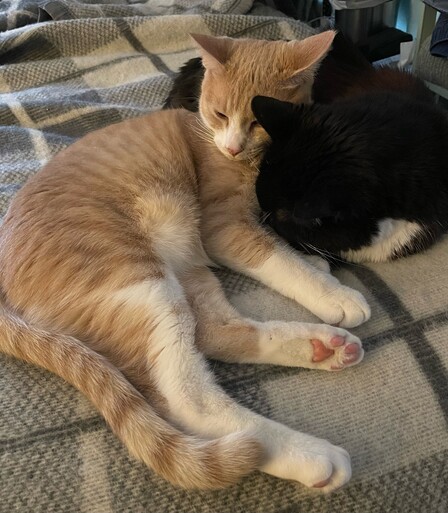
Have two cats instead. The ginger, Xander, is only 10 months old & is larger than the tux by far; the tux, Spike, is the largest cat we’ve ever known (he of the polydactyl paws). #catsofmastodon

 European Radiology
 Packard Moose