https://utasansh.in/cloud/utasanshin/Videos/ashibishonganee_251124.mp4

Yūyu Uehara and me sang together the song ashibishonganee, while playing the #sanshin. I was so happy that I didn't mess it up. When singing in a duet, I feel much more responsible compared to when singing alone.

This happened at the Performance Art Festival organized by the Ryūkyūkoku Min'yō Kyōkai on november 24th, 2025. Those who couldn't come to watch and listen, please enjoy it now by watching the video.
#utasanshin #唄三線 #三線 #Okinawa #沖縄 #minyo #民謡
https://labonneheure.ch/cloud/utasanshin/Videos/ashibishonganee_251124.mp4

Yūyu Uehara and me sang together the song ashibishonganee, while playing the #sanshin. I was so happy that I didn't mess it up. When singing in a duet, I feel much more responsible compared to when singing alone.

This happened at the Performance Art Festival organized by the Ryūkyūkoku Min'yō Kyōkai on november 24th, 2025. Those who couldn't come to watch and listen, please enjoy it now by watching the video.
#utasanshin #唄三線 #三線 #Okinawa #沖縄 #minyo #民謡
utasanshin 唄三線 - [email protected]

Choď do *yče

Goemon je energická skladba, ktorá kombinuje tradičnú japonskú mitológiu s moderným tribal bass zvukom

Chapleau
Okena je chill chill

Experimentálny tanečný hit WaqWaq Kingdom s ugandskou producentkou Catu Diosis spája tradíciu s modernosťou.

Chapleau

WaqWaq Kingdom - Hot Pot Totto

"Acclaimed Japan “minyo footwork” duo WaqWaq Kingdom - aka Shigeru Ishihara (DJ Scotch Egg / Seefeel) and Kiki Hitomi (ex-King Midas Sound) - return with feverishly joyous new album Hot Pot Totto, a bubbling hot pot of dance music that responds to ecological anxiety."

https://waqwaqkingdom.bandcamp.com/album/hot-pot-totto

Fav track: The Tower

#listeningNow #music #bass #electronic #japan #chiptune #dance #dub #footwork #gagaku #minyo #psychedelic

Hot Pot Totto, by WaqWaq Kingdom

11 track album

WaqWaq Kingdom

Thanks to my teacher Kamiya Kōichi's close guidance during my training in Okinawan Min'yō (folk songs), I won the First Newcomer's Prize in the contest organized by the Ryūkyūkoku Min'yō Kyōkai (Folk Song Association of the Ryūkyūs) yesterday, against 30 other competitors.
#Okinawa #Minyo #沖縄 #民謡 #琉球 #utasanshin #唄三線
Minyo Crusaders return to Europe for a summer tour at nine festivals in five countries

In recent years, the musical ensemble Minyo Crusaders have regularly made trips to Europe for summer tours, and this summer is no exception. If our calculations are correct, this will be the fifth…

AVO Magazine
--- english ---

I came to the island of #Okinawa this May to learn its folk songs (‘uchinaa min-yō’ or simply ‘min-yō’) and traditional dances. A min-yō singer sings (‘uta’) and plays the three-stringed lute sanshin at the same time. This double role is called #utasanshin. This double role is also central to the courtly (‘koten’) music of Okinawa. Before that, I had already learnt min-yō and eisa (a type of traditional Okinawan dance) self-taught in Switzerland and then regularly gave group lessons in eisa and min-yō. I was the only teacher for both in Switzerland. If you learn without a teacher, you get stuck at a certain level and it's difficult to develop in areas of finesse. But I wanted to develop further, and for that I needed good teachers. I have now found them in Okinawa. I learn min-yō from Kamiya Kōichi, who is the best teacher for me. I learn the traditional dances from different people.
I enjoy singing and dancing together. I don't necessarily need a stage for that. What this certainly needs is a gathering of people. The more of them actively sing or dance along, the happier I become.
I am interested in the traditional songs and dances because I recognise in them a truthfulness and deep wisdom that can only emerge through the maturity and cultivation by dozens of generations. In contrast to Switzerland, where such songs and dances are hardly practised any more, Okinawa has a significant proportion of the population that practises them. This practice is very visible to the public.
If I compare my skills with those of my teachers here on Okinawa, I am clearly still a beginner. The kind of maturity that characterises my teachers can only be achieved through decades of practice. However, such maturity is my goal. It will take me decades to get there.
I really like teaching. I am aware that there are many more suitable teachers than me here on Okinawa. But every teacher has their own unique qualities. Who knows, maybe one day I will be your teacher?

--- 日本語 ---

私は今年の5月に沖縄の民謡と伝統的な踊りを学ぶために沖縄に来ました。それ以前は、スイスで独学で沖縄民謡とエイサーを学び、両方を教導しました。どちらもスイスで唯一の先生でした。先生なしで学ぶと、ある一定のレベルで止まってしまい、繊細な部分を伸ばすのが難しくなります。しかし、私はもっと成長したかったし、その為には良い先生が必要でした。私は今、沖縄でその様な先生を見つける事が出来ました。民謡は神谷幸一先生から習っています。伝統的な踊りもいろいろな人から習っています。
一緒に歌って踊るのが楽しいです。その為に必ずしも舞台が必要なわけではありません。確かに必要なのは人の集まりです。積極的に歌ったり踊ったりしてくれる人が多ければ多いほど、私は嬉しくなります。
私が伝統的な唄や踊りに興味を持つのは、そこに何十世代にも渡って熟成され、大切にされてきた物だけが持つ真実味や深い知恵を感じるからです。この様な唄や踊りを殆ど実習しないスイスとは対照的に、沖縄ではかなりの割合の人々が実習しています。その実習風景は、一般の人々にもよく見えます。
沖縄の先生方と私の技量を比べても、まったく意味がありません。なぜなら、私はここでは明らかにまだ初心者だからです。私の先生方を特徴づける様な成熟は、何十年もの練習を経なければ達成できません。しかし、その様な成熟が私の目標です。そこに到達するには何十年も掛かるだろう。
私は教えることが本当に好きです。ここ沖縄には、私よりも相応しい先生がたくさんいる事は承知しています。でも、どの先生にもそれぞれの良さがあるんでしょう。何時か私があなたの先生になるかもしれませんよ。

#沖縄 #沖縄民謡 #唄三線 #minyo #uchinaa-minyo
la bonne heure

--- english ---

I came to the island of #Okinawa this May to learn its folk songs (‘uchinaa min-yō’ or simply ‘min-yō’) and traditional dances. A min-yō singer sings (‘uta’) and plays the three-stringed lute sanshin at the same time. This double role is called #utasanshin. This double role is also central to the courtly (‘koten’) music of Okinawa. Before that, I had already learnt min-yō and eisa (a type of traditional Okinawan dance) self-taught in Switzerland and then regularly gave group lessons in eisa and min-yō. I was the only teacher for both in Switzerland. If you learn without a teacher, you get stuck at a certain level and it's difficult to develop in areas of finesse. But I wanted to develop further, and for that I needed good teachers. I have now found them in Okinawa. I learn min-yō from Kamiya Kōichi, who is the best teacher for me. I learn the traditional dances from different people.
I enjoy singing and dancing together. I don't necessarily need a stage for that. What this certainly needs is a gathering of people. The more of them actively sing or dance along, the happier I become.
I am interested in the traditional songs and dances because I recognise in them a truthfulness and deep wisdom that can only emerge through the maturity and cultivation by dozens of generations. In contrast to Switzerland, where such songs and dances are hardly practised any more, Okinawa has a significant proportion of the population that practises them. This practice is very visible to the public.
If I compare my skills with those of my teachers here on Okinawa, I am clearly still a beginner. The kind of maturity that characterises my teachers can only be achieved through decades of practice. However, such maturity is my goal. It will take me decades to get there.
I really like teaching. I am aware that there are many more suitable teachers than me here on Okinawa. But every teacher has their own unique qualities. Who knows, maybe one day I will be your teacher?

--- 日本語 ---

私は今年の5月に沖縄の民謡と伝統的な踊りを学ぶために沖縄に来ました。それ以前は、スイスで独学で沖縄民謡とエイサーを学び、両方を教導しました。どちらもスイスで唯一の先生でした。先生なしで学ぶと、ある一定のレベルで止まってしまい、繊細な部分を伸ばすのが難しくなります。しかし、私はもっと成長したかったし、その為には良い先生が必要でした。私は今、沖縄でその様な先生を見つける事が出来ました。民謡は神谷幸一先生から習っています。伝統的な踊りもいろいろな人から習っています。
一緒に歌って踊るのが楽しいです。その為に必ずしも舞台が必要なわけではありません。確かに必要なのは人の集まりです。積極的に歌ったり踊ったりしてくれる人が多ければ多いほど、私は嬉しくなります。
私が伝統的な唄や踊りに興味を持つのは、そこに何十世代にも渡って熟成され、大切にされてきた物だけが持つ真実味や深い知恵を感じるからです。この様な唄や踊りを殆ど実習しないスイスとは対照的に、沖縄ではかなりの割合の人々が実習しています。その実習風景は、一般の人々にもよく見えます。
沖縄の先生方と私の技量を比べても、まったく意味がありません。なぜなら、私はここでは明らかにまだ初心者だからです。私の先生方を特徴づける様な成熟は、何十年もの練習を経なければ達成できません。しかし、その様な成熟が私の目標です。そこに到達するには何十年も掛かるだろう。
私は教えることが本当に好きです。ここ沖縄には、私よりも相応しい先生がたくさんいる事は承知しています。でも、どの先生にもそれぞれの良さがあるんでしょう。何時か私があなたの先生になるかもしれませんよ。

#沖縄 #沖縄民謡 #唄三線 #minyo #uchinaa-minyo
utasanshin 唄三線


https://utasansh.in/cloud/utasanshin/Videos/shioya_keiroukai_2024_reduced.mp4

This is the result of me being taken care and carried by the local society who is supporting me tremendously in my wish to become a good performer. I am filled with gratitude. Jintoo! ("Really!")

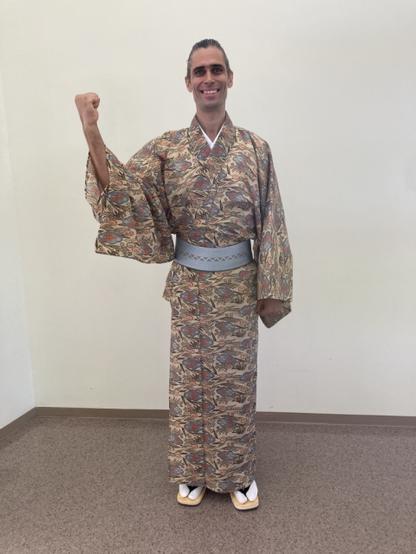
The clothing and makeup was for the kajadifuu, a traditional courtly dance which is danced at the beginning of any celebration, which three women in their seventies and me danced together synchronously, a bit earlier at this same event, which happened 23rd november 2024 and which was the keirōkai (gathering to honour the elderly) of Shioya, Uruma-Shi, #Okinawa.

You can hear me introducing myself and the songs I'm playing:

Haisai, chuuwo uganabira.
Wannee suisu kara chaabitaru ema yaaibiin.
Kamiya Kooichi shinshii kara minyoo naratooibiin.
Naratti kara gokagetsu* natooibiin.
Kuchoo kara tanomarete* chaabitan.
Ikkyokuya bachikwaibushi utudukisabira.
Tsugee gutushibi nu uta yaaibiin.
Saigo* munushiribushi yaaibiin.
Ippee nihwee deebiru.

*The words marked with a star are Japanese, the rest is Okinawan. I'm able to learn Okinawan gradually thanks to the many wonderful people who are taking care of me and who mostly are over 60 years old and thus speak Okinawan fluently. The lyrics of the #minyō (folk songs) are in Okinawan, so this language is crucial to me.

Hello everybody, how are you.
I'm Ema who came from Switzerland.
I'm learning minyō from my teacher Kamiya Kōichi.
5 months passed since I started learning from him.
I was invited by the head of the neighbourhood self-governing body, so here I am.
I present you Bachikwaibushi as the first song.
The next song is Gutushibi nu uta.
The last song is Munushiribushi.
Thank you very much.

The video is a three minutes resumée of the fifteen minutes presentation.

The man climbing the stage towards the end grabbed a #sanshin (which was not properly tuned for this song 😂) and accompanied me for the last minutes 🤗

#utasanshin #沖縄民謡 #唄三線