Stories That Vanish
By Cliff Potts, CSO, and Editor-in-Chief of WPS News
Baybay City, Leyte, Philippines — April 11, 2026
There are things I know I read that I can no longer find.
I do not mean crank mail, midnight radio, or the kind of junk people use to build fake worlds for themselves. I mean things I remember seeing in public, respectable places: major magazines, policy reporting, and government-linked material that was not hidden at the time. Then, years later, when I went back looking for them, they were gone, buried, replaced, renamed, or so hard to recover that they may as well not exist.
That is not just frustrating. It changes how a person thinks about the public record.
I have no interest in pretending memory is perfect. It is not. Time compresses things. One article can blend into another. A fact, an argument, and a headline can merge in the mind over twenty years and come back as one remembered story. That happens. But that does not mean nothing was there. It does not mean the digital record is stable. It is not. In many cases, it is far more fragile than people want to admit.
A few examples have stayed with me for years.
One of them involved breast cancer and radiation. What I remember reading, around the Bush years, was a claim that increased background radiation tied to the American nuclear arsenal was contributing to breast-cancer risk in the United States. I went looking for it later and could not find it. What I can find now is very different. Current CDC-linked toxicological material says most background radiation exposure in the United States comes from natural sources and medical exposure, not from the weapons stockpile. That directly cuts against the version I remember. At the same time, those same public-health materials still acknowledge that ionizing radiation is associated with cancer risk in some contexts, including breast cancer. So what remains is not a neat answer. What remains is a gap between what I remember reading then and what the easier-to-find record says now.
Maybe the older item was wrong and later work replaced it. Maybe I read a different source and later attached it to CDC in memory. Maybe a narrower claim about radiation and cancer got mentally widened over time. All of those are possible. But here is the larger point: when an older claim disappears from easy public reach and only the newer one remains visible, the public record starts to feel less like history and more like a cleaned shelf.
Another example holds up better.
Before September 11 changed the political weather, George W. Bush really was talking about reducing nuclear weapons. In a White House speech on May 1, 2001, he said plainly that his goal was to move quickly to reduce nuclear forces and to reach the lowest possible number consistent with national security. That means the broad memory was real. This was not invented later. It was part of the policy discussion before the towers fell. After 9/11, that earlier line of thought was swallowed by the war era, but it had existed.
The larger strategic idea behind that memory also turns out to have been real. Bush-era nuclear planning did not simply say nuclear weapons were useless. That would be too simple. But serious policy analysis from that period shows a growing belief that some missions once assigned to nuclear weapons might instead be handled by advanced conventional systems, including precision-guided weapons. In plain language, the military had better tools than it used to, and some planners no longer saw giant Cold War stockpiles as the elegant answer to every hard target on earth. That does not mean nuclear weapons stopped mattering. It means the strategic imagination was changing.
That matters to me because it is one of those cases where the bones of the memory were right, even if the exact magazine article I remember has still not been pinned down. The policy was real. The shift was real. But the trail back to the way ordinary readers first encountered it is harder to recover than it should be.
The same thing happened, in a more tangled way, with labor and hiring.
I remembered a story about a large New York law firm getting into trouble for advising corporations on how to avoid hiring qualified American engineers in favor of foreign workers seen as more controllable or more loyal. I could not find that exact story in the form I remembered. But I did find something close enough to show that the memory was not built from thin air. In 2008, the American Bar Association Journal reported that the prominent New York immigration firm Fragomen, Del Rey, Bernsen & Loewy was being investigated by the U.S. Department of Labor over instructions related to handling “apparently qualified” U.S. workers in labor-certification cases. That is not the same as the exact story I remembered, and it was Labor, not the NLRB. But it is very much in the same neighborhood.
Even more striking, the underlying “loyalty” argument was real. A Center for Immigration Studies report quoted immigration attorney Sherry Neal as saying foreign nationals could appear to be more loyal workers because they were less mobile than other in-demand tech workers. The same report cited management-side logic that visa-dependent workers often stayed put because changing jobs could disrupt the immigration process. That is not an accusation pulled from the air. That is a labor-market argument people were actually making.
So what do I do with all of that?
I do not think the right answer is to pretend every memory is exact. That is lazy. I also do not think the right answer is to shrug and say that if something is hard to find now, it probably never mattered. That is even worse. The truth is uglier and more ordinary. Some stories are remembered correctly. Some are remembered partly correctly. Some are memory composites built from multiple real things that have become difficult to reconstruct because the trail is broken, scattered, paywalled, overwritten, or buried.
That is not paranoia. That is what life in the digital archive actually feels like.
We were told the internet would preserve everything. What it often preserves instead is access for the moment, followed by drift, decay, and selective recoverability. Pages move. Agencies revise summaries. Magazines reorganize their archives. Search engines surface the latest version and bury the older one. Institutional memory gets cleaner while human memory gets messier. The end result is a public culture where it becomes easier and easier to say, “That never happened,” simply because retrieving what did happen now takes too much work.
Power loves that condition.
It helps political myth. It helps corporate self-protection. It helps every institution that benefits when the past grows hard to reach. Once the trail weakens, propaganda has room to move in. One era’s open debate becomes the next era’s missing context. One period’s admitted policy becomes the next period’s disputed rumor.
That is one reason WPS News exists.
Not because every memory is sacred. Not because every vanished story proves a plot. But because if somebody does not keep records while events are still visible, later someone else will insist they were never visible at all. The archive does not have to be perfect to matter. It just has to exist.
That is the lesson I trust most now. Save what matters when you see it. Save the policy paper. Save the article. Save the government statement before it gets moved, rewritten, summarized, or lost under a redesign. Because later may be too late, and the person telling you nothing was ever there may have the cleaner search results on his side.
I know what I remember. I also know memory can bend. Living with both of those truths at the same time is part of being honest.
But so is this: some stories really do vanish.
If this work helps you understand what’s happening, help me keep it going: https://www.patreon.com/cw/WPSNews
This essay was written by Cliff Potts, Editor-in-Chief of WPS News. WPS News has been active in one form or another on the internet since 1998. For further information, see https://cliffpotts.org.
References
American Bar Association Journal. (2008, August 19). Major NY immigration law firm investigated by Dept. of Labor.
Agency for Toxic Substances and Disease Registry. (n.d.). Toxicological profile for ionizing radiation.
Bush, G. W. (2001, May 1). Remarks by the President to students and faculty at National Defense University. The White House.
Center for Immigration Studies. (2006, April). Green card for foreign grads: Is unlimited access to foreign workers good policy?
Kristensen, H. M. (2002). The role of U.S. nuclear weapons: New doctrine falls short of needed change. Federation of American Scientists / Nautilus Institute.
Squassoni, S. (2001). Nuclear weapons in the Bush Administration: Policy and posture review. Congressional Research Service.
#digitalArchives #disappearingRecords #laborAndImmigration #mediaHistory #nuclearPolicy #publicMemory #WPSNews Brewminate
 Daniel Bellingradt
 Maikel de Bakker
 Hacker News
 Blaze Trends
 sport of sacred spherical cows
 WPS News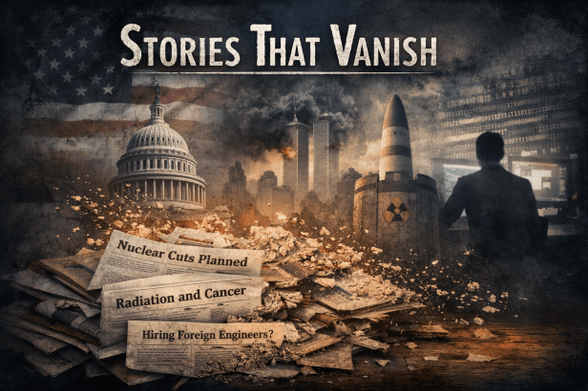
 Media of Cooperation