New #openaccess article in The Mathematical Gazette:
Optimal play in ‘Guess Who?’

Suggests using questions with an embedded paradox to produce three responses from your opponent - yes, no, or argh paradox head explodes - allowing you to narrow down the suspects more quickly.

The authors say their optimal strategy uses nothing "more advanced than induction and a recursion relation based on elementary probability... Hence Guess Who? could guide an introduction to #GameTheory to interested students through a ‘real-world’ game."

#MathsToday #ALevelMaths #MTBoS #ITeachMath

https://www.tandfonline.com/doi/full/10.1080/00255572.2026.2652912

Teachers! We're running a day of year 12 maths workshops on 25th June on campus in Sheffield city centre. Bring a group? They'll see the university campus and enjoy taking part in maths workshops run by university lecturers.

https://shuoutreach.com/event/exploring-maths-experience-day/

#MathsToday #AlevelMathematics

Exploring Maths Experience Day

Maths has always been a vital tool to understand the world around us, as well as a playful and creative way to engage our curiosity. Come along to our Exploring Maths days to glimpse the world that…

SHUOutreach

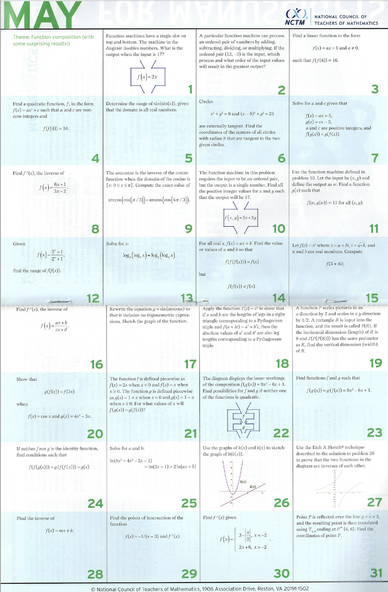
The May #ProblemSolving Calendar is here! Solve yourself or w/your students & share your working-out thoughts here or on the blog.

*special theme* -- Function Composition #Algebra2 #precalculus

#iTeachMath #MTBoS #T3Learns #RecreationalMath #MathsToday #ClassroomMath

https://karendcampe.wordpress.com/2026/05/01/may-calendar-problems-4/

May Calendar Problems

May is upon us and for many that signals the end of the school year. If you need some problems to fill random times in class (half your students taking an AP exam or on a field trip? need a break f…

Reflections and Tangents
A reminder that some things are changing for Maths Week Scotland from May! #MathsToday #UKMathsChat

RE: https://bsky.app/profile/did:plc:st5knuf5edn2h7oxcih3yggy/post/3mj37hhgzak2b

Want to hear two nerds chatting about maths history?

You're in luck!

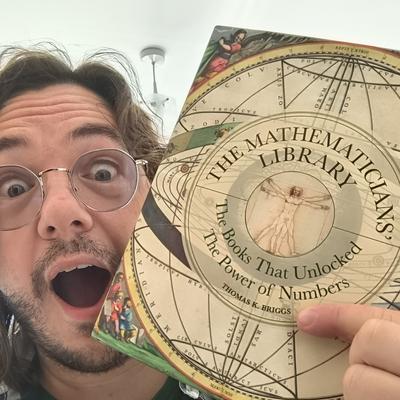
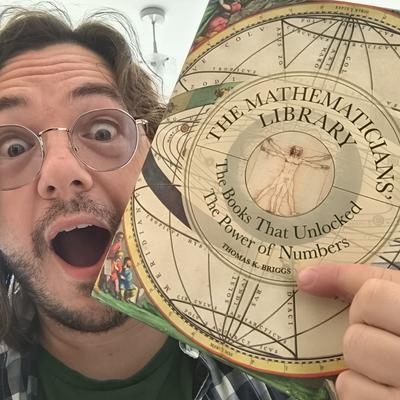
Ben Cornish invited me onto *The Mathematicians Podcast* to talk about *The Mathematicians' Library*: https://mathematicians.podbean.com/e/episode-55-injective-thomas-k-briggs-on-the-mathematicians-library/

#Maths #History #HistoryOfMaths #MathsToday

Episode 55 - Injective - Thomas K Briggs - On The Mathematicians' Library | The Mathematicians Podcast

In this special book club episode of 'The Mathematicians Podcast', I sit down with author, maths communicator, and museum learning consultant, Thomas K. Briggs. Join us for a glass of wine and a deep dive into Tom's book, 'The Mathematicians Library', a title so intriguing it was a must-have for the show. This 'Injectives' sub-series episode is a one-to-one conversation; today exploring the vast history of mathematical literature. Discover the oldest book in Tom's personal collection and unravel the criteria for what truly constitutes a "book of mathematics". Tom paints a vivid picture of ancient mathematical works, describing the evolution of writing media before the age of flat sheets and ink. The discussion navigates through the emergence of authorship in the Mediterranean, Indian, and Chinese traditions, and Tom shares his favourite example of a significant mathematical work without a known author. He also recounts the fascinating journey of a particular mathematical text through the ages, a story of translation and transcription that has preserved ancient knowledge. In a new segment of "Desert Island Codex," Tom reveals which ancient mathematical document he would choose to study in solitude and which ancient lecture he would love to have heard.  Moving beyond the book, the episode looks into Tom's work as a museum consultant. He sheds light on the origins of encryption and the methods ancient leaders used to send secret messages. The discussion also explores the vast, untranslated collection of Babylonian tablets and what they might still reveal about Mesopotamian mathematical understanding. Finally, Tom offers his own insightful, pithy definition of what mathematics truly is. He also reveals which mathematician he is most excited to see featured on a future episode of the podcast. Tune in for a captivating conversation that journeys through the annals of mathematical history, from ancient texts to modern museum exhibits.   You can find Ben on Bluesky @mathematicians-pod. You can support him at ko-fi.com/benjamincornish.   You can find Tom: on his website https://tkbriggs.co.uk/ ; on Bluesky  @TeaKayB.mathsy.space ; Join the History and Mathematics in Education Network https://historyand.mathsy.space/ ;      The music was-"Danse Macabre - Finale"Kevin MacLeod (incompetech.com)Licensed under Creative Commons: By Attribution 3.0http://creativecommons.org/licenses/by/3.0/   Keywords: history of maths, ancient mathematics, mathematical literature, Thomas K. Briggs, The Mathematicians' Library, Euclid, ancient texts, encryption, Bletchley Park, Babylonian tablets, museums, history of science, mathematics podcast. Hashtags: #TheMathematiciansPodcast #HistoryOfMaths #AncientMaths #MathematicalBooks #STEM #Podcast #Interview #Maths #History #Science #Books #Museums #Encryption #TheMathematiciansLibrary

Reading ancient languages takes a lot of time, effort, experience, & other things involved in learning so it's *really* difficult for kids (or most adults) to engage with ancient texts on historical objects in museums...

... Except there's a relatively quick win, if a little infrastructure is put in place to take advantage of it:

*Numbers.*

Ancient civilizations had their own unique ways of presenting and manipulating numbers, but recognising, extracting, and converting them to a more familiar number system is a process which has a very low entry point and a massively high ceiling. It's a fantastic opportunity for any museum with examples of ancient numbers amongst its collection to give visitors the feeling of being a time-travelling codebreaker, unraveling the mysteries of ancient writing.

Bonus: engaging with ancient number systems in this way can prompt deeper thinking about and engagement with the number system that a visitor considers "the normal one", which can support their learning of contemporary mathematics.

#Museum #History #Maths #Language #MathsToday

... deeper thinking about and engagement with the number system that a visitor considers "the normal one", which can support their learning of contemporary mathematics. #Museum #History #Maths #Language #MathsToday