#maps #mars #marsnetwork
I'm back with a new network mission. We have seen that a Mars seismic network has been desired for a long time. In 2009 at LPSC, Bruce Banerdt presented a plan for Cerberus. It would use 3 copies of the Phoenix lander (which had just completed its mission) and would fly in c. 2016. Here is the abstract:
https://www.lpi.usra.edu/meetings/lpsc2009/pdf/2485.pdf
It doesn't say anything about landing site selection but Bruce kindly sent me a study of landing sites by Matt Golombek et al.
#mars #cerberus #marsnetwork
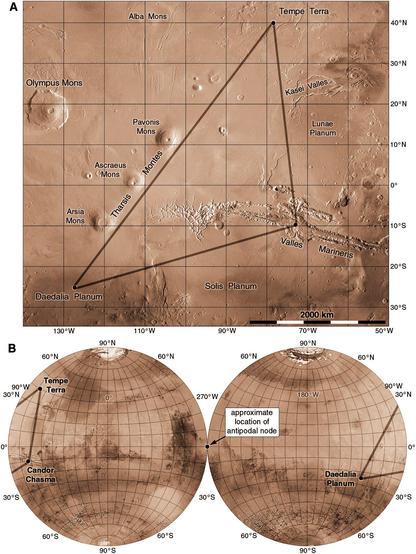
In 1992 an ESA mission scenario called Marsnet was discussed at a meeting in Germany. It would be a 3 or 4 lander network (the 4th if funding permitted). A 1996 paper said that 50 sites were considered before 3 sets of 4 sites were selected. The one for which we have details is shown here. Sadly the report was not released and I couldn't add it to my first Atlas. Maybe it's accessible now but I have not seen it. Please don't hide important studies!
# maps #mars #marsnetwork
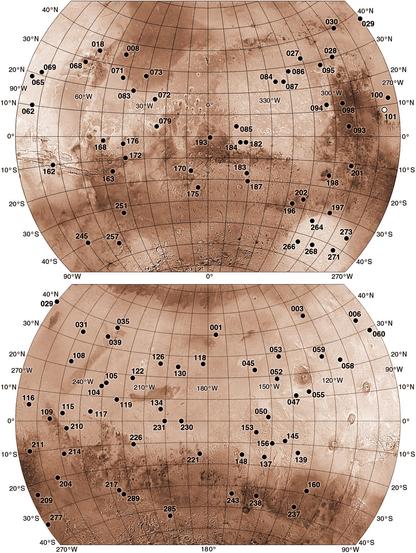
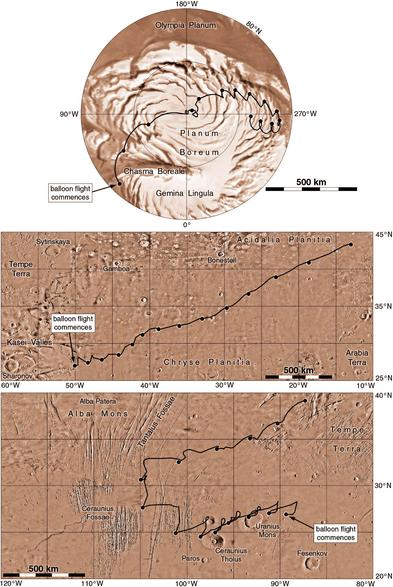
One plan had a single spacecraft deploying 4 balloons each with 5 weather stations and one seismic station. Global climate models suggested wind patterns and these maps show how 3 balloon missions might travel. Every black dot is a touchdown point, and at some of them the landers are released. No balloon has yet flown anywhere off Earth except Venus but there have been plenty of studies for Mars balloons. And we did have a cute helicopter.
How do the network landers get to the surface? They could be released by a carrier spacecraft during approach to Mars, or dropped off from orbit. But at the 8th MSWG meeting in February 1993, Jacques Blamont of French space agency CNES suggested dropping landers from a balloon. The balloon is blown by the wind, and either drops landers as needed or touches down periodically and releases its lander on the surface. Some designs land every night and fly in the day.