 Phil Stooke
A 2005 presentation by Jack Jones of JPL at a planetary probe workshop described a Mars balloon mission using a Montgolfiere hot air balloon. The heat is from sunlight warming the balloon. It would enter the atmosphere, descend on a parachute and be dropped from that to inflate as it fell. It might have a lifetime of a month and could make several touchdowns to deploy instruments as it circled the sunlit summer pole.
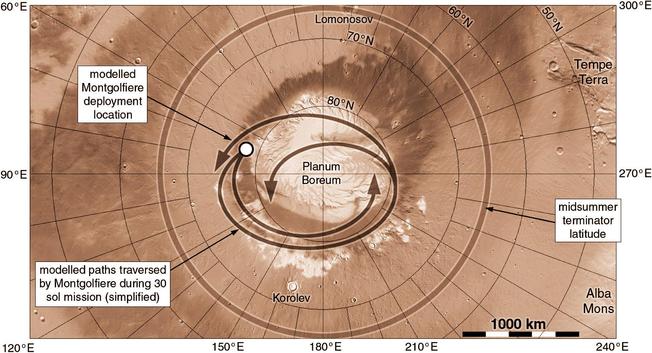
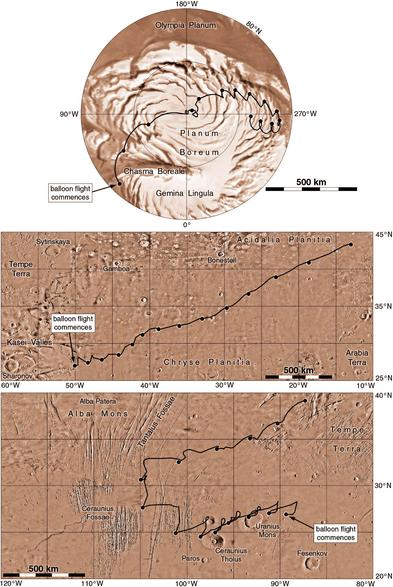
One plan had a single spacecraft deploying 4 balloons each with 5 weather stations and one seismic station. Global climate models suggested wind patterns and these maps show how 3 balloon missions might travel. Every black dot is a touchdown point, and at some of them the landers are released. No balloon has yet flown anywhere off Earth except Venus but there have been plenty of studies for Mars balloons. And we did have a cute helicopter.
How do the network landers get to the surface? They could be released by a carrier spacecraft during approach to Mars, or dropped off from orbit. But at the 8th MSWG meeting in February 1993, Jacques Blamont of French space agency CNES suggested dropping landers from a balloon. The balloon is blown by the wind, and either drops landers as needed or touches down periodically and releases its lander on the surface. Some designs land every night and fly in the day.