 Pop Culture Library Review
Barcodes, library slips, bookworms, and book deliveries in “Whisper of the Heart”
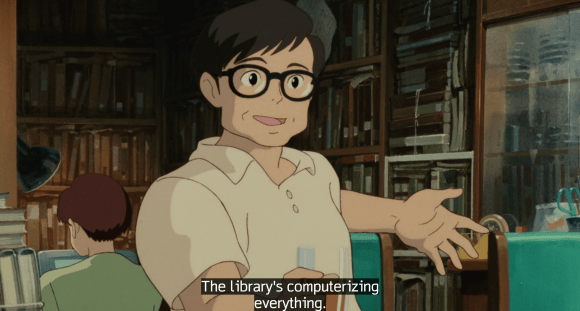
Shizuku’s father is a librarian in this film. He later says that he would like the card catalogs to stay too, like her.When I watched Whisper of the Heart, a romantic drama anime film which came out over 29 years ago (on July 15, 1995), on Max, I never expected that libraries, and librarians would be such a central part of the film! I was aware that the film was listed on Jennifer Snoek-Brown’s list of “Foreign-Language Films” on Reel Librarians. The latter list notes films reportedly with librarians and/or archivists alphabetically by title”. She warns that she can’t confirm that “every film on this list actually includes a librarian and/or archivist” as her primary focus is on examining English-language films. While that is a laudable goal, I don’t limit myself in that way, personally, and happily cover anime on this blog time and again. In fact, I have written about over 70 anime series, four films, and various manga, with my first post in August 2020. [1] This review will focus on the role of libraries, and librarians like the protagonist’s father, in the story, while relating it to other fictional examples and real-life library concepts.
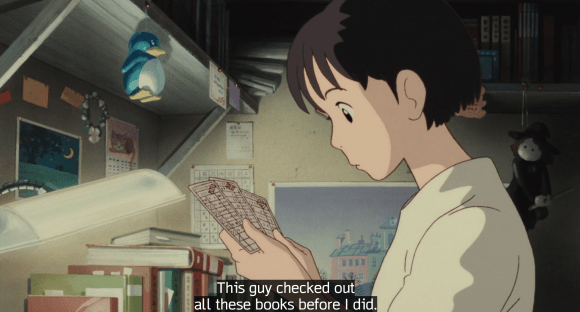
One of the first conversations in the film is between the 14-year-old protagonist Shizuku Tsukishima, living in the Tokyo suburb of Tama New Town, who learns the local library is going to the bar code system, and her father. She tells him that she likes the library slips instead. He actually agrees with her, but decides to go with the library’s change anyhow. Thanks to the library slip, she learns that one man’s name is in common on all the books she has checked out: Seiji Amasawa. This piques her interest. This major plot point is mentioned in many summaries and reviews of the film, noting that Seiji is on every single one of these checkout slips and how she is slowly drawn to him as the film goes forward, with their feelings growing. Shizuku is also drawn toward these books because she loves fantasy books, and meets Seiji at an old antique shop somewhere in town. Other reviewers have noted that the checkout cards are an interesting narrative device, which “lends itself well to romantic daydreaming.” It is worth noting that Shizuku is spending his summer vacation, last one she has at Mukaihara Junior High School, translating and reading “popular foreign music into Japanese” like John Denver’s Country Road. [2]
At one point, Shizuku checks a book out of the library, which was never checked out before, and even though she somewhat ends up disturbing the job of the librarian (or the teacher standing in as a librarian), she comes across Seiji. Then, not longer after, he is curiously reading the book she checked out and she takes it from him, surprised to see him. And he even knows her name from the book. So much for reader’s privacy! Although some may see a sense of relief and kinship at seeing these library check-out cards, looking at these cards would run afoul of existing ethics, as outlined by the ALA. Those ethics state that libraries will “protect each library user’s right to privacy and confidentiality with respect to information sought or received and resources consulted, borrowed, acquired or transmitted.”
Such cards are sometimes known as borrowing cards. They had/have an equivalent inside the library: a circulation card. Such cards may include the name of who borrowed the book and name of the book. There are also slips/cards which remain in a book only listing the date a book is due to be returned, known as date due slips. I’m not sure why I haven’t gone into this much detail on this before, but better late than never. In the case of this film, it would be a borrowing card, rather than a date due slip, which was stuck in the back of book, and then the book would be shelved, a way to record who borrowed a book before computer systems supplanted this system. Paper can still be used in today’s libraries, even to write down call numbers for books. The latter has also been shown in the films Dangerous Minds and Regarding Henry.
I am reminded of a scene in All the President’s Men, in which Bob Woodward and Carl Bernstein go to the Library of Congress, and a Black male librarian gives them the slips for who checked out certain books, as opposed to an interaction with a White female librarian. I described this all in a post on this very blog in February of last year:
…In the classic 1976 political thriller, All the President’s Men, Bob Woodward and Carl Bernstein travel to the Library of Congress after their research seems to be stalled and having a librarian have a strange conversation with one them. They go to one librarian, who declares that the records they want are confidential, and that he can’t fulfill their request of library card checkout slips since July 1971. The other, the image of which is shown above, fulfills their request. Voiced by Jaye Stewart, he tells them “I’m not sure you want ’em, but I’ve got ’em.” Woodward and Bernstein proceed to go through perhaps thousands of check-out slips in the Reading Room of the Library of Congress. Unfortunately, the work is for naught, as it doesn’t confirm if a White House staffer checked out books on Ted Kennedy…Snoek-Brown…[said] hat it is not ethical to “give out checkout slips or records without a court order” as librarians have an “obligation to protect the privacy rights of our patrons.” I agree with Snoek-Brown entirely on that point
Coming back to the film, I would think that such borrowing cards would weaken the commitment of the library to reader confidentiality. As it presently stands, almost every U.S. state has laws “protecting the confidentiality of library records”. The Japan Library Association in a statement published in 1980, states that librarians should respect the privacy of each library user, and should not “divulge his/her name or details of books or other library materials used to third parties”. A more recent statement notes library privacy and confidentiality, among other virtues, as important. This film came out before the economic downturn in Japan, in 1997, which unfortunately lead to privatization of libraries through “outsourcing of staff to reduce costs and provide a flexible workforce”, with privacy of user information is at stake because private management companies are “not obligated to protect users’ privacy and routinely gather their data”. [3]
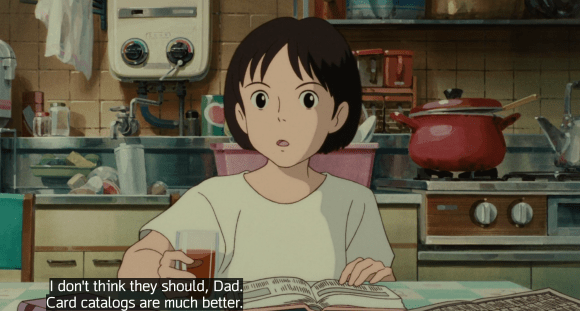
Shizuku says card catalogs are better than digital recordsMoving on from that, and back to the film, Shizuku soon follows a cat to an antique shop and is drawn to a cat statue named Baron Humbert von Gikkingen, with the shop’s owner, Nishi, telling her about him. She barely makes it to the library in time, is annoyed by Seiji, and is embarrassed in the process, as he delivers “her” lunch for her, with the fat cat (she had followed to the shop) riding on the back of the bike. The lunch is actually for her dad, who works in the library! This library is a fictional place created for the film itself, as no such library exists at that location (Irohazaka Sakura Park). [4]
This fantastical nature of the library is not unique. However, this library is more akin to something that exists in reality, rather than in a magical realm by itself. This makes the series unique. Surely, there are public libraries akin to those in real-life in Josee the Tiger and the Fish or I Want to Eat Your Pancreas, to give two examples, apart from the many within school buildings that I’ve often written about. This library is clearly a place of knowledge, but it is not a place or refuge. Rather, it is a place of learning and development.
As the movie goes on, Shizuku learns who donated a book at the library: the father of Seiji. She is later called a “bookworm”, which she accepts happily. After all, she often goes to the library, a fantasy reportedly depicted in The Cat Returns, a 2002 film. She takes out books in the public library, so she can learn more for her story. At one point, she remains one of the last people there, writing away, and Seiji visits her in the library, while she writes her story. As a writer, she becomes more than a bookworm, and Seiji is more than a novice violin maker. Both characters are not exceptional, but have proven that they have what it takes to ensure their work can become “exceptional”, with their romance blossoming by the film’s end, even without a kiss. [5]
There is much more to this film than what I’ve noted so far and ending the article here would be selling it short, to say the least. For Shizuku to be called a bookworm as an insult, and turning it into a positive, is not limited to this film. There is an entire series entitled Ascendance of a Bookworm, which focuses on Myne and her quest to provide free books to the populace, building her previous life as a college librarian. In his quest, she even becomes a church librarian with some magical powers. The series has even been cited as an example of when an outsider from another world “usher systematic change in their adopted one.” The term was even alluded to in the series Bibliophile Princess, as a bibliophile, someone who frequently reads or collects books, and loves books, is also known as a bookworm. Bibliophile appears more “positive.”
Otherwise, there was a British comic from 1978-1985 entitled Bookworm about a young boy who always has a book and his parents tell him to do more “boyish” things, but it results in disaster. There’s also an 1850 painting entitled The Bookworm by Carl Spitzweg. A variation of this piece was even named The Librarian! Pu Songling published a romantic short story, in about 1740, entitled The Bookworm, while there are characters known as bookworms in Tiny Toon Adventures and most infamously in the campy 1960s Batman series. There are many other bookworms in fiction, like in Wonder Man (1945), Navy Blues (1937), and even Wong in the Marvel Cinematic Universe, to an extent.
There is also the Association internationale de bibliophilie, which is called International Association of Bibliophiles or AIB in English. It is dedicated to bibliophiles. Russia has its National Union of Bibliophiles (formed in 2010), while there are is a book club in Detroit, a former group for female bibliophiles (Hroswitha Club), and the Oxford University Society of Bibliophiles. There is even a 15-minute film, which I haven’t seen, entitled The Fantastic Flying Books of Mr. Morris Lessmore, about a man who is writing his memoir, but is blown off a balcony, writing out of a library,and even becomes a librarian with the city suffering from impact of a storm. There’s also books such as The Great Book-Collectors about book-collecting practices of the British Library, Bodleian Library, and Ashmolean Museum, along with a physical archive named Library of the Printed Web dedicated to “web-to-print artists’ books, zines and other printout matter.”
All of this is related to the concept of tsundoku, which means acquiring reading materials but letting them pile up in your home without actually reading them. It can refer to books ready for reading later, as well, when those books are on a bookshelf. It is related to what A. Edward Newton wrote about in 1921, and stands in opposition to the term antilibrary. The latter, coined by Lebanese-American author Nassim Nicholas Taleb means a “collection of unread books”, which make people curious and humble. [6] He further stated that the older someone gets, the more they know, the larger is their “accumulation of unread books” and those who focus on such unread books are antischolars, i.e. those who do not “care about how much you know, but how much you don’t know” and how to find information you need.
When it comes to libraries, I would think people would side more with idea of antilibrary than the idea of tsundoku, as the latter seems to imply that having unread books is “bad.” Having books you haven’t read should not be seen as a negative. It is inevitable there will be books you haven’t read in your lifetime, no matter what. And libraries hold the books so they can be read by others, and shared, to spread knowledge, and understanding. This doesn’t mean that every book is right, immutable, or correct. Rather, the books can help you understand more about the world, at their best, and at their worst, promote misinformation. The latter can be prevented with careful weeding to ensure that patrons have the best information available.
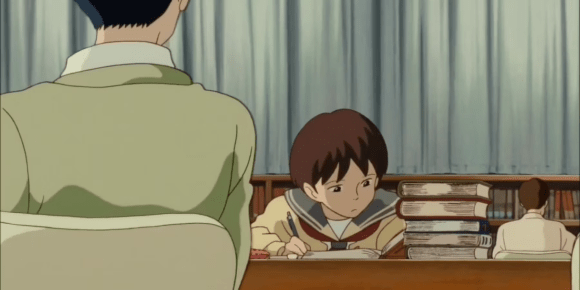
Shizuku is studying in the library with a stack of books sitting on the table next to her. The man she likes is across the table from her, I believe.As I’ve noted on this blog various times, libraries serve many important functions in society. One of those is providing a place to study. This is shown clearly, as indicated in the above screenshot. You don’t have to be a bibliophile/bookworm for that. In fact, not all bookworms are librarians, and not all librarians are bookworms. Some are, but due to the many tasks during the work-day, often librarians don’t have time to read a book on the job, as some people might think.
When it comes to Japan, I’ve noted this before on here, but there are over 3,000 public libraries in this island nation, and remain an important part of the country’s society. In fact, there is even an entire Wikipedia page listing them, entitled “List of libraries in Japan” (not to be confused with the page “List of archives in Japan“). Some probably still have card catalogs. These libraries, known as toshokan in Japanese, are centered by the National Diet Library. The only series, I know, to date to directly feature this library is 26-episode early 2000s R.O.D. the TV anime series, which features characters from the Read or Die light novels, manga, and OVA, and the Read or Dream manga.
Academics have noted that information commons/learning commons which provide various materials, facilities, and services, in one place, originally appearing in North America, has also appeared in Japanese universities and college. Such spaces are reportedly in an ” the early stage of development”, and there is a need for such spaces to rebuild their own services because of student needs. Furthermore, many libraries in pre-modern Japan were arguably private and have been called bunko, meaning “storehouses of books.” Currently, most have been subsumed into larger national, prefectural, university, or research library institutions. Some have even covered this in books such as Youth-Serving Libraries in Japan, Russia, and the United States.
It is also said that Japanese academic libraries are well-resourced and support the country’s research capacity, while reflecting the country’s “strong bureaucratic culture.” I’m not sure if this is also the case for the country’s public libraries as well, to be perfectly honest. I can say, with certainty, that libraries are an important part of the country, especially considering that the Imperial Library (forerunner to the National Diet Library) was established in the latter 19th century, and in 1947, the National Library Act created Japan’s sole national library (National Diet Library). This was followed by the landmark 1950 Library Act. The law states, in part, that the country’s libraries are aimed to promoting “sound development…[and] the enhancement of the education and culture of the nation”. It goes onto say:
…libraries shall endeavor to accomplish…[collection of] nooks, archives, audio-visual materials and other necessary data and materials…with suitable attention paid to the acquisition of local materials, art works, materials on local administration, gramophone records and films…library materials shall be properly classified and processed…efforts shall be made to ensure that library personnel acquire sufficient knowledge of library matters…close communication and cooperation shall be maintained by…inter-library loans between libraries…reading circles, seminars, appreciation groups, film showings and exhibits of data…shall be sponsored and encouraged…close contact and cooperation shall be maintained with schools, museums, community centers and research institutes, etc….professional personnel of libraries shall be called librarians and assistant librarians.
And that’s only part of Chapter 1! There is no comparison to this in U.S. law. The legislation, which passed the U.S. Congress in April 1800 (see page 56), only mentioned that the purchase of books “as may be necessary for the use of Congress at the said city of Washington, and for fitting up a suitable apartment for containing them and for placing them therein, the sum of five thousand dollars shall be…appropriated.” That same law went onto say that a library catalogue shall be furnished by a joint congressional committee, with books “placed in one suitable apartment in the capitol in the said city, for the use of both…houses of Congress and the members thereof”. That is it. It wasn’t until 1802 that a law defined the functions and role of this library, the Library of Congress (LOC), and even made the appointment of the Librarian of Congress a “presidential responsibility”! Still, this was nothing like the Library Law in Japan, which was much more extensive.
Such a law in the U.S, would be unthinkable, even at this current time, despite the fact it could have extreme value in ensuring the institution’s mission and objectives. On the other hand, LOC has broadly defined that on its own, and has a bit of autonomy, as it is only the de facto national library. This makes it different from the many across the world, coupled with any state-established libraries serving as preeminent information repositories for specific regions.
When I watched Whisper of the Heart on Max, with my mom and dad, I never expected libraries to be as big of a part of the film from the get-go. I am truly grateful that I came across this film, and would surely watch it again if I get a chance. That;s all for this post. Until next week! As always, comments are welcome.
Shizuku looks at library slips and finding out some man checked the SAME book out before her© 2023-2024 Burkely Hermann. All rights reserved.
Notes
[1] Since then, I’ve written about (I don’t recommend you watch all of these, though, and some of the following I would not watch again) over 80 anime series: Revolutionary Girl Utena, Wandering Son, Ice, Kuttsukiboshi, Paradise Kiss, Macross Frontier, Classroom of the Elite, Gargantia, Kandagawa Jet Girls, El-Hazard, Sorcerous Stabber Orphen, Ascendance of a Bookworm, R.O.D. the TV, B Gata H Kei, Bloom Into You, Little Witch Academia, Yamibou, Whispered Words, Aoi Hana / Sweet Blue Flowers, Strawberry Panic!, My Next Life as a Villainess: All Routes Lead to Doom!, Manaria Friends, Kampfer, Lapis Re:Lights, Yamada-kun and the Seven Witches, Blue Drop, The Mystic Archives of Dantalian, Cardcaptor Sakura, Venus vs. Virus, Otherside Picnic, My-Hime, Simoun, Riddle Story of Devil, Ms. Vampire who lives in my neighborhood, Dear Brother, Library War, Girl Friend Beta, Kokoro Library, Attack on Titan, Let’s Make a Mug Too, Tatakau Shisho: The Book of Bantorra, Bernard-jou Iwaku a.k.a. Miss Bernard said, Komi Can’t Communicate, The Ancient Magus Bride: Those Awaiting a Star, Gosick, Laid-Back Camp, As Miss Beelzebub Likes, Bibliophile Princess, Love Live! Sunshine!!, Shikimori’s Not Just a Cutie, My Roommate is a Cat, Rascal Does Not Dream of Bunny Girl Senpai, Kin-iro Mosaic, Akebi’s Sailor Uniform, Makura no Danshi, Azumanga Daioh, Oresuki, Seitokai Yakuindomo, Gabriel DropOut, Spy x Family, A Couple of Cuckoos, Märchen Mädchen, Healer Girl, Smile of the Arsnotoria the Animation, Smile Pretty Cure!/Glitter Force, A Good Librarian Like a Good Shepard, A Place Further Than The Universe, Teasing Master Takagi-san, Myself ; Yourself, Kaguya-Sama: Love Is War, Stars Align, Tokyo Mew Mew New, Skip and Loafer, Kubo Won’t Let Me Be Invisible, Violet Evergarden, Somali and the Forest Spirit, Aharen-San wa Hakarenai, Cardcaptor Sakura: Clear Card, Chitose Got You, Clannad, Cue!, Encouragement to Climb: Next Summit, Don’t Toy with Me, Miss Nagatoro, Gabriel Drop Out, Kin-iro Mosaic, K-On!, Noir, Otherside Picnic, The Rising of the Shield Hero, and Re:Zero, and four films: I Want To Eat Your Pancreas, Calamity of a Zombie Girl, Your Name, and Josee, the Tiger and the Fish. Later posts this year will focus on series such as Ouran High School Host Club, Is the Order a Rabbit?, Kiss Him, Not Me, The Demon Girl Next Door, The Executioner and Her Way of Life, YuruYuri, Library War, Maria Watches Over Us, Magical Girl Spec-Ops Asuka, and Nogizaka Haruka no Himitsu (Haruka Nogizaka’s Secret), to name a few.
[2] “Whisper of the Heart,” IFC Center, accessed Jun. 6, 2023; Russo, Lee. “How Whisper of the Heart Explores the Fear of Failure,” CBR, Jun. 13, 2020; Graeme. “The Best Films I’ve Ever Seen: Whisper of the Heart,” Film School Rejects, Jun. 15, 2018; “Whisper of the Heart,” Studio Ghibli, accessed Jun. 6, 2023; Faith. “Whisper of the Heart,” Studio Ghibli Movies, Nov. 28, 2014; Toole, Michael. “Whisper of the Heart Blu-Ray + DVD Review,” Anime News Network, Nov. 29, 2014; Osmond, Andrew. “Whisper of the Heart Review,” Anime News Network, Jan. 11, 2012; Mindus, Jay. “Why Studio Ghibli’s Whisper of the Heart Is the Perfect Movie for Young Artists,” CBR, May 12, 2022; “Whisper of the Heart (Mimi wo sumaseba),” Harvard Film Archive, accessed Jun. 6, 2023; Cyrenne, Randall. “Whisper Of The Heart,” Animated Views, Mar. 7, 2006.
[3] Alix, Francis A. “The History and Current Challenges of Libraries in Japan,” SLIS Connectings 10(1): 10.
[4] Graeme, “The Best Films I’ve Ever Seen: Whisper of the Heart,” 2018; Toole, “Whisper of the Heart Blu-Ray + DVD Review,” 2014; Osmond, “Whisper of the Heart Review,” 2012; “Tracing Shizuku’s Steps: Visit ‘Whisper of the Heart’ Locations in Real Life,” tsunagu Japan, accessed Jun. 7, 2023; “Visiting ‘Whisper of the Heart’ Movie Location,” justa-fangirl, 2014.
[5] “Whisper of the Heart,” Ghibli Wiki, accessed Jun. 7, 2023; Cyrenne, “Whisper Of The Heart,” 2006; “Whisper of the Heart (Mimi wo sumaseba,” Harvard Film Archive; Mindus, “Why Studio Ghibli’s Whisper of the Heart Is the Perfect Movie for Young Artists,” 2022; Pineda, Rafael Antonio. “Live-Action Whisper of the Heart Sequel Film Delayed Due to COVID-19,” Anime News Network, Apr. 20, 2020. The live-action sequel, also named Whisper of the Heart came out in October 2022 in Japan, but it was received badly if the reviews from Japan Times and Crunchyroll listed on the “Whisper of the Heart (2022 film)” Wikipedia page are any indication. Apparently, there is even a library scene in the film. I haven’t watched the film, so I can’t confirm that completely, however.
[6] Brooks, Katherine. “There’s A Japanese Word For People Who Buy More Books Than They Can Actually Read,” HuffPost, Apr. 19, 2017; Tobar, Hector, “Are you a book hoarder? There’s a word for that,” Los Angeles Times, Jul. 24, 2014; “Tsundoku: The art of buying books and never reading them,” BBC News, Jul. 29, 2018; Crow, Jonathan. “‘Tsundoku,’ the Japanese Word for the New Books That Pile Up on Our Shelves, Should Enter the English Language,” Open Culture, Jul. 24, 2014; “A QUOTE ON BIBLIOMANIA,” Language Hat, Feb. 7, 2008; Popova, Maria. “Umberto Eco’s Antilibrary: Why Unread Books Are More Valuable to Our Lives than Read Ones,” The Marginalian, Mar. 24, 2015; Stillman, Jessica. “Why You Should Surround Yourself With More Books Than You’ll Ever Have Time to Read,” Inc., Dec. 5, 2017; McDonough, Lauren Smith. “Everyone Is Obsessed With the Trend of Antilibraries Right Now,” House Beautiful, Dec. 19, 2017; Boyd, Rebecca Lowry. “The book trend everyone is talking about right now,” Better Homes & Gardens, accessed Jun. 27, 2023.
#AllThePresidentSMen #AnimeNewsNetwork #antilibrary #AscendanceOfABookworm #barcodes #BibliophilePrincess #bibliophilia #BlackLibrarians #BlackWomen #BluRays #books #booksAreNotSacred #ethics #femaleLibrarians #IWantToEatYourPancreas #JapaneseLibrarians #JapaneseMen #JapanesePatrons #JoseeTheTigerAndTheFish #KOn #libraryCards #librarySlips #magic #NationalDietLibrary #NavyBluesFilm #RODTheTV #ReadOrDieLightNovels #ReadOrDieManga #ReadOrDieOVA #ReadOrDream #readerConfidentiality #ReelLibrarians #SeitokaiYakuindomo #Simoun #students #studying #teachers #TheCatReturns #tsundoku #WhisperOfTheHeart #WhiteLibrarians #WhiteWomen