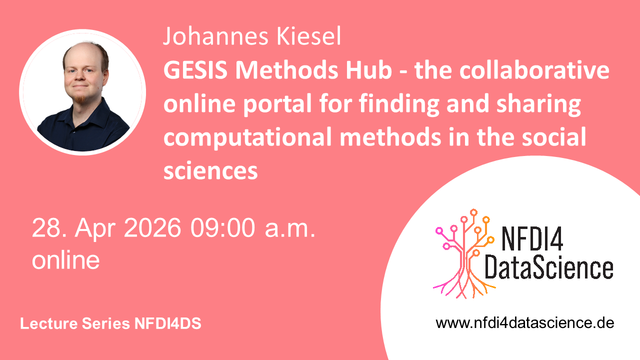
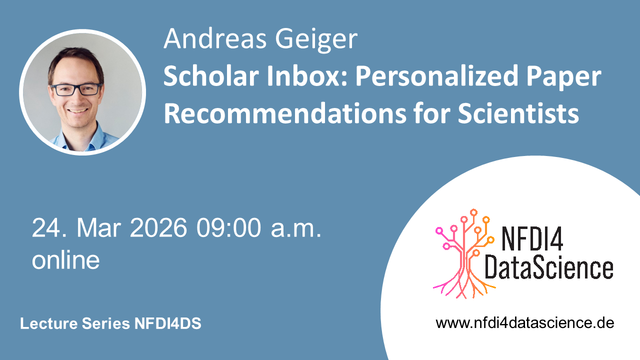
Our NFDI4DS Lecture Series continues with Lecture 14 on 24. March 2026 9:00 online.

Andreas Geiger will present Scholar Inbox, a new open-access platform designed to address the challenges researchers face in staying current with the rapidly expanding volume of scientific literature

Registration: https://events.hifis.net/event/3497/

#NFDI4DS #NFDIrocks #LectureSeries #sholarlyPapers #AIAssistant #Science

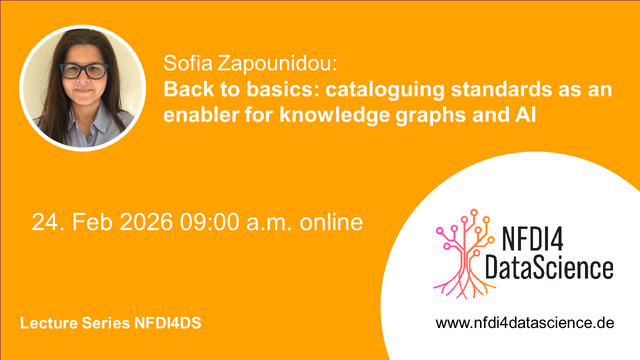
Our NFDI4DS Lecture Series continues with Lecture 13 on 24. February 2026 9:00 online.

Title: Back to basics: cataloguing standards as an enabler for knowledge graphs and AI

Speaker: Sofia Zapounidou

Registration via https://events.hifis.net/event/3628/

#NFDI4DS #NFDIrocks #LectureSeries #KnowledgeGraphs #AI #Cataloguing #DataManagement

Our NFDI4DS Lecture Series continues with Lecture 12 on 27. January 2026 9:00 online.

Title: Supporting Research Data Management with generative AI - a modern FAIRytale?

Speaker: Sandra Geisler

Registration via https://events.hifis.net/event/3498/.

#NFDI4DS #NFDIrocks #LectureSeries #ResearchDataManagement #RDM
#GenAI

On 12 January 2026, from 5:45 p.m. to 7:15 p.m. in lecture hall XIII 🕕, Dr Katrin Assenmacher from the European Central Bank 💶 will discuss whether digital central bank money represents a revolution 🚀 or evolution 🔄 in the monetary system.

👉 uni.koeln/EZYKJ

#WiSo #iwp #lectureseries

This year, Simon Prince, Professor of Computer Science at UCL, published a series of tutorials on ordinary differential equations (ODEs) and stochastic differential equations (SDEs) in machine learning for RBC Borealis. These are intended for readers with no background in these areas and require only basic calculus.

Article 1 describes what ODEs and SDEs are and their applications in machine learning.

https://rbcborealis.com/research-blogs/odes-and-sdes-for-machine-learning

Article 2 describes ODEs, vector ODEs and PDEs and defines associated terminology. They develop several categories of ODE and discuss how their solutions are related to one another. They discuss the necessary conditions for an ODE to have a solution.

https://rbcborealis.com/research-blogs/introduction-ordinary-differential-equations

Article 3 describes methods for solving first-order ODEs in closed form. They categorise ODEs into distinct families and develop a method to solve each family.

https://rbcborealis.com/research-blogs/closed-form-solutions-for-odes

For many ODEs, there is no known closed-form solution.

Article 4 considers numerical methods, which can be used to approximate the solution of any ODE regardless of its tractability.

https://rbcborealis.com/research-blogs/numerical-methods-for-odes

This concludes their treatment of ODEs. In the coming weeks, we will focus on SDEs. They will describe stochastic processes and SDEs, and show how to solve SDEs using either direct stochastic integration or Ito's lemma. They will introduce the Fokker-Planck equation, which transforms a stochastic differential equation into the PDE governing the evolving probability density of the solution. They also consider Andersen's theorem, which allows us to reverse the direction of SDEs.

#ODEs #PDEs #SDEs #ODE #PDE #SDE #Calculus #ML #DL #VectorCalculus #LectureSeries #Tutorials

Regularly spending time in the #metaverse still feels like science fiction to many — perhaps partly due to limited access to #VR equipment or because the technology's usefulness for everyday tasks is not yet evident to everyone. Meanwhile, regular users spend more and more time in virtual spaces, sometimes even disconnecting from the physical world.

The question how these two groups can be brought closer together will be discussed by Hugo do Nascimento from Federal University of Goiás in our upcoming #sfbtrr161 lecture. One of his research projects aims at creating bridges between virtual and physical spaces and investigates how an interaction between the two could be designed.

📆 Monday, December 15, 4 to 6 p.m.
📍 University of Konstanz, Room ZT 702 & online

For more information about the lecture and our other upcoming events, visit 🔗 www.sfbtrr161.de/events_sfbtrr161/ 🔗 (link in bio)

#sfbtrr161 #visualcomputing #visualisierung #wissenschaft #forschung #university #researchtalk #lectureseries #hci #interaction #virtualreality

🔥 start of our new lecture series on synthetic methods

This first session of the research forum series on Synthetic Methods explores the intersection of technological infrastructure and cognitive reasoning in contemporary Artificial Intelligence.

🔗 https://u-si.de/RyQlv

#sfb1187 #SyntheticMethods #GenerativeAI #MixedMethods #LectureSeries

we invite you to our upcoming talk in our lecture series NFDI4DS with NFDI Section Infra WG DS&AI.

Title: Knowledge and Data Management with LLMs

Speaker: Dr. Hans Zhou

Date and Time: Tue 28. October 2025 9:00 online

Please register: https://events.hifis.net/event/3121/

#NFDI4DS
#NFDIrocks
#LLM
#RDM
#KnowledgeManagement
#DataManagement
#LectureSeries

📝💤 "Behold, the 'brief' intro to optimal transport where intuition triumphs over 'maths' because who needs rigor? 🙄 It's basically a #YouTube rabbit hole disguised as a blog, because nothing says 'understandable' like suggesting you watch a four-year-old lecture series. 📚📺"
https://alexhwilliams.info/itsneuronalblog/2020/10/09/optimal-transport/ #optimaltransport #rabbitHole #blogpost #mathintuition #lectureSeries #HackerNews #ngated
A Short Introduction to Optimal Transport and Wasserstein Distance · Its Neuronal

Come and join our 9th NFDI4DS Lecture in cooperation with the NFDI Section Infra Working Group Data Science & AI.

On 22. July 2025 9:00 online
Jacobo Miranda talks on "How to get Fine-tuned (specialized) LLMs for your academic need with de.KCD".

* fine-tuning LLMs
* storing models and datasets
* using cloud computing

Registration: https://events.hifis.net/event/2617

#NFDIrocks #NFDI4DS #AI #LLM #fine-tuning #de.KCD #LectureSeries #training