 Sentence first
86 that slang etymology
Sometimes the universe hints strongly at what I should write about. Recently I read two books in close succession that featured the same curious slang word, used in different ways and worth a quick study. For one thing, it’s not just a word but a number: 86.
First there was Merritt Tierce’s fierce first novel, Love Me Back, whose narrator, a restaurant worker, says:
Later that day I am in the wine cellar updating the eighty-sixed list when the Bishop’s handler comes by.
Then I read Alison Bechdel’s brilliant comic memoir Fun Home, which shows another usage of 86 and a speculative origin story – but is it true? (Click images to embiggen.)
The etymology of 86 is uncertain, but it probably emerged as waiters’ and bartenders’ slang in the 1920s–1930s. Some authorities suggest that it’s rhyming slang for nix, a word of Germanic origin, but that doesn’t explain why it’s not, say, 36 or 96.
Still, this is the general route offered, with varying degrees of certainty, by GDoS, AHD, M-W, ODO, and the OED. Michael Quinion mentions a few other routes. The dictionary depicted in Bechdel’s comic, incidentally, is the 1951 first edition of Webster’s New World Dictionary, I think.
The OED’s first recorded use of slang eighty-six, in 1936, is as ‘an expression indicating that the supply of an item is exhausted, or that a customer is not to be served’. The first of these definitions is the one that applies to Tierce’s line above (‘in the wine cellar updating the eighty-sixed list’).
The verb came later, in the sense ‘eject or debar (a person) from premises’, then in broader senses, such as the media advisor quoted in the New Yorker telling Robert Redford to ‘eighty-six the sideburns’. Again that’s per the OED, which dates the verb from 1959.
Green’s Dictionary of Slang takes it back further: the original usage to 1933, in Walter Winchell’s On Broadway column: ‘A Hollywood soda-jerker forwards this glossary of soda-fountain lingo out there … “Eighty-six” means all out of it.’ And the verb to 1948, in the Washington Post: ‘The Alcoholic Beverage Control Board eighty-sixed two Ninth st. grog centers yesterday – cut off their taps.’
Though I don’t hear it in Ireland, 86 proved an appealing bit of slang, producing other usages in subsequent decades: an exclamation meaning Get out! or Go away! (1964); and No! (1981); a verb meaning kill, murder, or execute (1978); and be finished or ready to leave (1999).
Now I can eighty-six this from my to-blog file.
Updates:
Ben Zimmer discussed food-industry code on Lexicon Valley a few years ago and more recently at the Atlantic. He shares possible origins of 86 (including the Chumley’s-bar story) and other examples of food-industry code (81: a glass of water). His conclusion:
All of the speculation masks the likeliest origin, that it is simply a vestige of the arbitrary codes shouted out by soda clerks. And eighty-six has persisted thanks to the service industry’s continuing need to share signals—whether it has to do with removing menu items or removing customers.
#86 #AlisonBechdel #books #comicBooks #comics #dictionaries #eightSix #etymology #languageChange #languageHistory #lexicography #MerrittTierce #reading #rhymingSlang #slang #words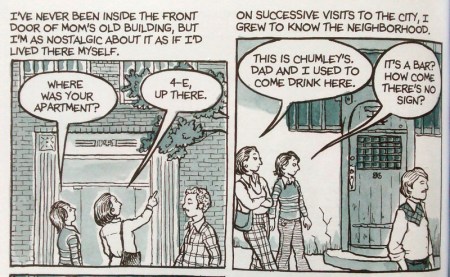
 Assoc for Scottish Literature
 Hacker News


 VIKINGS vs SAMURAI

 Daily Happy Reasons