 This Is My Glasgow
The Rocket Man at Lambhill Stables in the north of Glasgow. It was creates from scrap metal by Steve Keniry and Billy Lafferty. It's made from 7 gas bottles, 6 beer barrels, 1 compressor tank and several kilos of stainless and mila steel.
With the introduction of Scotland's first intercity train line between these two cities in 1842, the passenger-carrying Swifts faced stiff competition and soon fell out of favour.
#glasgow #glasgowhistory #lambhillstables #forthandclydecanal
The early 19th Century Lambhill Stables on Forth and Clyde Canal in Glasgow. This was part of a fast passenger boat system of the canal known as Swifts. The horses used to tow these boats would have been changed here, and at other regularly spaced stables along the canal, to allow the passengers to get between Edinburgh and Glasgow as quickly as possible.
Cont./
#glasgow #glasgowhistory #lambhillstables #forthandclydecanal
Looking out over the northern edge of the Roman Empire from the Lambhill Stables in Glasgow, or at least what was its northern edge between AD 142, when the Antonine Wall was constructed, and AD 162, when it was abandoned as the Romans pulled back to Hadrian's Wall.
#glasgow #antoninewall #lambhillstables #possilmarsh #romanbritain #sculpture #publicart #glasgowhistory

The memorial to the Cadder Pit Disaster at Lambhill Stables in the north of Glasgow. On the 3rd of August 1913, a fire broke out at Cadder No. 15 Pit, killing 22 of the 26 men who were underground at the time.
#glasgow #glasgowhistory #mining #lambhill #cadder #memorial #lambhillstables
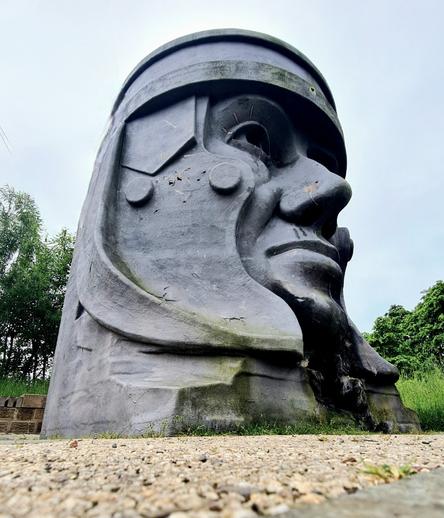
Aurelius by Malcom Robertson. Positioned on the line of the Antonine Wall behind the Lambhill Stables, this giant head looks out from the site of a former fort across what was once the northern frontier of the Roman Empire and into the barbarian terrritory beyond.
#glasgow #lambhill #sculpture #romans #antoninewall #lambhillstables