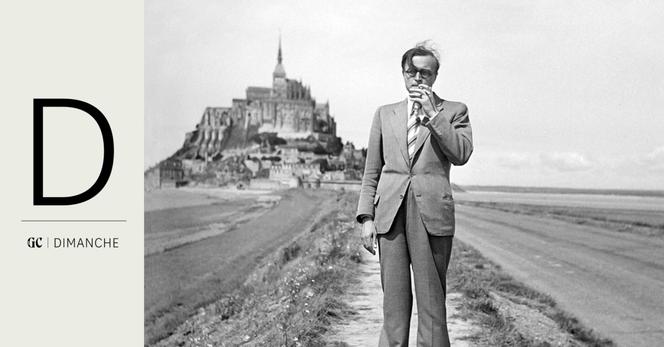
Au début du mois de mai, un essai de moi est paru dans la nouvelle edition du dimanche de Le Grand Continent. Cet essai, tiré en partie d’un livre à paraître prochainement chez Routledge, porte sur Alexandre Kojève comme penseur de l’intégration Européenne. M’appuyant sur ses écrits politico-philosophiques, pour certains publiés, pour d’autres encore inédits, je montre que Kojève a formulé une ‘philosophie de l'Europe’ qui, lue dans le contexte politique actuel, apparaît plus pertinente que jamais.

Je remercie Le Grand Continent pour l'excellente traduction de mon texte de l'anglais vers le français.

https://legrandcontinent.eu/fr/dimanches/kojeve-le-pere-fondateur-cache-de-leurope/

#Kojeve #legrandcontinent #europe #european #europeanunion #philosophy #history #histodons #politicaltheory

Kojève : le père fondateur caché de l'Europe | Le Grand Continent

Et si le processus d’intégration communautaire qui a transformé la vie d’un continent après la Seconde Guerre mondiale n’était rien d'autre qu'une note en bas de page d’un cours d’Alexandre Kojève ?

Le Grand Continent

„Pluribus“ und die Einsamkeit der letzten Menschen: Über Gemeinschaft, Überleben und die Illusion von Freiheit

Meine Lieblingsserie der letzten Woche war eindeutig „Pluribus“ auf Apple TV. Wahrscheinlich auch weil das Szenario mich an einer meiner All-Time-Favorites Serien überhaupt erinnert: „Last Man on Earth“. Beide Serien spielen damit, dass ein Virus weite Teile der Menschheit […]

https://blog.hamdorf.org/pluribus/
What Does It Mean to be Human? (According to Philosopher Alexandre Kojève)

Today, the notion and status of the human have become more and more problematic. We speak about human history as the epoch of the Anthropocene—an epoch that has led to the current global ecological…

Literary Hub

Relatedly, I just became aware of this short text by Boris #Groys on Kojève's notion of the human, which contextualises many of the arguments made by Kojève in his 1942 manuscript on #work, outlined by me in the JfCR article linked in the post above. This text is the Introduction of Groys's Kojève biography, which just came out with #Verso.

https://lithub.com/what-does-it-mean-to-be-human-according-to-philosopher-alexandre-kojeve/

#Kojève #histodons #philosophy #Hegel

What Does It Mean to be Human? (According to Philosopher Alexandre Kojève)

Today, the notion and status of the human have become more and more problematic. We speak about human history as the epoch of the Anthropocene—an epoch that has led to the current global ecological…

Literary Hub

My #article on two largely unknown manuscripts by Alexandre Kojève in the French National Archives has just been published open access in the Journal for Cultural Research. I outline the arguments of these manuscripts and draw connections between these arguments and those of other published or unpublished work by #Kojève. It is an exploratory article; an initial attempt to grasp the significance of these still virtually unknown texts. It has not necessarily been easy to summarise Kojève's intricate thought in the space of a short research article. There will undoubtedly be further commentary on these manuscripts in the future, be it by myself or by others.

The two manuscripts are The Notion of Work and Notice on the Political Neoformations of the Twentieth Century. The Notion of Work draws heavily on the Hegel lectures and is structured in just the same way as The Notion of Authority. Neoformations is a more original piece of work, though not without parallels to some of Kojève’s unpublished pre-war writings and some of the documents he authored in his later capacity as a diplomat.

One of the most idiosyncratic, and perhaps at first glance most unsettling claims of Neoformations is the claim that the self-consciously authoritarian state marks the completion of the development of the state in history. In Kojève’s politico-theoretical lexicon, however, the term ‘#authoritarianism’ refers to any and all exercise of political #authority. He does not distinguish between, say, 'authoritative' (positively connoted) and 'authoritarian' (negatively connoted). I understand Kojève as a thinker who seeks to encourage us to reflect about the ends to which political authority is directed. In this sense, he is in my mind not overly far removed from Frankfurt School affiliates such as Erich #Fromm, who drew a sharp distinction between ‘rational’ and ‘inhibiting’ authority in Escape from Freedom.

Link to the article: https://www.tandfonline.com/doi/full/10.1080/14797585.2025.2559281 #fascism #communism #histodons #Hegel

Becoming the prince’s counsellor: Alexandre Kojève’s Vichy-period manuscripts

During the short lifespan of the Vichy regime, Alexandre Kojève produced a set of philosophical policy documents at the behest of Henri Moysset. In 2020, The Notion of Work and Notice on the Politi...

Taylor & Francis
Alexandre Kojève: Bildung in a Revolutionary Cell

by Alexander Aerts

JHI Blog
Kojève & Cigarettes | Hunter Dukes

Fact-checking American <span>Geist</span>

Climatologists must create a smoother interface between physical science and social science

The Yale economist Richard Nordhaus recently won a Nobel Prize for linking climate science with economics, but other aspects of the human system are still totally undone.
We need an anthropology and sociology of climate adaptation.

We don’t really understand what the hell plants do. Plants and plankton have absorbed half of all carbon pollution, but it’s unclear if they’ll keep doing so or how all that extra carbon has changed how they might respond to warming.

Economics, sociology, botany, politics — you can begin to see a new field taking shape here, a kind of climate post-science.
Rooted in climatology’s theories and ideas, it stretches to embrace the breadth of the Earth system.

The climate is everything, after all, and in order to survive an era when human desire has altered the planet’s geology, this new field of study must encompass humanity itself — and all the rest of the Earthly mess.

Nearly a century ago, the philosopher #Alexander #Kojéve concluded it was possible for political philosophy to gain a level of absolute knowledge about the world and, second, that it had done so.

In the wake of the French Revolution, some fusion of socialism or capitalism would win the day, he concluded, meaning that much of the remaining “work to do” in society lay not in large-scale philosophizing about human nature, but in essentially #bureaucratic #questions of economic and social #governance. So he became a technocrat, and helped design the market entity that later became the European Union

https://heatmap.news/climate/this-is-the-end-of-climate-science

The End of Climate Science

A new field of study is being born.

Heatmap News

Mocking #fascism is so much fun!

I got the chance to meet with a reporter from The Daily Beast and I enjoyed the opportunity to discuss my ideas without fear of censor.

When the subject of #Hegel came up, I confessed, as #Kojève did, of having read him several times without understanding a word. Eventually, i arrived at a more “receptive-mystical” approach…I read instead like a poet, allowing his words to finger my mind’s pussy, and leaving the rest to my subconscious mind to process.