 The Kleinian Arborist
1/
The next few posts are going to explore how to arrange limit sets in time to make movies that appeal to human eyes. So far the animations on this channel have varied granularity ε or the μ parameter that defines the topology of the limit set.
This movie, and the ones following in this thread, consists simply of concatenations of double cusp limit sets, so there is no continuous movement to model.
However, to our visual systems there is a "preferred" way to sequence double-cusp groups that is appealing, and conserved across projections.
The art tax for this post is a simple example of a pleasing path: a looped animation of the Jorgensen tb=2 projection for the cusps 1/n, where n is { 63, 62, 61 ... 4, 3, 2, 3, 4, ... 63 }.
The palette and the rules for choosing line colors (by the depth of the terminal node in the tree associated with those line segments) do not change at all from frame to frame. In this case the palette size was 60.
The apparent color-cycling behavior comes about because the shapes that our minds map as "the same" from one frame to the next have a consistently increasing tree depth associated with them.
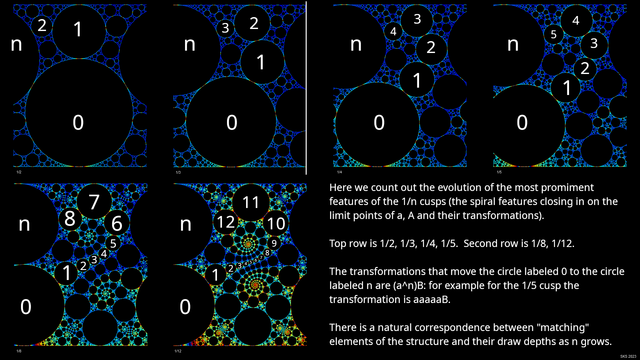
To look at this a little more closely, see the attached still image, which shows how the structure of the limit set changes as n varies. Each step along the path is the transformation of the previous circle by a group generator. For the 1/n cusp, for walking this path, we apply the loxodromic/spiral generator a (or A) n times, before applying the parabolic generator B (or b).
#kleinianlimitset #kleiniangroup #fractals #mobius #mobiustransforms #mathematicalart #mathart #mastoart #perfectloops