
6/

In general, the smoothly-connecting double cusp groups with numerator k are clustered into groups where the denominator is of the form \(kn + m, m < k \); m, k co-prime.

So, for example:

- if k=4, m ϵ {1,3}
- if k=5, m ϵ {1,2,3,4}
- if k=6, m ϵ {1,5}
- if k=7, m ϵ {1,2,3,4,5,6}
- if k=8, m ϵ {1,3,5,7}

There are always an even number of such sub-streams, and they come in pairs (where m=j, k-j) where the structure is similar, but complementary. For example, when k=7, the paired streams are {7n+1, 7n+6}, {7n+2, 7n+5}, {7n+3, 7n+4}.

Attached are several movies that show this effect when the numerator is 7.

- the first one, titled "7n-Smoosh", shows what a concatenation looks like that includes all denominators in order, with maximum denominator 150

- the other three are titled "7n+1", "7n+2", and "7n+3" with maximum denominator 250

As was the case for the case where the numerator is 3, the relative beauty of these videos is in the eye of the beholder, but the ones that are constrained to constant offsets of a multiple of the numerator are much more consistent to one another.

#kleinianlimitset #kleiniangroup #fractals #mobius #mobiustransforms #mathematicalart #mathart #mastoart #perfectloops

5/

Attached are three different traces of the Maskit projection through the double-cusp groups where the numerator is 3, with a cap on the denominator at 188.

The first attached video (whose caption begins with "Smoosh") shows the result of concatenating every available cusp, sorted by increasing value of the corresponding fraction; that is, the cusp list starts with {3/188, 3/187, 3/185, 3/184 ...}. Note that there is no double-cusp group for 3/189 or 3/186 because those fractions reduce.

Unlike the movies for numerators 1 and 2, in this case the animation looks quite choppy and, although visual appeal is a matter of taste, certainly does not minimize differences between frames.

The second and third videos show the technique to generate smooth animations. Since the frames corresponding to cusps expressed as 3/(3n + 1) share an orientation, as do the cusps 3/(3n + 2), we must render two separate movies, one for each pattern, to get a smooth animation.

#kleinianlimitset #kleiniangroup #fractals #mobius #mobiustransforms #mathematicalart #mathart #mastoart #perfectloops

4/

Attached are gifs of the Maskit, Jorgensen, and Unit Circle projections of the 2/(2n+1) cusps where 1 <= n <= 63 (yielding cusps ranging from 2/3 to 2/127.

There are't any cusps with even denominators because the numerator and denominator associated with a double cusp group must be coprime.

A few things are retained from the animations through the 1/n groups from previous posts : each projection seems to converge to a final visible shape quite quickly, and as the palette size shifts relative to the value of n, the color patterning shifts in a consistent way between all three projections.

Interestingly, in both the 1/n case and the 2/(2n+1) case, the color gradients are most distributed for half-multiples of the palette size and most concentrated at multiples of the palette size (60 in these renders). So 2/61 has similar colors to 1/30 (palette size=60), and 2/167 has similar colors to 1/63, across all projections.

Next time we'll do the same thing for the double cusp groups where the numerator is 3. You're invited to speculate about whether there will be any surprises...

#kleinianlimitset #kleiniangroup #fractals #mobius #mobiustransforms #mathematicalart #mathart #mastoart #perfectloops

2/

Attached see the same animations as in the first post in this thread, with the important exception that they are in different projections (the unit circle reference projection and the Maskit projection).

Just like the Jorgensen projection presented last time, these show the double cusp groups 1/n, where n is { 63, 62, 61 ... 4, 3, 2, 3, 4, ... 63 }.. The palette (length 60) and color assignment rules similarly are the same.

At first it seems like quite a coincidence that the colors behave the same way with respect to n (that is, showing the most variation when n is a half-multiple of the palette size, the least when n is a multiple of the palette size), but it made sense (at least to me) after some reflection.

The underlying structure and topology of these projections are the same, so the node depth needed to draw what our minds perceive as the preserved elements from frame to frame proceeds the same way.

Interestingly, this phenomenon is conserved across resolutions as well, so renders of these groups at, say, 1920x1080, show the same high-level color patterning behavior (I'll post a demo later on YouTube).

#kleinianlimitset #kleiniangroup #fractals #mobius #mobiustransforms #mathematicalart #mathart #mastoart #perfectloops

1/

The next few posts are going to explore how to arrange limit sets in time to make movies that appeal to human eyes. So far the animations on this channel have varied granularity ε or the μ parameter that defines the topology of the limit set.

This movie, and the ones following in this thread, consists simply of concatenations of double cusp limit sets, so there is no continuous movement to model.

However, to our visual systems there is a "preferred" way to sequence double-cusp groups that is appealing, and conserved across projections.

The art tax for this post is a simple example of a pleasing path: a looped animation of the Jorgensen tb=2 projection for the cusps 1/n, where n is { 63, 62, 61 ... 4, 3, 2, 3, 4, ... 63 }.

The palette and the rules for choosing line colors (by the depth of the terminal node in the tree associated with those line segments) do not change at all from frame to frame. In this case the palette size was 60.

The apparent color-cycling behavior comes about because the shapes that our minds map as "the same" from one frame to the next have a consistently increasing tree depth associated with them.

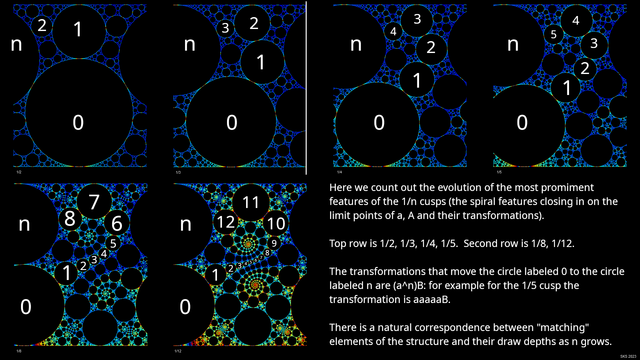
To look at this a little more closely, see the attached still image, which shows how the structure of the limit set changes as n varies. Each step along the path is the transformation of the previous circle by a group generator. For the 1/n cusp, for walking this path, we apply the loxodromic/spiral generator a (or A) n times, before applying the parabolic generator B (or b).

#kleinianlimitset #kleiniangroup #fractals #mobius #mobiustransforms #mathematicalart #mathart #mastoart #perfectloops

This is the first in a series of posts arising from the Fibonacci cusps of Kleinian double-cusp groups.

The attached static image is an illustration of the Maskit slice; if you draw a line along the topmost points in this plot, it cuts the plane into two regions: above it groups are discrete (and, among other things, are amenable to the ε-termination tool from last time), below it most groups are chaotic (plotted points being the exceptions).

Each point on the Maskit curve itself corresponds to a point on the real line between 0 and 1, inclusive; by convention we refer to those points that correspond to rational numbers "cusps"; they not only literally stand out from the curve, but also generate very appealing images made up entirely of tangent circles. But there are ofc infinitely more points that correspond to irrational numbers.

If you imagine perching on the top-right hand side spot at 2+2i, then jumping down and to the left to the next prominent cusp, then down and to the right, then left again, you'll visit:

1/1, 1/2, 2/3, 3/5, 5/8, 8/13 ...

These are the Fibonacci cusps, if you follow the path forever, it implies that you'll eventually converge on the point associated with 1/ϕ.

Art tax: Jorgensen and Maskit projections going through the first seven Fibonacci cusps and back.

[1] https://people.math.harvard.edu/~ctm/gallery/teich/maskit.gif

[2] https://en.wikipedia.org/wiki/Bers_slice

#kleinianlimitset #kleiniangroup #fractals #mobius #mobiustransforms #mathematicalart #generative #generativeart #mathart #fibonacci #fibonaccicusps #perfectloops

My new music visual inspired by the track of Apex Rise [OC][A] https://peertube.video/videos/watch/c5c8b615-7518-4df7-8ab8-d131564bef9d
Perfect head stabilisation for hunting crumbs of pain au chocolat [L] [OC] https://peertube.video/videos/watch/f2468ae0-4496-4577-8bd7-e7c52bee1573
Perfect head stabilisation for hunting crumbs of pain au chocolat [L] [OC]

PeerTube
This is so nice [A]

PeerTube