Communication problems

I have, sadly, been thinking more about WordPress’s enshittification.

Automattic’s own goal is partially just a comms problem, but it’s also (to mix sports metaphors) a forced error.

For a while, my dashboard has been offering me the option to use AI tools when drafting posts and as recently as last month there was a blog post about exciting AI courses.1 This was presented as a feature, a good thing, WordPress jumping on the latest tech bandwagon.

Yesterday’s official “More Control Over the Content You Share” post (comments are closed) takes the opposite position. An opt-out is a feature, a good thing, WordPress going above and beyond because they’re a company that cares about their customers’ privacy.

If this had been an opt-in scenario, fine.2 Better than fine! I would like an extra helping of bot-be-gone! But it’s not an opt-in, it’s an opt-out. I didn’t click the opt-out box until last night, so I assume everything on this site at that time has already been sold off.3 I’m not naive; I assume this site has already been scraped. We’ve long known that bots disrespect robots.txt and other wards. But it’s one thing for a company to say “we’ll do what we can to discourage bots from scraping your site, but we can’t guarantee other companies will behave ethically” and quite another to say “if you hear about this box and click it, we won’t specifically sell your data to a company we’re working with.”

Automattic can’t decide if !AI is the next new thing, or another security threat. This mixed messaging left them in an exceptionally poor position to inform users about upcoming changes. (It’s not at all clear to me that they wanted an informed user base. But if they did, then they went about it poorly.) And it also leaves me unclear as to their future plans. Have they made the strategic decision to kill the golden goose and try to monetize all the data now? Are they going to proceed with, essentially, two different user bases, one with modest security needs and more monetization options and the other with tighter security and lower discoverability (because that opt-out also opts out of Reader)? This was an internally divisive decision; will there be backtracking, or re-tracking? None of these thoughts fill me with confidence.

Branding problems

Since I saw news of the data selloff yesterday, I have also seen a fair number of people pointing out that WordPress.org is not the same as WordPress.com. This is quite true. WordPress is an open source product that can be downloaded and self-hosted. Automattic owns WordPress.com and Tumblr. Automattic is the immediate problem.

But it’s a little trickier than that. Since WordPress is an open source project, it has a lot of contributors, and there’s a lot of overlap with Automattic. Speculation is already swirling about which plug-ins may or may not be safe to use on self-hosted WP installs. There is also the question of whether the core product will remain safe to use. I’ve seen a number of folks on Mastodon pointing out that the dev community would fork WP if anything untoward happens…but that is less than encouraging from my perspective. It still points to a future vulnerability.4

I may end up deciding that the correct answer for me is to move to self-hosted WordPress with judicious use of plug-ins. That certainly is an option that works for folks with needs similar to mine. It’ll also mean more work on my end, and a need to continually keep up on who is contributing what to WP and various plug-ins and avoiding anything by Automattic.

I know something about open source development and something about the split between the .com/.org.5 A lot of people don’t—and that is at least partly due to an intentional branding decision. It’s going to backfire now. There was a lot of goodwill—even if much of it was passive—toward WordPress and, therefore, Automattic. I’m not sure how long that will last, despite the considerable inertia involved.

Even if you’re paying for the product, you are the product

One of the things I find most upsetting about this situation is that we (the generalized we, but also me in particular) have largely accepted “if you’re not paying for the product, you are the product” as a way to navigate the array of shiny offerings laid before us. But in this case, paying doesn’t help.

Note that I don’t think Automattic should be selling anybody’s data, whether they’re on Tumblr, a free WordPress plan, or a VIP Enterprise plan.6 But again, I think there’s more of an expectation that this might happen if you’re using a service for free (this has certainly always been my attitude about Gmail, but it was worth sucking up because of the spam filters; that attitude is changing, however. But still, it’s a trade-off I made up front, and I’d be way more upset if Proton started shenanigans with my paid account). And Tumblr especially…well, Tumblr is practically defined by a cycle of poor moderation decisions and sales to companies that don’t know what to do with it and eventually throw up their hands in despair.7

But. I assume companies that sell a service are setting prices where they want it to be. I assume my hosting fees more than cover whatever advertising Automattic would otherwise make off a free site; I similarly assume that the storage and WP maintenance (both being done at scale) are also covered. Thus I am particularly displeased that my data is also up for grabs.

Because that’s basically what I’m paying for: data management. I’m not paying a lot, but I’m paying what’s asked. I’m also not looking for a lot of security. I don’t need uptime guarantees and I’m not dealing with financial data, medical data, information requiring a security clearance, or anything like that.8 The literal bar is “please hold onto this data and do backups sometimes.” I thought “and this is my stuff I’m paying to you hold, please don’t sell it” was implied, but I guess not.

This is not me, a middle-aged, middle-class white lady, being a Karen. I don’t want to speak to the manager. I don’t need to speak to a manager. Companies are made up of adult people who make decisions, and as a fellow adult person I will make the decision to stop doing business with them.9 The only question is what non-Automattic option is least enshittified? And when will I have the spoons to make the shift?

  • I am not going to get into the definition of “AI,” which companies love misusing. ↩︎
  • Well, not really. !AI is harmful in all sorts of ways. But an opt-in would at least have removed one of the ethical issues. ↩︎
  • Did they specifically say they were selling data? Not in their post, though it’s certainly implied by the way business partnerships work, and 404 Media reported that was the plan. ↩︎
  • Yes, this is a vulnerability of all open source projects (and all products in general). But in this case, the open source project is the baby of what now must be considered known bad actors. ↩︎
  • My spouse is an open source contributor. Honestly, being on the sidelines to some community kerfuffles confirms that “open source” should never be automatically deemed trustworthy. I don’t relish having to do deeper due diligence. (The SFF community and publishing kerfuffles are enough of a distraction.) ↩︎
  • I am not sure if WordPress is attempting to sell data from enterprise customers, though if they did opt-in the Mouse by default that’d be pretty amusing. (On a smaller scale, they apparently opted-in John Scalzi, who’s no Mouse but was IIRC recruited as a customer/brand ambassador a number of years ago.) ↩︎
  • I am sorry for you, Tumblr users. But this is one of the reasons I never really invested in Tumblr, and decided last night that it was just easier to delete my account than opt out of anything. ↩︎
  • Some sites do, and I really wonder what sort of knock-on effects this decision is going to have, especially in, say, the EU. ↩︎
  • I’m paid up through most of this year, so I have plenty of time to research my options. I had flirted with the idea of posting story reprints on the site, which I now won’t do just on general principles, but this nonsense won’t otherwise impact how I use the site between now and whenever I move it. ↩︎
  • https://aphowell.com/2024/02/28/trust-issues-with-wordpress/

    #ai #automattic #enshittification #kerfuffles #wordpress

    Enshittification

    So it looks like Automattic is going to start feeding the !AI beast. This is something that I am very much not on board with. At this point, it’s not terribly clear how the data mining will b…

    A. P. Howell

    The Report

    More information continues to roll out about the 2023 Hugo Awards. Chris M. Barkley and Jason Sanford released a report (published on Genre Grapevine and File770), including internal emails, about what went on behind the scenes. I expect new revelations will continue to emerge, and I fully expect things will only become worse, more embarrassing, and more illustrative of toxic behavior.

    Based on the report by Barkley and Sanford, a subset of Hugo Admins (Western members of the committee) conducted research into nominees, based on exceptionally vague criteria supplied by Dave McCarty.1 This research—including such things as nominees’ discussion of China, Tibet, and sexual orientation, and not simply technical details such as the publication date of nominated works—perhaps explains why certain individuals were deemed ineligible for the award. And it must be noted that the research is not simply outrageous but just plain embarrassing in its incompetence, and reveals an astounding lack of genre-specific and general knowledge.2 Absent evidence of non-Western admins’ input, the research reads as a racist caricature of potential Chinese government political objections.

    But more importantly, the report also notes that a large number of ballots were simply discarded. There may have been concerns about slate voting (i.e. a lot of similar-looking ballots, typically as a result of people casting votes based on recommendation lists).3 It’s important to note that slate voting is a) allowed under the rules, b) has been allowed in the past, even when the votes have been cast in bad faith,4 and c) the Hugos use a mechanism specifically designed to cope with slate voting.5 Here, we have a case where Chinese ballots were treated with less respect than those of right wing culture warriors. And as a result, the Chinese nominees who should have made—and in some categories, dominated—the ballot were replaced with other works.

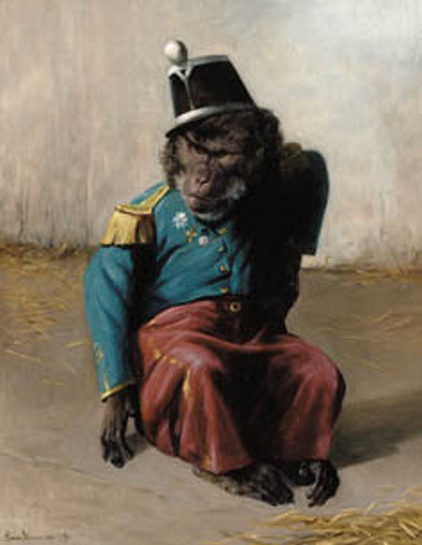
    I keep telling myself that the Hugos are neither my circus nor my monkeys, and yet I cannot make myself look away. (“Cirkusaben,” Simon Simonsen, 1890. Wikimedia Commons.)

    Bad Actors & Missing Information

    Thusfar, it looks like Dave McCarty is the worst of the bad actors: he seems to be the one blithely discarding ballots, re-assigning votes or ballot positions to non-Chinese works,6 and running his own proprietary voting software.7 And while there have been attempts at apology or understanding—was he concerned, rightly or wrongly, for the safety of Chinese committee members? Was he being bribed, or did he perceive himself to be bribed?—it’s sort of beside the point. He didn’t act like someone concerned for others’ well-being.8 He certainly didn’t act in the best interest of the award, convention, or associated organizations. The entire 2023 nomination process appears to be fraudulent (and, given McCarty’s past work as an admin, it’s certainly reasonable to wonder about the validity of prior results).

    But as much fun as folks are having villainizing and/or psychoanalyzing one person,9 let’s be clear: this was an institutional failing. One person should not have been in the position to essentially choose his own ballot and the winners of the award. And he certainly shouldn’t have been getting help from (at least part of) his committee. In short, it’s good that there have been apologies, resignations, censures, etc., but there’s no mechanism—and not necessarily any institutional will—to keep bad actors out of positions of power.

    Largely missing from the discussion I’ve seen is the perspective of Chinese fans, creators, and concom. (It’s also a major lacuna in the report from Barkley and Sanford. I hope it will be filled over time.) A lot of what I’ve read have been machine translations, with the occasional translation or comment from English-speaking Chinese fans. I don’t know Mandarin (or any other flavor of the language) and, more importantly, I don’t know the context of Chinese fandom.10 So I am aware there are all sorts of gaps in the Narrative of the 2023 Hugos, but it’s still clear that the narrative is Quite Bad, Really.

    Now What?

    I remain sad on the part of the fans who do take part in Worldcon activities—I have some friends who are very active about reading and recommending works for the Hugo, and I don’t know if their passion will survive this fiasco—and the Chinese fans who were so excited to do so for the first time. I’m sorry for the winners and nominees who are so frustrated by the tainted process. And of course I’m sorry for the people who should have been on the ballot, and perhaps won, but were denied that opportunity.

    There’s a lot of discourse about How To Fix This. I most like the suggestion Rachael K. Jones made on Bluesky: release an anthology of excluded works. That doesn’t actually fix anything, and such an anthology wouldn’t accommodate categories like novels. But I think it would be more useful to at least some of the excluded nominees than extending eligibility (messy) or creating a one-time award (largely a community in-joke, not a career-boost). An anthology would at least get more eyes on their work and some money in their pockets, and those are two of the potential benefits of being a Hugo-nominated or -winning author.

    I personally think the damage to fans should be addressed by giving every member of Chengdu a WSFS membership to a subsequent Worldcon (a free membership, needless to say).11 That doesn’t fix 2023, but it also means that the fans who wanted to vote for the Hugos may have the opportunity to see their votes counted in a future year.

    Monkeys & Circuses

    Science fiction convention fandom in general, and Worldcon in specific, is Not My Thing. But as a lifelong fan of science fiction and fantasy, and writer of same, the Hugos are most definitely adjacent to My Things.

    I never had any illusion that the Hugo Awards were awesome and definitive, just long-running and well-known. I always knew they were a pay-to-play people’s choice award powered by enthusiasm. I still think there’s value to fan awards (whether they’re associated with a specific convention or geographically-amorphous group of voters), and I kind of liked the fact that the Hugos were not like the Nebulas were not like the Locus were not like the Otherwise, etc., etc.

    Unfortunately, it’s clear that the Hugos do not, in fact, currently occupy the place of a fan award. Maybe the talk about How To Fix The Hugos will lead to necessary institutional changes. I hope that happens. But I think we’ll only be able to judge the effectiveness in retrospect. In 2034, maybe we’ll be able to say that the Hugos turned around in 2024…or 2025…or 2026. There are folks who care deeply about Worldcon, for whom it very much is Their Thing, and I wish them much luck fixing it.

    The past couple of years, I have been boosting Astounding Award-eligible writers (particularly those who write short fiction). The Astounding is administered alongside the Hugo, and therefore also tainted.12 As long as the Astounding remains coupled to the same administrative structure, it’s not an award I’ll spend effort promoting. There are other awards with a better track record of ethical behavior.

    I am still planning to give shout-outs to new writers. My platform is modest, but I know these posts do get some traffic and lead to some clicks for the authors. New authors deserve readers—and readers deserve to discover new authors. No matter what Hugo admins think.

  • It’s unclear if the criteria ultimately came from him or some other source. Maybe there will be more documents or explanations forthcoming, but for the time being I see no reason to invent possible sinister conspiracies instead of talking about actual documented activities. ↩︎
  • Most glaringly, Nepal is mistaken for Tibet. The volunteers vetting nominated works often had not read them—and were not asked to—and were apparently unaware that T. Kingfisher is the widely-publicized pseudonym of Ursula Vernon. (This lack of domain knowledge is deeply ironic considering the talking point that Hugo administration could not possibly be handled by non-fannish outside auditors without knowledge of SF.) ↩︎
  • Yilin Wang translated the blog post that included a list sometimes called a slate. (The number of suggestions varied per category, including exceeding the number of nomination slots on the ballot, so even voters consulting that list couldn’t vote in lockstep.) ↩︎
  • See the Sad and Rabid Puppy years, when right-wing and neo-Nazi voting blocks attempted to hijack the awards for the benefit of right-wing authors or the general embarrassment of the Hugos. There was also an earlier case of a campaign to push an L. Ron Hubbard novel onto the ballot. ↩︎
  • E Pluribus Hugo, aka EPH, was introduced following the Puppy fiasco, and is meant to prevent a slate from dominating the ballot. (It’s math stuff, and apparently the math people say it works. Jameson Quinn and Bruce Schneier co-authored a paper about it.) ↩︎
  • This is one of the in-the-weeds comments about the strange-looking numbers and possible explanations for them; see Camestros Felapton’s blog posts, including this one, for more analysis (sometimes with numbers). I can’t comment on the math, but I frankly think it’s kind of a useless avenue of investigation. Once it’s known that the data set has been tampered with, it’s hard to trust any subsequent conclusions that are perforce based upon the fraudulent data. ↩︎
  • Can McCarty write decent code? Nobody knows for sure, but signs point to no. ↩︎
  • If I felt I needed to fake award results to protect other people, I would fake them well. I definitely wouldn’t release a set of numbers that made it obvious that votes and eligibility had been tampered with. ↩︎
  • And, frankly, as much of a relief as it is to see some actual documentation of villainous behavior. Sinophobic speculation has always featured in discourse about anticipated or actual problems with the Chengdu Worldcon. ↩︎
  • I’m not part of U.S./Anglophone convention fandom and Hugo fandom, but I have a more-than-passing familiarity with both and it’s much easier for me to come up to speed when the sources are written in English. ↩︎
  • Pricey? Yes. Messy, given the legal structure of individual Worldcons and WSFS? Yes. But this was a very big, very bad fraud and I’m not sure that promising it won’t happen again is adequate. ↩︎
  • In 2023, Xiran Jay Zhao was deemed ineligible without explanation. ↩︎
  • Featured image is a detail of John Pavelka’s “Monkey Riding a Goat,” Pyongyang Circus, DPRK, 2010. Creative Commons CC BY 2.0 Deed.

    https://aphowell.com/2024/02/18/the-mess-that-is-the-hugo-awards/

    #astoundingAward #astounding2024 #chengduWorldcon #hugoAward #hugos2024 #kerfuffles #shenanigans #worldcon

    The 2023 Hugo Awards: A Report on Censorship and Exclusion | Jason Sanford

    Get more from Jason Sanford on Patreon

    Patreon