Quick wrap-up of the year https://statntheorecol.github.io/posts/news-2025/ A new preprint on #statespace models #identifiability https://arxiv.org/abs/2508.08714 (using a spectral perspective) and another on #occupancy models for heterogeneous data https://arxiv.org/abs/2510.08151
2025 News · Statistical and Theoretical Ecology Group

Statistical and Theoretical Ecology Group

On my way to @sfe2_2024 in Lyon for the week. Looking forward to meet up with colleagues and friends.

I will chair the #TheoreticalEcology and #Modelling session on Tuesday morning (Auditorium) and will talk on Wednesday morning in the same session, about parameter #Identifiability in #IntegratedPopulationModels.

Also don't miss out the Symposium Advances in Statistical Ecology on Wednesday!

Send me a message if we don't cross paths and would like to chat.

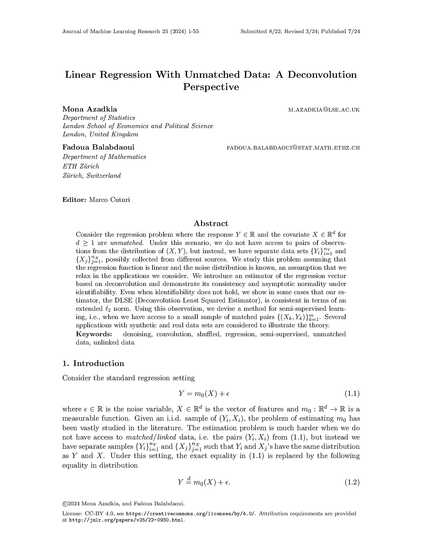
'Linear Regression With Unmatched Data: A Deconvolution Perspective', by Mona Azadkia, Fadoua Balabdaoui.

http://jmlr.org/papers/v25/22-0930.html

#deconvolution #identifiability #estimator

Linear Regression With Unmatched Data: A Deconvolution Perspective

Currently also working on:
- #IPM #identifiability
- multispecies time series models
- #occupancy models for heterogeneous data.
(don't hesitate to chat me up about these!)
New #preprint out 😁 looking at structural causes and mitigation of #identifiability problems when reconstructing past evolutionary change, inspired by the problems in phylogenetic inference.
It's quite technical, and unfortunately I don't have time/funding to continue working on this in the near future 😕 but maybe these thoughts are helpful to the #EvolutionaryBiology community
#Phylogeny #MathematicalBiology
https://arxiv.org/abs/2403.03000
Possible and Impossible Inferences From Reconstructed Evolutionary Processes using Phylogenies as an Example

Our understanding of past evolutionary change is often based on reconstructions based on incomplete data, raising fundamental questions about the degree to which we can make reliable inferences about past evolutionary processes. This was demonstrated by Louca and Pennell (2020), who showed that each pure-birth process can be generated by an infinite number of birth-death processes. Here, I explore what it means to reconstruct past evolutionary change with three approaches from measure theory, group theory, and homotopy theory to better understand structural constraint and origins of (non)identifiability. As an example, the developed framework is applied to the case of birth-death processes.

arXiv.org
Prospective #postdocs: I have opportunities for a 1.5 year contract on a grant dealing with #identifiability aspects in population modelling, #IntegratedPopulationModels, and the inference of species interactions. Don't hesitate to contact me if any of the above interests you!

Some Remarks on Identifiability of Independent Component Analysis in Restricted Function Classes

Simon Buchholz

Action editor: Pierre Alquier.

https://openreview.net/forum?id=REtKapdkyI

#identifiability #analysis #component

Some Remarks on Identifiability of Independent Component Analysis...

In this short note, we comment on recent results on identifiability of independent component analysis. We point out an error in earlier works and clarify that this error cannot be fixed as the...

OpenReview

Some Remarks on Identifiability of Independent Component Analysis in Restricted Function Classes

https://openreview.net/forum?id=REtKapdkyI

#identifiability #analysis #component

Some Remarks on Identifiability of Independent Component Analysis...

In this short note, we comment on recent results on identifiability of independent component analysis. We point out an error in earlier works and clarify that this error cannot be fixed as the...

OpenReview

Jeremy Beaulieu and I are giving a phyloseminar this coming Tuesday at noon US Eastern: http://phyloseminar.org/

Diversification analyses: what can we do, and what should we do?

#phylogenetics #diversification #identifiability #statistics

phyloseminar.org | home

Multivariable Causal Discovery for General Nonlinear Functions

https://openreview.net/forum?id=2Yo9xqR6Ab

#causal #inference #identifiability

Jacobian-based Causal Discovery with Nonlinear ICA

Today's methods for uncovering causal relationships from observational data either constrain functional assignments (linearity/additive noise assumptions) or the data generating process (e.g....

OpenReview