Warning! This post contains spoilers, marked and unmarked, for I Saw the TV Glow. Proceed at your own risk… and if you haven’t seen the movie already, I encourage you to stop reading and go watch it before proceeding any further. It’s a film that benefits from being seen unspoiled.

0. before i saw the glow

The day after my 51st birthday, I took myself out to an actual movie theater—a rarity in this peri-pandemic world—to see Jane Schoenbrun‘s 2024 film I Saw the TV Glow. My social media feed for weeks prior had been filled with multiple commentators, mostly trans (and specifically transfeminine) people alternately waxing rhapsodic about the movie and decrying how emotionally devastated it had left them: sobbing in the theater or the car afterwards, staring blankly into space for days afterwards, and having lots of Thoughts™ about the movie, what it means, and what it has to say about queerness and transness. After a few weeks spent dodging spoilers for the film like a hyperflexible gymnast/secret agent infiltrating a high-tech laser security system, I finally gave in and took myself out to the movies to see it, and now I too have thoughts.

Oh boy, do I have thoughts.

What follows is not a review, and shouldn’t be mistaken for one. I’m not especially qualified to review the artistic or technical qualities of a film and, other than under very specific circumstances, I’m entirely unqualified to say whether a given person “should” see a film or not. Artistic appreciation is an intensely personal experience, and I can think of few films which demonstrate the personal nature of art as emphatically as I Saw the TV Glow.

So, rather than a review, this post is me thinking out loud: a record of my own mental processing of a film which traumatized a number of people on my social media feed and managed to work its way into my dreams before I’d ever seen more than the admittedly well-crafted trailer, and about which I’ve since made the debatably humorous comment that it gave me psychic damage.

1: starburned and unkissed

I suspect the way a person feels about I Saw the TV Glow will depend entirely on a variety of factors, including their own relationship with gender, sexuality, identity, and ’90s youth/teen pop culture. I could easily see this movie leaving a viewer baffled, confused, even angry. I can also see it leaving a viewer sobbing in their seat during the credits, or in the theater bathroom afterwards.[1] I can even imagine, however dimly, someone sitting through the entire 100-minute runtime and responding with a diffident, “well, that happened” shrug.

That last reaction is the hardest to envision, though. I’ve rarely ever seen a film which more openly squares off with the viewer and demands they engage with it on its own terms, and I have never in my life seen a film which more fully deserves the adjective “dreamlike.” I Saw the TV Glow conveys its unrestrained, yet weirdly quiet dream logic with a visual style which relentlessly bombards the viewer with weapons-grade strangeness while consistently drawing us in. The film wears its artistic antecedents—Buffy the Vampire Slayer, various Nickelodeon shows, Twin Peaks—on its sleeve, but rarely in a direct, obvious fashion. It reads very much like a coming-of-age teen drama directed by David Lynch… but I doubt Lynch could have made a film as defiantly, unrelentingly queer as I Saw the TV Glow.

Of course, it takes more to make a film queer than proximity to queerness. If that weren’t the case, simply noting the queerness of the film’s writer/director would be sufficient. Observing Maddy’s explicit lesbian identity or the ways in which Owen’s depression and isolation can be easily read as an incapacitating gender dysphoria[2] would be more than enough. However, a film can have queer characters or be made by a queer filmmaker and still fundamentally reify cisheteronormative attitudes about queerness. What makes a film queer, at least in my not-a-film-studies-major-but-having-a-gender-women-and-sexuality-studies-degree opinion, is the extent to which it fundamentally pushes back against those cisheteronormative attitudes and ideals. In other words, it doesn’t matter how many gay folks are cast, or how much the soundtrack slaps: does this movie depict a queerness that queer people can recognize? Is this a movie that looks at queerness from the outside, or a movie that shows queerness looking back at the world?

In that sense, I Saw the TV Glow is the queerest movie I’ve seen in a very long time, and quite possibly the most trans movie—and specifically the most transfeminine movie—I’ve ever seen.

I realize how bold that statement is, and if I were a real movie reviewer, I might start quantifying the queerness of the film in an effort to trying to justify that claim, to argue you around to my way of thinking.

I’m not gonna do that, though, because as stated earlier, this isn’t a movie review. This is emotional triage.

Well, that doesn’t look ominous.

2. feeling like a psychic wound

I’m not going to bother with writing a synopsis. They’re all over the internet, if you want one. (Then again, if you haven’t see the movie yet, you really oughtn’t read this.) If we’re gonna talk about I Saw the TV Glow, though, we kinda have to talk about that ending.

If you look on the internet, you’ll find dozens of actual reviews of the movie, along with multiple commentators analyzing the movie itself, independent of any critical assessment. If you do just such an exploration, you’ll find that much of the hubbub you’ll find center’s around the movie’s third act, which can be said to start roughly about when…

…a massive spoiler happens in the movie. I’m serious. Don’t expand this if you don’t want to have the ending of the movie revealed to you.

…Maddy tries to take Owen out past the football so they can bury themselves in the earth, believing that if they do so, they’ll wake up as Tara and Isabel in the world of The Pink Opaque—or, as Maddy/Tara insist, the real world. However, Owen shoves her to the ground just past the 50-yard line and runs away, locking himself in his house for days afterwards.

From this point forward, Owen narrates his life for us in classic television-main-character style, speaking and often looking directly at the camera. He sketches over the next few years of his life in dismal detail: his father dies, he stays in his parents’ home, he ostensibly starts a family (referenced once, and never shown on-screen), he loses one job and gets another. At one point, he rewatches The Pink Opaque (now on streaming!) only to realize the show is nothing like he remembers: silly, cheesy, childish, and kind of stupid. It’s also notably nothing like the clips he (and we) saw earlier in the film: no Isabel, no Tara, no mythology, no genuine horror, no “big bad” in the form of Mister Melancholy. It’s just a silly kids’ show.

Just a silly memory.

A twenty-year timeskip later, Owen is looking rough: grey, wan, dissolute, shuffling around his job at the Fun Center (ha!) where all the games appear to be based on references to The Pink Opaque. We see split-second visual signs that things are dire indeed, such as the “money tornado” game with an LED scroll above it reading “YOU ARE DYING.” Of course, only Owen seems able to see it, and it affects him not at all… until he has a total freakout during a children’s party, screaming that he’s dying and begging for help, while the entire room freezes. Later, locked in the bathroom, he cuts his own chest open with a boxcutter. Earlier in the movie, he tells Maddy that he’s terrified that, were he to be cut open, there’d be nothing at all inside him. Now, though, he literally does so, only to reveal coruscating light, static, and sound. Voices. The Pink Opaque lives inside him. He laughs, looking almost ecstatic, and then…

…and then we see him dress in his uniform and walk back into the Fun Center, shambling like a zombie, mumbling apologies to everyone he passes, none of whom see him or respond to him.

Smash cut to black. Credits. </end>

So, like, not to be overly harsh here, but what the fuck, movie?

Really, movie? You’re just gonna do us like that?

3. the apparition knocking at my door

Welcome to the uncomfortably personal part of the blog post. Please, help yourself to an ice cream.

So, here’s the thing.

I was born in 1973. My teen years spanned the ’80s and early ’90s, so the setting of I Saw the TV Glow is a little after my time, but it’s close enough that I can feel the breeze as the bullet goes by. I didn’t grow up with Are You Afraid of the Dark? or Goosebumps as childhood touchstones, but I came to Buffy and Twin Peaks in my twenties, and I still vibe with the soundtrack. In many ways, I carried my adolescence well into my twenties, perhaps into my thirties.

That’s what being a closeted trans girl can do to you.

Childhood is a scarier place than most of us remember.

I almost transitioned when I was 28. I spent hours on the internet with search terms like transsexuality and transgenderism, poring over dense blocks of text and being distressed by medical photographs. Eventually I stopped, noting that everything I’d found suggested that surgery was the end goal of transition. If I didn’t want to pursue surgical sex reassignment, I thought, I must not be transsexual, or transgender, or whatever the right word was. Whatever the particular experience or state of being was that made these women pursue biomedical transition, I must not have it.[3]

I’ve spent most of my life struggling with dysphoria. Of course, I didn’t know that word until relatively recently. I just felt as though there were something intrinsically wrong, with me or with the world, something broken or misaligned or out-of-sync on some fundamental level.

I didn’t learn the language I needed until I went back to college at 41. As it turns out, a gender studies degree is an excellent way of both hiding from your own gender issues and training yourself in the tools you’ll need to deal with them when they come roaring back with a vengeance.

And they will, my friends. They always do.

I was 46 years old when I realized, or admitted, that I was a girl. I’ve told that story elsewhere, so I won’t repeat it. I will merely note that my egg was cracked by a question to which, on some level, I already kinda knew the answer.

Like many trans people, I’m quite good at hiding from myself things I don’t want to know, or don’t feel ready to cope with yet.

I was 47 when I legally changed my name, when I started taking the feminizing hormone estradiol, when I came out to the world at large. I’d already told many of my closest friends and family, and I let everyone else know through the time-honored method of making a Facebook post… on Transgender Day of Visibility, no less.

I was 51 when I sat in an empty movie theater and watched the last few seconds of I Saw the TV Glow, then sat in the silence of the blackness before the credits rolled, stunned and reeling and very, very still, the only thought in my head being, that could’ve been me.

That wan, grey ghost. That broken shell of a human. That could’ve been me.

Oh, Owen.

I could have died never having admitted the truth to myself, never having actually known myself. I could’ve spent my life never having been Tamsin, to myself or my wife or my daughter or the world. That could’ve been me.

It wasn’t, of course. I avoided that outcome. I found the courage—prompted by my wife’s question, true, but answered under my own volition—to embrace myself, at long last. My story is not Owen’s, or Isabel’s. I reclaimed my own heart, and the world in which I live now is as magical and beautiful as any I could hope to find.

In the final seconds of I Saw the TV Glow, I see a vision of what my life might be if I’d taken the other path, if I’d never come out of my eggshell. I feel the breeze of the bullet as it goes by, and I know just how close I came. A few inches to the left, a smidge less courage or will or whatever force drove me to finally admit the truth about myself, and that could’ve been me.

4. my heart is like a claw machine

One of the most brilliant things about Schoenbrun’s film lies within the central metaphor of the film, the conceit on which the whole film turns.

Being an egg or a closeted trans person, Schoenbrun suggests, is like being the central character in a kind of reverse-isekai drama. You’ve been transported from the real world into an alternate reality, an unreal world… but rather than being a mundane human thrown into a realm of pure fantasy and adventure, you’re a magical being ejected from the fantasy world, imprisoned in an ill-fitting suit of raw flesh, incorrect assumptions, awkward silences, and depression. Your true self has been taken from you, and you are left, hollow and false, to move through the midnight realm in which you find yourself trapped.

The metaphor is especially poignant because, in the world of I Saw the TV Glow, there’s never any confirmation of what we suspect to be true, what we desperately want to be true: that the world of The Pink Opaque actually is the real world, and the decaying suburb through which Owen shambles is nothing more than a psychic prison. The movie encourages us to embrace hope—that Maddy really is Tara, that Owen really is Isabel, and that there really is a way out, if only Owen/Isabel can find the courage to embrace it—without ever once confirming that hope is anything more than wishful thinking at best, or a dangerous, self-destructive delusion at worst.

The film never gives us this confirmation, because—and lean in here, kids, this is important—no one can tell you if you’re trans or not.

No one can tell you your truth, because no one else can know it. They can guess it, they can suspect it, they can be pretty goddamn sure, but they can’t know. The most they can do is suggest it, or maybe ask some well-aimed questions.

The only one who can know, of course, is you. As cheese or cringe as it may sound, you have to be the hero of your own story. You have to find the courage first to tell yourself the truth, and then to choose to embrace it. Maybe you aren’t literally a psychic heroine buried in a shallow grave, poisoned with Mister Melancholy’s Luna Juice and dying by inches… but as metaphors for being a closeted trans person go, that one’s not bad.

4. believe in me as i believe in you

As I coast towards the end of this particular blog post, I want us to glance outside the present film for just a moment.

The trans allegory of The Matrix is well-trodden territory, so I won’t belabor the point, but there’s a scene in Lana Wachowski’s The Matrix Resurrections (2021) in which we are shown Neo—firmly trapped in his “Thomas Anderson” persona—squatting on a toilet in a public bathroom. While doing his business (hilariously set to a orchestrally augmented version of Jefferson Airplane’s “White Rabbit” complete with tuba accompaniment), he’s shown staring at the heavily graffitied stall door. In the midst of all the other marginalia is a line from Don DeLillo’s 1971 novel Americana, written with a paint pen in classic Matrix green: “It is so much simpler to bury reality than it is to dispose of dreams.” 

The profundity of the quote in a crudely quotidian and intensely gendered space was deeply poignant in the content of The Matrix Resurrections, but resonates even beyond that movie, or even the franchise as a whole. The line is practically the beating, coruscating-static-light heart of I Saw the TV Glow, and could easily have been the film’s epigraph. It depicts the figurative and literal burial of reality as a way to dispose of the dream of being beautiful, powerful, or authentic. Of mattering. Of being real, at long last, when all you’ve ever known is a disconnected abstraction of life.

Art always has a message, a meaning, regardless of the claims of the artist. We may agree or disagree with the message, but it’s intrinsically there. Even art that purports to be “about nothing” is, in its own existence, saying something to us. While still allowing for individual interpretations, Jane Schoenbrun has been quite explicit in interviews as to what meanings they intended when making I Saw the TV Glow. It is an explicitly queer, trans film[4] with a message—one which, while potentially universal in its applicability, has a special resonance for us.

At multiple points in the film, we see the streets in Owen and Maddy’s suburb covered with multicolored pastel chalk scrawls, not unlike static. Images appear in them, but they too are largely an abstraction. The one moment we are shown these childlike chalk drawings unequivocally, explicitly communicating a clear message—almost certainly from Maddy/Tara—it’s both desperate and hopeful: there is still time.

Time to do what? To admit and accept the truth, of course. To disinter yourself from an early, unwelcome grave. To reclaim your heart. To live.

There is still time.

Drifting through Void High School’s halls, Owen passes “motivational” posters stenciled in red and yellow, all bearing macho mottos about strength and courage, but courage isn’t fearlessness; it’s doing what needs to be done, even when you’re afraid. The world is filled with terrors and torments, but also with comfort and pleasure and a wild, ecstatic joy. To avoid the risk of the former is to amputate the possibility of the latter, encasing yourself in a shallow grave: what iconic lesbian comedian Robin Tyler calls the “vertical coffin” of the closet. If you’re still breathing, there is still time. Any moment can be the right moment. Do it forcefully or quietly, in defiance or with support, with a voice firm with conviction or quavering with fear, to the whole world or to those you trust most or only to yourself.

It is never too late to come out, to be real, to embrace your authentic self… even to transition, if that’s your path. It’s never too late, until the moment you’re dead. It may not be easy or painless, but if this is your truth, if you’re reading these words, I promise you—not a rhetorical “me” or “you,” but the real me typing these words, the real you reading them—I promise you, on my own heart, you can do this.

There is still time.

coda: the things that i say in the dark

I rarely do this, but something niggling at the back of my brain is prompting me to add this post-script:

I’m not a therapist or any other mental health professional. I’m just a middle-aged nonbinary trans girl who came closer to living the Bad Ending of this movie than I like to think about… but I didn’t. That doesn’t make me any better than anyone else, but it does give me a certain perspective. If you’ve read this post and want to talk to someone about it, you can find me at any of the social media links in the header or footer of this post, or you can email me from this contact form.

I can’t promise to have any answers, but I promise to listen, and if I can do something to help, I will.

🖤

[1] This outcome doesn’t take any particular insight to imagine, however, since I first heard about I Saw the TV Glow through several social media posts from transfeminine people stating they did exactly this.

[2] Which is [SPOILER ALERT] alleviated only in a brief moment of euphoria while dressed as Isabel, one of the two main heroines of The Pink Opaque, the TV show over which Maddy and Owen bond. It’s notable that this is the only scenes I recall from the film in which Owen is seen smiling.

[3] This, by the way, is one of the dangers inherent in the lie of transmedicalism. It actually convinces trans people that they’re not actually trans, which makes it not just factually untrue, but needlessly cruel. It’s a tool of oppression, and I will never stop hating it, or being disgusted at the ways it’s used to harm trans people.

[4] And yes, there are multiple readings for the film and its ending, and yes, those readings can be much more universally applicable than a strictly transgender reading… but I’m wary of the impulse to immediately brush aside the trans reading of a trans creator’s explicitly-and-by-design trans-themed film in favor of something more “universally”applicable, i.e. something cis people can appreciate. To phrase it more succinctly, I Saw the TV Glow is emphatically a trans movie: made by one of us, about us, for us. I’m truly happy that cis people can get something out of it too, but to disregard or dismiss the inherent trans content of the movie is a bit like ignoring class warfare in Saltburn, sexism in The Handmaid’s Tale, or racism in Get Out.

https://reimaginedgirl.com/2024/06/24/the-glow-holds-me-now/

#film #howToBeTrans #iSawTheTvGlow #janeSchoenbrun #thinkyThoughts

Jane Schoenbrun - Wikipedia

[Note: Some of my thoughts here were influenced by three conversations: one at home with my wife, one by video call with my therapist, and one by phone with my friend timberwraith while I was walking around Terminal 3 of Chicago O’Hare International Airport, waiting to board a flight home.]

Previously on re:imagined girl, I announced that I was done documenting Operation: Polymorph as its own topic. After all, I do have other things in my life than facial feminization surgery. Of course, that doesn’t mean it’s not still incredibly relevant to my everyday life. “Gone from the charts, but not from our hearts,” as they used to say.[1]

During my essentially enforced downtime while recovering from surgery, one of the things I spent a lot of time contemplating was what my life would look like afterwards: once the swelling goes down, once I’m no longer “recovering from surgery,” once I’m just, y’know, some girl named Tamsin. Now, as I move steadily away from Operation: Polymorph and into the post-surgery phase of my life—which, really, is just the rest of my life—this question has moved to the forefront of my beehive of a brain.

It’s common to hear people say that transition is a marathon, not a race, but I think that metaphor gets us a little wrong-footed (ha! get it?) if taken too literally. As I understand it from my transfeminine senpai, there comes a point when you’ve done all of the “Big Things” that are part of your transition—medically, socially, legally, whatever—and then, finally, you transition (ha! get it?) from being a woman in transition to just being, y’know, a woman.[2]

Wait, is this a marathon? Please don’t tell me this is a marathon. I hate marathons. And races. And running. And that’s way too many people. (Photo by RUN 4 FFWPU on Pexels.com.)

In her audiobook M to (WT)F, Samantha Allen sums up this phenomenon with a succinct question: “So, now what?” She goes on to write,

I think I forgot that there is life after transition—indeed, most of my life, knock on wood. Inch by inch, I’ve tried to figure out who I am now. Years ago, I was able to wonder for the for the first time, not if I could be a woman, but what kind of woman I would become. Now, I have to start answering that question, instead of asking it.

Barring any unforeseen changes or events, I’ve finished most of my biomedical transition, including all of the Big Things I had planned.[3] Does this mean I’m… done? Have I finished transitioning? Is that all there is?

Well, let’s think about that.

When my egg first cracked in January of 2020, it set in motion a whole host of thoughts, feelings, events, decisions, and transformations. I don’t just mean the obvious things like getting my face remixed; I mean the internal work of processing the mental and emotional changes this new piece of information initiated.

There exists in some segments of the trans community a narrative in which a trans person started as one person, then had the realization that they were trans and became another person. I know that many trans folks find that narrative resonant or useful, and maybe even comforting. I hope it won’t come across as in any way critical, then, when I say that this was absolutely not my experience. In a sense, I didn’t change at all; I was simply able to (or was forced to) acknowledge who I actually was. I didn’t suddenly realize I was actually a different person, and that person happened to be female. Rather, I realized I was still the person I always had been and that “the person I always had been” was a woman… and had been one my whole life.

Image: A white snowy owl turning around to face the camera with a shocked-looking expression, much like the O RLY? owl meme.

This realization recontextualized literally everything I thought I knew about myself. I spent the first several months after this realization repeating the same pattern a few times a week:

  • recall some weird part of my past I’d never fully understood,
  • remember I was a girl who didn’t know she was a girl at the time,
  • and think or say something along the lines of, “Oh! Now that makes sense!”
  • It’s not as frequent nowadays, but it still happens from time to time, and it’s always accompanied by the same mixture of delight and bemusement. Like, seriously, how did I not know?

    The answer is that I am very, very good at hiding things from myself, including uncomfortable truths about myself which my subconscious mind believes might place me in danger of harm if I openly acknowledged them. This “talent” is a childhood survival mechanism which still complicates my life from time to time, but has also resulted in some hilarious moments of realization. One was the conversation I had with the ex-girlfriend who would later become my wife in which we realized we were still in love with each other, and had been for a long time.

    Another was my initial “holy shit I’m a girl” realization.

    (Comic by @AyvieArt on Twitter.)

    My transition began in January 2020, but was largely invisible to most people. Part of that was the whole pandemic lockdown, of course, but part of it was that I moved slowly and deliberately. The early part of my transition mostly involved a lot of talking: with my wife, my therapist, and eventually with a few friends here and there. I experimented with my presentation, I tried to build relationships with other trans people (especially other transfeminine people), and—because words are how I understand the world—I read a lot. I read books, articles, essays, blogs, social media, and more, all to try to get a handle on this weird thing that was going on with me.

    In short, the beginning of my transition was a boring ordinary life change made up of boring, ordinary choices and decisions, rather than a dramatic magical-girl transformation sequence.

    I mean, to be fair, this would’ve been a lot cooler, but here we are.

    And honestly? The rest of my transition has been pretty quotidian, too. Yes, I’m on HRT, and yes, I’ve had gender-affirming surgeries, and both of those things have been among the best decisions I’ve ever made for myself. However, I want to point out that even those aren’t particularly esoteric, nor are they uniquely transgender experiences. Lots and lots of cisgender people take hormonal treatments, and many have surgeries intended to affirm their gender identities or presentations. Mine are specific to my circumstances… but aren’t everyone’s?

    Most people who are even passingly familiar with trans people will have at least a cursory understanding of “transition,” the narrative process in which trans people start in one place—believing ourselves to be cisgender, however ill-fitting that descriptor may be—and then, through some mechanism of self-discovery (and, if desired and accessible, changes to one’s physical, social, and/or legal status), end in another place. Given the intensely personal natures of gender, identity, and selfhood, we shouldn’t expect one person’s transition to necessarily look like another’s. However, the basic narrative is essentially the same: start at X, go through changes, become Y. Recent developments in trans theory have complicated this a little, suggesting that trans people aren’t “becoming” their gender, but instead are harmonizing their external expression with the gender they’ve always been, but the fundamental movement of the narrative remains a fairly linear arc of character development.

    The more I think about it, though, the more I’ve started to question this narrative, even in its modified form.

    To be clear, I am not saying this narrative is wrong. I’m emphatically not saying that trans people shouldn’t transition, nor that we shouldn’t have unfettered access to any and all means of addressing gender dysphoria and seeking gender euphoria. I am foursquare in favor of all trans people having access to every biomedical, social, and legal method of bringing their lives into alignment with their internal sense of identity. What I question is the universal applicability of the narrative of “transition” as the foundational concept which many trans people use to explain the arc of their identities.

    My own personal experience of transitioning has been… well, not much like other folks. Again, this is not particularly unusual: my identity, experience, and selfhood are my own, and are unique to me. However, the ways in which my experience has differed from other transfeminine people’s experiences gave me pause, and pushed me to ask why they were different. I didn’t feel the strong sense of disjuncture or detachment from my pre-transition self that so many other trans people identified, nor any need to disown the person I’d been prior to my “holy shit I’m a girl” moment. The sole exception to this lack of disconnection from my pre-transition self was the changing of my name and pronouns, the labels I used to indicate that my self had changed… but even then, I wasn’t disavowing my past self. I was, rather, notifying the world of a state change. My old name was now my deadname; my former self was now a past self.

    That past self wasn’t a different person, though, except insofar as any of us are different people from who we were five years ago, or fifteen, or fifty. Or, to look at it another way, my past self is a different person, but there’s a continuous thread of consciousness, narrative, and identity between all the people I’ve been and the person I am now. I’m not any of those past selves now, but I contain them within me. They’re all people I was, on my way to becoming the woman I am today.

    (Photo by Pixabay on Pexels.com.)

    Which brings us back to the question: Have I finished transitioning?

    I don’t know. In one sense, maybe I have. I’ve done my particular subset of Big Things™, and what’s left are either life maintenance things or minor tweaks to a presentation which, for whatever it’s worth, seems to be pretty well settled at this point. Maybe I’m reaching that point Samantha Allen described, where the question is not if I can be a woman, but what kind of woman I want to be.

    In another sense, maybe I haven’t finished. Those tweaks and treatments do still sit uneasily on my to-do list, suggesting that—emotionally at least—my transition isn’t done, and may never be. Even if I electroshock every hair follicle on my face into oblivion, even if I train myself into a perfect (or perfect-for-me) voice, even if I make any and every other change that occurs to me, I may still never feel like I’m “done.” Perhaps I’ll be in transition as long as I’m still looking to the horizon for something I still need to do to feel “finished.” Perhaps I’ll always be “in transition,” because I lack a model of what it looks like to not be in transition, to just be a woman.

    And maybe there’s no finish line. Maybe transition isn’t any kind of race, marathon or otherwise. Maybe it’s just the word we use to describe this particular bit of our path: a name for the road, or for the kind of terrain it crosses. That word might be relevant in some contexts, but its relevance doesn’t reside in taxonomy. Transition doesn’t make us “more trans,” because there’s no such thing as being “more trans.” You simply are. Being trans is just a way people like us experience gender: a quality of my womanhood, not a gender in itself.

    In the end, asking myself if I’m done with transition is the wrong question, because what’s important about transition isn’t whether or not it ends. It’s that, in doing this, we are becoming the people we truly are, the people who, in our hearts, we know ourselves to be. In that sense, transition is just one part of the work I have done, am doing, and will do until the day I die, all to be closer to my best, most authentic self. And even there, there’s no finish line. As clichéd as it may sound, the destination really is less important than the journey: where we’ve been, where we’re going, and where we are in the moment of our asking.

    (Photo by Lisa Fotios on Pexels.com.)

    So, am I done with my transition?

    I’m still alive, so, no. I’m still becoming who I am, and likely always will be.

    That’s part of the fun of it.

    [1] This is normally the spot where I’d make one of my self-deprecating quips about being perfectly well aware that I’m old, thank you very much for your concern… but you know what? I’m proud of having made it this far. It’s not a privilege afforded to everyone, and certainly not to enough trans women.

    [2] While I’m obviously not transmasculine myself, I imagine it’s quite similar for trans guys, as well as for nonbinary people who go through a transition process.

    [3] The remaining elements will either be ongoing, like HRT and voice training, or require a period of intermittent treatments, like electrolysis. Fun!

    https://reimaginedgirl.com/2024/03/23/no-finish-lines/

    #howToBeAGirl #howToBeTrans #meta #operationPolymorph

    Haunted Timber

    i'd rather live among the trees...

    Haunted Timber

    Hello, beautiful creatures.

    In a characteristically typical move, I was clever enough to have come up with the title for my first post-operative blog post, but not prescient enough to have written its content. Really, though, I don’t think it could’ve been any other way. After all, it takes no great powers of prognostication to have forecast that I would have all of the qualities given in this post’s title. Knowledge of the actual experiences of which those qualities are the markers, however, does kinda require having actually lived through them. So, to an extent, I’m starting this blog post without knowing where I’m going. It is both tabula rasa and terra incognita, if you will.

    And exactly as stabby as this image suggests.
    (Photo by Aksonsat Uanthoeng on Pexels.com.)

    Having an organizing theme does help me get my thoughts into some kind of accessible order. Sometimes I try to be super clever with that organizing theme, but clever requires a hell of a lot more energy than I have right now, so instead, you get the easiest one imaginable.

    the good

    Well, what can I say? I wanted to know if I was someone who could do the thing. Turns out, I am. I am officially six days past my facial feminization surgery, five days past discharge from the hospital, and one day past my first post-op check-in. I’m ambulatory, my pain is being managed, and my swelling has diminished to the point where I can actually start to see some of the changes. The weirdest part of this whole process has been the realization that I don’t actually know what my new baseline normal is. I won’t really have the final-final version for up to a year from now, and I’ll only have the ~80% final version at about three months from now, so being able to see the changes starting to reveal themselves is especially exciting.

    the bad

    Here’s the hard truth: I’m in a lot of pain. There’s pain at all of my surgical sites, of course—my brow, the staples inside my hairline, my cheeks, my upper and lower lips, my chin, along my jaw, and the insides of my mouth where my cheeks and lip meet my gums—as well as my abdomen, where they borrowed some fat to transplant into my face. I also have a persistent headache, which no medication or hydration is quite touching, and a general, persistent sensation of pressure all around my head, which is both painful and just uncomfortable.

    What I want to be careful to stress here is that none of this is unusual or unexpected. Everything I’m experiencing is entirely within normal parameters. Point of fact, both my surgeon’s office and my wife and friends have commented that I appear to be healing really quickly. This is likely due, at least in part, to the post-operative hyperbaric oxygen therapy I’ve been doing. It’s also probably due to the fact that I’ve spent a substantial amount of my non-HBOT time sleeping or resting. Seriously, I overestimated the amount of time I’d have for playing Baldur’s Gate 3 or reading books by an awful lot. Most of my time, I’m asleep… or, y’know, lying in bed trying to sleep. And failing. Because pain.

    So, to recap: pain. Healing fast, yes, but lots of pain.

    I looked for stock photos about “pain,” and the search returned several bland images and… this. (Photo by Ferdinand Studio on Pexels.com.)

    the ugly

    Laverne Cox’s hashtag campaign insists that #TransIsBeautiful, while a transfeminine friend of mine insists that “Trans is pain.” Both are true, of course, and I’ll add another one: trans is messy. There’s no getting around this, so I won’t try: living with a swollen faceful of bruises and stitches is hard. It’s hard waking up every morning in pain and discomfort, often far earlier than I’d like, knowing that what greets me in the bathroom mirror is going to be a slightly color-corrected version of the same battered, war-torn landscape of discolored skin, smeared ointment, and goopy eyes I went to bed with. Even with my stitches removed, there’s still a line of angry, crusty, red-black barbed wire impressions separating my nose from my upper lip, ready to inspire any number of cocaine-fuelled elegies about lovers separated by political and/or aesthetic divisions.

    Okay, that metaphor got way, way away from me[1], but you get my meaning. It’s messy. I don’t mean “ugly,” in the masochistic, self-destructive way trans girls so often use to hurt ourselves: “OMG I’m so ugly, I’ll never pass, I’m such a brick/hon/whatever,” and so on. I mean it’s messy, in precisely the same way all human bodies are: gooey, sticky, oozing, swelling, inflamed, crusty, and gross. All bodies are like this, and trans bodies are no exception. When we have surgeries, we have to recover just like cis people do: one stitch at a time, so to speak.

    This morning, I woke from what I’m guessing was about four whole hours of sleep, my bandages having all slipped off or come loose, with my face throbbing and pounding like a righteously angry funk band.

    For a moment, just imagine that George Clinton and Bootsy Collins have a bone to pick with you. A very, very funky bone.

    It’s moments like this where I feel at my lowest, and I think, Why did I do this to myself? Was this necessary? Couldn’t I have just, I dunno, lived with the dysphoria?

    The really annoying thing is, knowing the answer to those questions doesn’t actually make things hurt any less in the moment. It just reminds me that I’m paying now for choices I made in the past, in hope of a better future—or, to put it another way, pastTamsin did this to presentTamsin so that futureTamsin can be happier.

    And right now, I kinda hate pastTamsin an awful lot, so futureTamsin had better appreciate this.

    So, there you have it: the good, the bad, and the ugly. Sounds prety dire, right?

    As I said at the beginning, though, I can kind of see her, the woman underneath the swelling and soreness. I can almost make out the shapes and lines of her face: the way her Cupid’s-bow lips sit beneath her retroussé nose, the way her eyes capture the light so much more than they were able to before, accentuated by the sweep of her cheekbones. All of those were present in potentia in the original, but none of them were made fully manifest—incarnate, if you will—until now.

    Almost.

    Or maybe that’s all wishful thinking and projection on the reality of the now, which is swollen tissue and angry nerves playing the most bellicose version of Rhapsody in Blue you’ve ever heard, like George Gershwin being mugged by Lou Reed’s Metal Machine Music in a New York alley sometime in the mid-’70s.[2]

    You shouldn’t be here, George. And neither should that pineapple.
    (Photo by Pineapple Supply Co. on Pexels.com.)

    Either way, though, I am where I am, good and bad and industrial jazz mashups and angry funk bands and all. Things are rough right now, but they’re also honestly amazing. I thought I’d never actually get to this place, and when I realized it was an actual possibility, I had to ask myself if I could actually follow through with it.

    The answer is “yes.”

    I’m struggling, but that’s part of the adventure, too, innit? I knew this job was dangerous when I took it. No risk, no reward. Fake it ’til you make it. And so on. (Insert your preferred motivational cliché here!)

    At some point I’ll have a whole list of people I want to shout-out and thank for everything they’ve done to support me, but at this exact moment I want to specifically name five:

  • Victoria, who brought us drinking glasses and reasonably-sized mugs, thereby making drinking beverages about a thousand times easier;
  • Laura, Nathan, and Shakira, who fed and played with our wee beasties while we were away in the Far West;
  • and, of course, my wife and partner Megan, who has taken care of me physically, emotionally, and spiritually throughout this entire process. She’s counted my pills, dried my tears, sorted my clothes, and reassured me constantly that I can do this, that it will be worth it, and that I’m doing marvelously. I owe you everything, my beloved, and I hope to spend the rest of my life demonstrating the impossibility of ever repaying that debt.
  • Okay, I’m all maudlin and sappy now. That’s a good note to end this post on, I think. More to come.

    Cheers, all of you, and thanks for reading along. 🖤

    [1] And, as Tolkien slyly noted of Bilbo’s wishes to have never gone on that stupid uncomfortable adventure which makes up the bulk of The Hobbit, not for the last time.

    [2] See? Toldja so. The really funny thing is, I haven’t taken any narcotics since yesterday morning. Apparently this is just how my brain works. And, for the record, I would never invoke such a fate on Mr. Gershwin, nor would I ever think Mr. Reed capable of such a thing, and I wish them both nothing but loving-kindness in whatever state they exist beyond this present incarnate moment.

    https://reimaginedgirl.com/2024/01/11/bandaged-bruised-swollen-stitched-and-sore-t6/

    #howToBeAGirl #howToBeTrans #music #operationPolymorph #thinkyThoughts

    [Note: The following is a post imported from my old Mastodon account at queer.party. On rereading it recently, I realized this was one of my early approaches to thinking and writing about FFS, and kinda sorta belonged here, so… here it is.]

    As journalist, humorist, and author Samantha Allen once rightly pointed out, a huge amount of “the transgender experience” is paperwork. The experience of filling out the intake paperwork for the surgeon I’m hoping to have redesign my face underscored this point to a distressing degree.

    Photo by Pixabay on Pexels.com.

    In particular, I found it interesting how much of the paperwork was intended to convey three ideas:

  • “I am legally competent to consent to this surgery, so you won’t be sued.”
  • “I’m really, truly transgender, which is totally a medical disorder diagnosed by my mental health provider, so my insurance will absolutely pay for this procedure. Oh, and I’m wildly unlikely to have post-surgical regrets that would lead me to sue you.”
  • “In the event that my insurance decides not to pay out for this hilariously expensive procedure, I will cheerfully accept responsibility for making sure you, the surgeon, get paid.”
  • To recap: in filling out this paperwork, I’ve agreed to participate in the pathologization of what is, in my experience, emphatically not a medical condition at all, but a perfectly ordinary variation of human experience. In other words, I’ve agreed to pretend I believe and affirm the truth of something I know isn’t true, so that the people who pay (most of) my medical bills will agree to pay this one, too. Ain’t capitalism grand?

    Of course, even that’s a simplification of a much more nuanced issue. Is being trans a mental health issue? Well, it wouldn’t be if we lived in a healthy culture, but goodness knows that’s not so. Is gender dysphoria a mental health disorder? Depends on who you ask, but I’d argue that being “healthy” in a sick society is no sign of true health, and being “sick” in a sick society may just mean you’re responding appropriately to your environmental conditions… but that’s another post.

    What I will absolutely say is that being trans in this culture makes me feel all kinds of awful, and induces a wide range of mental distress which, blessedly, I’ve been able to hold at bay through the deployment of that favorite fake boogeyperson of pearl-clutching conservatives, GENDER-AFFIRMING CARE! Yes, that’s right, I’ve been treating my mental distress with judicious applications of estradiol, progesterone, and most recently—gasp!—GENDER-AFFIRMING SURGERY to divest myself of some excess baggage I’ve been toting around for 50 years.

    [Editors’ note: Tamsin means her testicles, which have since been incinerated with the rest of the hospital’s medical waste by now. A fitting end, in our opinion. -Ed.]

    Am I a hypocrite for filling out this paperwork affirming something I don’t believe to be true? Maybe. Here’s a question I find far more interesting: is it in any way meaningful to make moral judgements on “hypocrisy” in a system which rewards complicity with the essentials for survival, to say nothing of the comforts which make a life out of survival, and which penalizes honesty with denial of life-saving and life-enriching care?

    To pare that down even more, I’m getting FFS as a way of reducing both psychological and social stress. So, let’s pivot. Maybe it’s a mental health issue after all: if not intrinsically, at least operationally. In this time, in this place, being seen and known as feminine reduces the pain, distress, and unhappiness I experience in a fundamentally transphobic society.

    In this circumstance, accepting the pathologizing of my intrinsic identity, rather than locating the pathology where it justly belongs—within the society in which I’m trapped—may just be the opportunity cost for getting my revised character design into production.

    Maybe I’ll feel bad about that later. If so, at least I can cry about it with a face that more closely resembles the one I see in my dreams than the one I currently see in the mirror.

    Vanity? Indubitably. But that’s hardly the greatest of my sins.

    https://reimaginedgirl.com/2023/07/01/paperwork-and-pathology-t-185/

    #howToBeTrans #operationPolymorph

    Tamsin: Bæddel Angel (@[email protected])

    Content warning: On paperwork and the pathologizing of trans identity (long)

    Yastodon

    When I was at university, I spent a lot of my downtime on campus hanging out with the other queer kids, as well as with folks from other student activity groups. This gave me, among other things, access to a button machine for making pinback buttons. I cannot be trusted with this kind of power, because I refuse to use it responsibly. Given this tool, some blank paper, and the pens available in my book bag, I immediately summarized my $24,000 bachelor’s degree in Gender, Women, and Sexuality Studies in four words:

    gender is a mess.

    In my defense, I also drew a cute little flower with petals in the six rainbow colors of the Pride flag.

    No, really, see? Here’s proof. (Photo by the author.)

    While even now I will cheerfully attest to the validity of that pithy little statement, I do have to admit it’s optimally suited to being on a button and not, y’know, an actual explication of a theory of gender, to say nothing of my own, personal gender. For that, I’d need a little more than 4.91 in2 of space. I’ll need something more like… well, a blog should just about do it, yeah.

    The trouble is that—like any other agglutination of thoughts, experiences, thoughts about experiences, debates about experiences and thoughts, and formalization of the outcomes of those debates, thoughts, and experiences—theories of gender are endlessly fascinating for those of us steeped in their esoteric mysteries, and mostly pretty fucking boring for everyone else. I mean, I might as well write a collection of dry lit’rary stories about glum, unlikeable people with colorful, asymmetrical hairstyles and they/them pronouns and beat people over the head with it. I could title it What We Talk About When We Talk About Being Nonbinary. Ugh.

    Still and nevertheless, it’s my blog, and I’ll theorize if I want to. And oh, my friends, I want to. I really, really do.

    As I’ve discussed elsewhere, I had the realization that my experience of gender was nonbinary in 2013. I further realized, in January of 2020, that my gender identity is rather more femme-of-center than the term “nonbinary” is often taken to mean. In the almost four years since then, I’ve refined my understanding of my own selfhood—my identity, my interior life, my hopes, dreams, and desires—or, in many cases, learned what some aspect of it actually is, for the first time in my life. You know that thing where someone decides to go on a “vision quest,” rumspringa, or midlife crisis to “find themselves?” It’s kind of like that, I guess, but the self I’ve found is a girl.[1]

    That’s weird enough, but what’s really been a trip is realizing that she always has been a girl. Even when I was a “boy” in 1970s central California, or an adolescent trying to navigate high school in upstate South Carolina. Even when I was fumbling through my twenties like a wobbly top, finding so much joy and terror in holding my newborn daughter in my thirties. All the way up until I realized, in my mid-forties, that she was me, and I was a girl.

    [IMAGE: A small metal top spinning and wobbling.]

    I carried her within me all that time, not exactly frozen in carbonite, but existing as another me: a me in potentia, a miniature unrealized reality. An entire alternate universe in one person. A timeline unexplored, a road not taken.

    That’s the funny thing about transition. It’s about the body, yes, and about identity, and expression, and a host of other things, but what it’s really about is time.

    It’s about the future, the vast array of what-might-be, all coalescing into one single point in time.

    It’s about the present, that infinitesimal, ephemeral place that isn’t a place, the point where possibility transforms into history.

    And it’s about the past, the infinite string of pearls trailing behind us, one for every moment, until one day the threads snaps and the pearls scatter, each to become a star in the night sky that is the story of us.

    When we choose to transition, we look back at ourselves and our lives, or forward to the futures laid out before us, squarely at the reality of our present moment. We look at the story of ourselves and we ask, what if?

    What if I had been “born a girl?” What if I had realized sooner? What if I choose transition right now? What if I don’t? How long will I have in this life, and how long will I be stuck in this body, this concrete lie of flesh and expectation? What if I change? Who will stay with me, and who will leave? Who do I want to die as? Who do I want to live as? Who will I become?

    All this chaos and change brought about by the catalyst of gender, and we still don’t know what it is.

    Elseblog, I’m in the process of writing a glossary-style page, where I came up with the following definition of gender:

    The component of identity comprised of social, psychological, and cultural factors influenced by (though not limited to) expectations associated with an individual’s biological configuration at birth, among other elements.

    It’s okay if you find that definition unreadable, insufficient, or just kinda stupid. I do too, and I wrote the bloody thing. In my defense, I’m attempting to reify something ineffable yet experiential, something with which most people (though by no means all) interact daily, often without even realizing it, and quite certainly without being able to define it in any concrete way. That’s the thing with gender: if the word is going to have any factual utility at all, it has to refer to something that actually reflects human beings’ lived experiences.

    This is where TERFs and other gender-essentialist transphobes fall on their faces, because their worldview requires…

  • a definition of gender which relies on denying the lived experiences of hundreds of thousands of human beings from all cultures and throughout the span of history
    AND/OR
  • a denial of the existence of gender itself, again flying in the face of literally all of recorded history
    AND/OR
  • an equation of “gender” with the term “sex,” overlooking both that they refer to two quite different phenomena and that their definition of “sex” is counterfactually oversimplified.
  • One of the problems with these posititions—apart from their fundamental intellectual bankruptcy—is that they all presuppose a definition of “gender” which is both logically derived from observable facts and applicable in all situations. Their reliance on these two conditions means that even one verifiable counter-example blows their position to smithereens. That being the case, the mere existence of intersex people and of cultures with multiple genders effectively renders their positions unworthy of serious critique.

    So, then: what is gender?

    Gender is a mess. Gender is playful. It’s expression, it’s energy, it’s art. It’s every color of paint in the art store, squeezed out in a giant blob and smeared across the canvas in the most riotous, kindergarten-art-class way possible—eat your heart out, Jackson Pollock! It’s a wardrobe filled with costumes and jewelry and facepaint and props, all in every imaginable style and size, and it’s the stage on which we wear them and wave them around, performing for an audience of one and of all. It’s a playground, and it’s the games we play.

    Like this, only moreso. (Photo by Rahul Pandit on Pexels.com)

    Gender is a mess. It’s complicated, chaotic, bloody, traumatized, and traumatizing. It’s every aspect of your being, your selfhood, your identity, all laid out for public display, judgement, condemnation, exploitation. It’s oppression and an invitation to oppression. It’s cruelty and torment and confusion and isolation and a bitter loneliness that permeates not just every waking moment, but even the dreams which provide too little respite and no escape.

    Gender is pink is for boys and blue is for girls and purple is for both and silver is for neither and hey, y’know what, screw it, everyone just wear what they want, be who you are, use whatever bathroom has the shortest line, why the hell do we even care, the world is on fire and children are dying in rocket attacks and concentration camps, so can we please leave each other alone about bodies and clothes and bathrooms and just focus on what actually matters in this sorry excuse for a life for one goddamn minute?

    Here is the conundrum: gender is one of the most fundamental aspects of our identities as human beings, and it’s also one of the central components of most cultures’ internal systems of social structure… and social control. To deny the gender ascribed on your body at birth and claim another—or none at all—is to identify yourself as being beyond the sphere of social comprehension. Outside the charmed circle of society, if you will. And being outside that circle, being outcast—ex castra, “outside the fort,” as the Romans would’ve said—is dangerous. Those walls might be confining, but they do provide safety. Without those walls, without the protection of social approval, we are vulnerable. Predators roam the lawless outlands, most of whom walk on two legs, invoking sanctity and justice as they commit atrocities before returning to the comfort of their walled communities.

    (Photo by Ricky Esquivel on Pexels.com.)

    I’m a trans woman. I am ex castra, outside the charmed circle, outside the walls. And should I be caught, I will be just another dead trans woman who was asking for it. That is how they’ll see me, and that is how I’ll be known to everyone but those who knew me.

    Why do it, then? Why subject myself to opprobrium, derision, danger, and threat? Why put myself through the trifecta of mental strain, emotional anguish, and physical pain, all towards an end which actually diminishes my status and safety within the godsforsaken transphobic culture that birthed me?

    I could theoretically choose to go back to pretending to be a boy. That’s called detransitioning: reversing the direction of one’s gender transition to go back to the gender one was assigned at birth. As of this writing, there’s a narrative being flogged in certain quarters of the media that detransition is super common because being transgender isn’t actually a thing, we’re all just scared, sick, deluded by the media, misled by other trans people, or just flat-out crazy. Of course, this narrative is absolute, counterfactual bullshit—what we used to call “a bald-faced lie” when I was younger—but that doesn’t stop TERFs and other conservatives from loving it like it promised them a tax cut. The fact is that detransition rates are really, really low… like, “not worth placing a bet on it” low. Furthermore—quelle surprise!—a substantial number of detransitioners go on to retransition later, when their social, financial, or familial circumstances change to allow them to be themselves with less fear of reprisal.[2]

    Still, it might be safer. Certainly, it’d be safer than being a trans woman in 21st century America isn’t. So, why persist?

    I won’t open boxes that I am told not to / I’m not a Pandora, I’m much more like /
    That girl in the mirror; between you and me / She don’t stand a chance of getting anywhere at all…

    (Kate Bush, “Suspended in Gaffa“. Photo by Elizaveta Dushechkina on Pexels.com.)

    Because this is who I am.

    I spent far too much time failing to live as myself, never understanding why I always felt detached from my own life, never quite catching the sounds of the murmurings that rose from the basement of my own brain, never grasping the occasional wisps of understanding that rose like steam from a floor grate. I might’ve lived a long and utterly incomplete life, all without the girl I carried with me through all those the years ever once getting to walk in the sunshine, wear a pretty skirt, laugh with her friends, or hear her own name spoken by the woman she loved. I might’ve died never having lived as myself.

    But I didn’t.

    By the grace of whatever fates look out for middle-aged trans girls unaware of themselves, and with the boundless help and support of my wife, I managed to step out of the wreckage of my own eggshell… or, to follow my own metaphor, I was forced to look in a mirror and openly acknowledge, for the first time in my life, the girl I’ve always been. I’m myself now—really, truly myself, not an agglomeration of other people’s expectations and desires—and I will never go back to living a lie.

    There’s a phrase that’s become increasingly popular in the trans community in the past couple of years. It’s punk as fuck, metal as hell, and can be quite startling if you haven’t encountered it before and your sensibilities run to more of a “can’t we all just get along” tolerance mindset. I’ll admit, it knocked me back on my heels when I first saw it. Over time, though, I’ve increasingly come to appreciate and identify with it. Especially in light of everything I’ve just shared, it seems only appropriate to share it with you now, as well:

    Death before detransition.

    Image by Hannah Kolbeck. (Buy the shirt here!)

    So, here’s the deal with my gender.

    The super-short version: I’m a woman.

    The slightly-less-short short version: I’m a woman or, colloquially, a girl.

    The regular-length short version: I’m a nonbinary transgender woman—or, colloquially, a nonbinary girl.

    It’s right about there where I often lose people, so I’ll explain.

    There’s a common misconception that the term nonbinary refers to a specific gender identity. Some people think it means being agender (without gender), while others think it means being genderfluid (moving between multiple genders), or bigender (identifying as two distinct genders), or some other gender identity. All of those genders can rightly be said to be nonbinary, but nonbinary simply means “not conforming to a binary schema.”

    What I mean when I say “nonbinary girl” is that I am a woman, a girl, but my schema of gender doesn’t position “woman” or “girl” within a female/male binary. Rather, I think of female and male as being two points within a sphere with all possible genders, or lack thereof, enclosed within its infinite, rainbow-colored conceptual space. They’re not the only possible reference points, nor even the most important. They’re just facets of orientation, directional markers.[3]

    In this model, femaleness is not defined by contrast with maleness. Femininity does not require masculinity to give it structure or meaning. Womanhood and girlhood, as both concepts and lived experiences, can and do exist without reference to manhood or boyhood. And so on.

    (Photo by Bastian Riccardi on Pexels.com.)

    For me, nonbinary is a modifier on girl, not a negation or addition. It’s not nonbinary/girl, nor even nonbinary and girl. It’s girl, no binary needed.

    So yes, nonbinary… but more importantly, girl. I use she/her pronouns, because I’m a nonbinary girl.

    If the concept is still eluding you, instead of banging your head on it until you see stars, you have my permission—even my encouragement!—to frame it as girl, just a little weird.

    Or, as Anna a.k.a. @trans.parent on Tiktok puts it…

    @trans.parent

    I bought my gender on Wish. #trans #lgbtq #nonbinary #transfemme #shethey #wish

    ♬ My gender is girl from Wish – Anna

    And now you have some of my preliminary thoughts towards a theory of gender, and an explanation of my own gender identity.

    You’re welcome. 😉

    [1] Astute readers will note that I tend to use “woman” when referring to myself and my gender more formally, and “girl” when I’m speaking casually. This convention isn’t especially intentional. Rather, it arose from the combination of my initial discomfort as a newly-realized transfeminine person at claiming the term “woman,” and the genuine delight I felt claiming the term “girl,” both of which seem fair, since I’ve only been going through second puberty for three years as of this writing. I’m more comfortable identifying myself as a woman now, though it’s still odd sometimes. And “girl” still makes me smile.

    [2] Please understand, none of what I say here is intended to deny the experiences of detransitioners. On the contrary, the experiences of detransitioners and retransitioners are entirely valid, and should be heard and understood with respect and sympathy. We should also be careful to actually listen to detransitioners: all of them, not just to the ones who’ve become darlings of the conservative media circuit.

    [3] My wife, the nonbinary mathematician, read over this section and pointed out multiple issues with my metaphor, which originally posited female and male as polar tendencies within the conceptual space of the gendersphere. I suspect that framing derived from some unexamined binaristic assumptions still lingering in my brain. Removing this polar language more closely aligned my (admittedly still imperfect) metaphor with the concept I was trying to express, and pleased both my desire to communicate accurately and her sense of mathematical harmony.

    https://reimaginedgirl.com/2023/12/16/smearing-paint-on-the-gendersphere/

    #definitions #howToBeAGirl #howToBeTrans #thinkyThoughts

    Operation: Polymorph is less than a month out.

    I’ve spent the past month-and-a-while working to ensure that my procedure(s) will be covered by my new insurance, as my old insurance will be cancelled four days before the surgery date. As of this week, though, that appears to be resolving in my favor. I’ve gotten labs done, filled out forms, booked an AirBNB, bought plane flights, reserved a car, made phone calls, gotten x-rays of my head, filled out different forms, sent and responded to emails, filled out even more forms, gotten two different CDs of images to the other side of the continent (the first one had the wrong files), and told my story to anyone who had the patience to listen to me rant about the whole thing. I’ve argued, I’ve complained, I’ve laughed, I’ve raged, I’ve politely explained to people that the extant state of affairs is unacceptable, and I’ve cried.

    And now, the insurance situation is mostly resolved. With luck, I’ll have my prior authorization in place by the end of the week. I need to get a few more labs done, and to mail the second CD of my facial x-rays to the surgeon, but as of right now, I’m on track to complete all of my surgical prerequisites before their due dates. All of which means that, as of this moment, I’m on track to get my facial gender-affirming surgery less than four weeks from now.

    All of this has been bringing up a whole lot of thoughts and feelings for me, many of which can be summarized as oh god oh god this is actually happening, but a few of which are a little more coherent:

    • My usual guilt at availing myself of privileges I know so many other trans folks have suffered, even died, from the lack of having.
    • My worry about being a burden on my beloved wife, who is not only supporting me through the lead-up to the procedure, but is accompanying me to California—a place she likes only slightly more than, say, the ninth ring of Hell—to take me to my surgery, then to care for me in the two weeks following.
    • My fear that I’ve become one of those utterly tedious people who never stop talking about their health issues, their insurance woes, and how utterly unfair and hard everything is.

    Underneath all the guilt and worry and fear, though, is a glimmering of what I must ruefully—but sincerely—identify as hope. A breathless, trembling, childlike hope.

    Photo by Dhivakaran S on Pexels.com.

    You see, there’s this girl… and, um, she’s me. She always has been.

    “Tamsin” isn’t an identity I chose, made up, or developed over time. It’s the name I chose for myself: for the girl and woman I always was, hidden and trapped inside the person I had to become to survive my childhood, my adolescence, and so much of my adulthood. Tamsin is me, the me I should’ve always been, the me I finally get to be. That’s what transition is, cis friends: it’s becoming more and more the person you truly are and always were. It’s the process of working your way out of the carapace of the identity that formed around you while you were too young, too scared, or too dissociated to actually be your whole, authentic, true self. It’s the act of sanding, chiseling, and carving away the accretions of years, even decades, of life in the wrong gender: societal expectations, familial obligations, internalized falsehoods, other people’s traumas.

    And in some cases, that carving away can be kind of literal, as will be the case of Yours Truly. After all, at the end of all this philosophizing and self-analysis, there’s a plane flight, a car ride, and an exceptionally rare date with a man: one with a lovely smile, a breathtakingly advanced education, and a scalpel.[1] I’m going to ask that man, and his extremely well-trained staff, to help carve away something like 40 years of those accretions I mentioned, specifically the ones on and around my face. This isn’t meant to “make me a woman,” though, because I’m already a woman. It’s not even meant to “make me look like a woman,” because what does a woman look like? There are statistical commonalities within certain groups, but those are trends, not determinative physical traits. They don’t make one a woman, so this whole process doesn’t either.[2]

    So, what’s it meant to do, then?

    The short answer? Time travel.

    Not like this, though. (Unless…?)
    [IMAGE: Animated GIF of the TARDIS tumbling through an exciting series of CGI effects, from the opening credits of Doctor Who.]

    Barring certain esoteric practices, it’s not possible for me to have been the girl she would’ve been, because that’s not how linear time works. However, through the miracles of gender-affirming treatment and cosmetic plastic surgery (along with patience, persistence, and a great deal of pain and discomfort), it’s possible to essentially roll the clock backwards temporarily, and make some changes while we’re back there. I’m asking my surgical team to carve away around four decades of the effects wrought on my facial structure by a testosterone-dominant puberty, and to shape what remains into their best-guess extrapolation of what I might look like in a timeline where I grew up as Tamsin, rather than the pumpkin shell Tamsin was kept in.

    William Wallace Denslow‘s illustration for “Peter Peter Pumpkin Eater,” from a 1901 edition of Mother Goose

    I’m doing all the things I can do to make this procedure successful, both administratively and healthwise. I’m getting my labs and exams, filling in my paperwork, foregoing my evening glasses of wine or weekend cocktails in favor of sparkling water with juice to flavor it, and in general being a good girl. I took care in choosing a prodigiously gifted surgeon,[3] and I’ve made all the arrangements for a quiet, restful recovery. I have, in short, done everything I can do, and it’s only moderately maddening that I still have no way of knowing if this will work. None of my preparations are a guarantee of success; there are too many moving parts, but more importantly, the conditions of success are too dependent on factors outside anyone’s control.

    In fact, the definition of “success” in this scenario is a bit nebulous. I’ve frequently quoted Mae Dean’s gag from Real Life about her transition goals being “like, this? …except girl though,” and that’s as pithy a summation of what a success state looks like as I can imagine. I don’t want to look like a runway model, an actress, or a YouTuber, or an Instafluencer. I’m not trying to look younger, sexier, or more like a reification of hegemonic white femininity. I just want to look like the woman I would’ve grown up to be if I’d been able to be the girl I was. If that also results in me being cuter, hey, I’ll take it.

    Therein lies both the hope and the fear. After all, there’s no guarantee of success, no assurance that the surgery will be successful in making me look like my own twin sister or the alternate-timeline version of myself… and here’s the kicker: even if it does, there’s still no guarantee it’ll alleviate the dysphoria I experience.

    Photo by lil artsy on Pexels.com.

    I mean, the odds are good that it’ll help, certainly—that’s the point of gender-affirming treatments—but for those of us who experience it, dysphoria can be notoriously difficult to overcome, manage, or even explain.

    That’s the other piece of this puzzle, the bit I haven’t really talked about. I’ve talked about transition as the process of transcending the false self and becoming your true self. What I haven’t discussed is the experience of realizing that true self while still trapped in a body that matches all the expectations ascribed to the false self. I haven’t talked about that because, frankly, talking about dysphoria is often deeply unpleasant, especially when you’re in the midst of feeling it. Fortunately, I don’t have to come up with something new to say; instead, I can recycle something I wrote recently. I was talking with a cisgender female co-worker, who said she couldn’t imagine how awful dysphoria must be. I replied that I was glad—I wouldn’t want her to feel it, because it really is awful. Then I continued:

    If you want to imagine it, though, pretend for a moment that you, exactly as you are right now, were to be suddenly metamorphosed into a stereotypically “masculine” body, and that everyone around you is suddenly acting not only as though this were totally normal, but as though you’ve always been this way. You might know in your heart of hearts that you’re actually a woman, not a man… but how would you prove it? How would you even explain it to someone? How would you move through the world as a woman, knowing you’re a woman, but being seen and interacted with as a man by everyone around you?

    It’s an imperfect analogy: outside of fiction, no one is suddenly polymorphed into another body. Nonetheless, it was a sincere attempt to convey the sense of disjunction, misalignment, and flat-out wrongness that are the hallmarks of the dysphoria many trans people experience… even if, as Zinnia Jones‘ classic essay “That was dysphoria?” 8 signs and symptoms of indirect gender dysphoria suggests, we often experience it without realizing what it is we’re feeling.

    In my teens and twenties, I would sometimes vent my frustration over being sexually objectified by making comments about wanting to disfigure myself, to mar my own face with an X-Acto knife. If I ruined my “pretty face,” I surmised, people would be less attracted to me. They wouldn’t respond to me as though my appearance, in conjunction with my presumed maleness, was an invitation to treat me as a willing object for their attentions and desires. I wouldn’t be a “pretty boy” anymore… and I wouldn’t feel cheap, dirty, and ashamed.

    In retrospect, I wonder how much of that was a manifestation of dysphoria. To be clear, being objectified is awful for anyone of any gender… but there was also a component of my response to that treatment which was intrinsically gendered. Not only I was being objectified, which was gross all on its own, but I was being objectified as a male. Insult to injury. Salt to the wound. I was pretty, I was desired, I was coveted… but as a “boy,” as a “man.” And that drove me to contemplate disfiguring my own face.

    Even as an idle comment, that’s rather telling. I would submit that, especially with that context, facial feminization surgery is by far the safer, healthier, happier option.

    Less than four weeks to go. We’re cleared to taxi, and the runway stretches out before us. Still plenty of time to stop the plane, or for mechanical failure to keep us from takeoff, or any number of other issues to arise.

    Nothing ventured, nothing gained. No guarantees.

    But I have hope.

    Update as of 08 Dec 2023 16:30 EST: The prior authorization is in. Barring any bizarre SNAFUs or unforeseen circumstances, we’re on for the 4th.

    Cleared to taxi, indeed.

    [1] On reflection, I realize that sounds like the setup for a genuinely terrible-but-stylish suspense-thriller, something more Blumhouse than A24. Oh, well. Onward.

    [2] “Ah,” murmur the chin-stroking Gentlemen of the Internet, believing they sense a flaw in my defenses, “but what is a woman?” Well, there are lots of ways to respond to that question, but whatever and whoever women are, one thing’s for certain, dudes: none of us need you to answer it for us.

    [3] That he’s an in-network provider with both my former and current insurance companies was, I freely admit, also a contributing factor.

    https://reimaginedgirl.com/2023/12/08/09-clearance-to-taxi-t-27/

    #howToBeAGirl #howToBeTrans #operationPolymorph #polymorph #thinkyThoughts

    prelude to polymorph (t-48)

    [Content warning: This blog post contains non-graphic mention of gender-affirming surgeries, with links to resources about same.] One evening back in the dark days of early 2020, when I was just st…

    re:imagined girl™

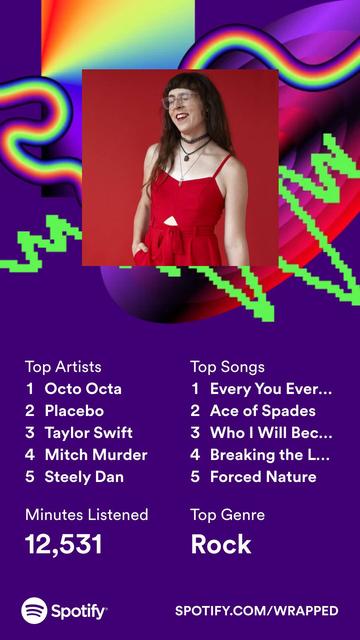
    Well, friends, it’s that time again. As the year slowly stumbles past the 11/12ths mark on its way to an ignominious conclusion, those of us who use the ethically debatable and problematic Spotify streaming music services go through the annual ritual of shaming ourselves with the sharing of our Spotify Wrapped results. This is a weird combination of humorous public self-humiliation (“Haha, look at what a disaster of a human being I am!”) and ironic hipster humblebrag (“Also, look at what an edgy disaster I am!”).

    Please understand, I am not exempting myself from this judgment. On the contrary, I fully acknowledge my own moral culpability in this cultural phenomenon, as I’m about to demonstrate. Below is my own Spotify Wrapped, which amply demonstrates what an edgy disaster ya girl really is. Below the image, you’ll find some explanations to translate this image for folks who aren’t familiar with some of these artists or songs.

    top artists

  • Octo Octa
    Maya Bouldry-Morrison, a.k.a. Octo Octa, is an American DJ and house music producer. She’s also transgender, which isn’t especially relevant, except that it’s part of what initially brought her to my attention, and part of why her music became part of the soundtrack to my own transition.
  • Placebo
    The duo of vocalist-guitarist Brian Molko and bassist-guitarist Stefan Olsdal, Placebo are usually branded as “Britpop,” alongside bands like Oasis, Blur, and Suede, but that obscures the underlying darkness and real edge in their music—less “pop,” more “post-punk”—and overlooks their inherent, unapologetic, confrontational queerness.
  • Taylor Swift
    How can 300,000,000 teenage girls be wrong?
  • Mitch Murder
    Sweetness and melancholy, fear and nostalgia, comfort and an odd underlying sense of unease are the order of the day for this Swedish synthwave pioneer, who makes soundtracks for Eighties movies that never existed—and remakes movie soundtracks that did exist in ways you never knew you needed.
  • Steely Dan
    Donald Fagan and Walter Becker’s contribution to the canon of the 1970s has been called many things over the years: yacht rock (flat-out wrong), dad rock (debatable, depending on your dad), jazz fusion (I guess?), soft rock (heh), art rock (oh, just stop). I think of them as the ultimate hipster band: too self-involved to open up emotionally and too self-possessed to really commit to anything but their own sardonic wit, but also, too goddamn talented to let either of those qualities sabotage them.
  • top songs

  • Every You Every Me
    This Placebo song is far more relevant to the girl I used to be, well before I knew I was one. Every time I listen to it, I want to hug her, tell her everything will be alright, and encourage her to make better choices.
  • Ace of Spades
    Motörhead’s ode to poker, gambling, living fast, dying tough, and being an unmitigated badass will never not be awesome.
  • Who Will I Become
    The way the beautiful, yet somehow queasy water-droplet opening notes of this Octo Octa track give way to jittery house percussion and bass have ensured its place as one of the musical themes for my transition.
  • Breaking the Law
    I’m a queer metalhead (among many other things) who grew up poor in the Eighties. This song is one of the most punk tunes Judas Priest ever released, and it was basically tailor-made for me to love. And I do.
  • Forced Nature
    The opening track of Octo Octa’s debut album Rough, Rugged and Raw is strangely more assured, cooler, more metropolitan than many of her later songs… and yet, there’s an underlying uneasiness to it, one she would develop as a central theme on later albums.
  • observations

  • These two lists couldn’t brand me more blatantly as middle-class, white, queer, ruefully bourgeoise, transfeminine, and nerdy. Not to say that someone who doesn’t have that set of qualities can’t or wouldn’t like any or all of these artists and songs… but, based solely on these available evidence, is anyone at all surprised this Spotify Wrapped belongs to a white Gen X trans girl? No. No, they would not.
  • Even in the darkest moments, a good melody can still steal my heart.
  • If someone ever finds a way of synthesizing sweetness, melancholy, fury, innocence, sardonicism, electronic soundscapes, and guitar riffs that can etch steel, I will write that artist’s name across my heart forever.
  • Over the past year, I’ve been nervous, unsettled, worried, even scared. I’ve looked to music to reflect my emotional state, but also to comfort me in the midst of it. In that, the past year has been no different from any other.
  • As a musician with albums on Spotify, I have mixed feelings about the platform. It’s deeply problematic for a lot of reasons, but it’s also a means of income for many artists, and a way to connect them with listeners. There’s no winning the argument, so I decline to argue about it. Life is short and full of misery, too many wrongs are crying for justice, and moral superiority is a shitty prize. Listen to the music wherever you can, pay artists as much as you can, and fight to make the world a better place, however you can.
  • You know I’m born to lose
    And gambling’s for fools
    But that’s the way I like it, baby
    I don’t wanna live forever

    And don’t forget the joker

    —Motörhead, “Ace of Spades” (1980)

    https://reimaginedgirl.com/2023/12/06/08-spotty-fi-rekt/

    #howToBeTrans #meta #music #spotify #spotifyWrapped #thinkyThoughts

    I was chatting with a transfeminine friend of mine about the trials and tribulations of being a trans femme in America 2023, and I found myself saying that, as much as things out here might suck, I’d still rather be my actual, authentic self—that is, a nonbinary transgender woman—than go back to pretending, ineffectually at best, to be a man. I’ve known more real connection, more genuine peace within and outside of myself, and more sheer joy in the time since admitting that I’ve been a girl the whole time than I had previously believed was possible.

    This all came to me in a flash as I found the words forming in my brain:

    “Better to be a girl in Hell than a boy in America.”

    And then, as often happens when I’m in the midst of making a grandiose pronouncement during a hyperverbose rant, I realized I was paraphrasing someone else’s words… in this case, none other than Satan—you know, Lucifer? The Morning Star, the Lightbringer, first of the Fallen?—by way of John Milton:

    The mind is its own place, and in it self
    Can make a Heav’n of Hell, a Hell of Heav’n.
    What matter where, if I be still the same,
    And what I should be, all but less then he
    Whom Thunder hath made greater? Here at least
    We shall be free; th’ Almighty hath not built
    Here for his envy, will not drive us hence:
    Here we may reign secure, and in my choyce
    To reign is worth ambition though in Hell:
    Better to reign in Hell, then serve in Heav’n.

    Paradise Lost, book I, lines 233-242

    Just so, John. Just so.

    Am I saying that being transgender is a Luciferian rebellion against the Almighty? Not precisely, no. It’s not an entirely inaccurate comparison, but I think I’d prefer to go with “Promethean,” in the sense that, through our exploration and expansion of gender and the ways it intersects with all of human experience, we bring fire (change) and light (knowledge) to humanity… and, for our trouble, end up chained to a rock having our livers torn out by a vulture.

    Okay, maybe that’s a crap metaphor, too.

    My point is, I’d rather be hated for who I am than loved for who I’m not. Yes, it’s a cheesy adage I originally saw on a pinback button in the ’80s, but that doesn’t make it any less true. Through dangers untold and hardships unnumbered, with a little help from my friends and a lot from my wife, I fought my way here to the castle beyond the Goblin City, found the girl I was always supposed to be, and realized I’d been her all along.

    If the price for that knowledge is that I have to deal with an endless wave of bullshit, hatred, and fear… well, we already covered that.

    Better to be a girl in Hell than a boy in America.

    https://reimaginedgirl.com/2023/11/26/07-a-girl-in-hell/

    #howToBeTrans #mastodon #thinkyThoughts

    07. a girl in hell

    I was chatting with a transfeminine friend of mine about the trials and tribulations of being a trans femme in America 2023, and I found myself saying that, as much as things out here might suck, I…

    re:imagined girl™

    One week ago, I was in Munich, Germany at a division meetup with over 300 of my coworkers. I spent a non-trivial portion of that time specifically in the content of being an “out and proud” queer trans woman in a position of relative visibility, both as one of the leads of the company’s LGBTQIA+ employee resource group and as a presenter for two different events. During the week I was there, I had to be “on”—performing the public version of Tamsin, what I think of as the “safe-for-work version” of myself—for at least 12 hours a day, every day.

    This was every bit as exhausting as you might expect.

    Being one’s true self is already a kind of vulnerability, and all the more so when one’s true self is a societally-acceptable target for violence. Adding the SFW component to the situation adds another level of vulnerability, as the professional environment takes many of the tools we use to defend ourselves off the table. In theory, this added vulnerability is ameliorated by the social constraints of professional decorum, but as anyone from a marginalized demographic can attest, that’s often not how things actually work in the real world. Even in a workplace as progressive as mine—and it really is, by and large—the prospect of being one’s whole, authentic, unadulterated, unvarnished self carries with it the possibility of interacting with people who object, not to my behavior, but simply to the fact of my existence, or of some facet of my existence.

    This is especially true for those of us whose which have been politicized, as have various letters within the LGBTQIA+ acronym have.

    Those of us whose selves have been relegated to the position of “identities” have often responded to this situation by creating that “safe-for-work” version of ourselves. This is the version of ourselves which responds to insensitive questions and unintentional microaggressions with gentle smiles and reassurances that, no, really, it’s fine, I don’t mind answering those questions, and yes, of course it’s okay that you used the wrong pronouns for me despite literally having never known me as anything other than a woman. And so on, and so forth, one day after another, one under-slept day smearing into another, coiling tighter and tighter into a resilient ball of stress papered over with cheerful smiles and witty banter, until I reach the end of the week and it’s time to fly home, back to a space where I can uncoil and stretch and collapse into a heap, finally my whole entire self for the first time in a week.

    And in that moment, I’m reminded that “safe for work” is about managing perceptions and protecting others, both of which are good and valuable things to do… but there must also be a concomitant time and space to be “safe at home,” to be one’s whole self, unmodified by others’ expectations and needs. I know for myself that, without that time, I begin to feel suffocated, and find it increasingly difficult to be that SFW version of myself.

    (Note to self: build “recuperation time” into schedule while travelling for work.)

    After writing the above, I asked my wife if it made sense and, ironically, if it was safe enough to post publicly. She responded, “Of course. You’re just talking about masking,” which is both entirely true and kind of funny. I often forget my neurodivergent traits until they’re pointed out to me, especially when they sit at the intersection of my neurodivergence and my queerness.

    So it goes.

    https://reimaginedgirl.com/2023/11/18/06-safe-for-work/

    #howToBeTrans #work

    06. safe for work

    One week ago, I was in Munich, Germany at a division meetup with over 300 of my coworkers. I spent a non-trivial portion of that time specifically in the content of being an “out and proud&#8…

    re:imagined girl™

    [Content warning: This blog post contains non-graphic mention of gender-affirming surgeries, with links to resources about same.]

    One evening back in the dark days of early 2020, when I was just starting my transition, my wife and I had a conversation while making dinner in which we discussed what, if any, medical interventions I might want to pursue as part of my transition. I wanted to move slowly, in part because I try to be a careful girl, and in part because I wanted to learn as much as I could before I made any irrevocable choices. I already knew I wanted to explore hormone replacement therapy (HRT), but I found anything that involved scalpels to be, frankly, kind of terrifying. “I don’t know that I’ll ever want to get surgery,” I said.

    So, it turns out I was entirely wrong.

    This past May, I had a bilateral orchiectomy, which is a procedure where… you know what? I’ll just let Wikipedia explain it. Go read that, then come back.

    Back now? Okay. So, yeah, I had one of those, and I am not exaggerating when I say that the procedure was easily one of the happiest, most affirming things I’ve ever done for myself. I observed at the time that both my excitement leading up to the orchi and my delight and satisfaction in the days following both stand as pretty strong indicators that, yes indeed, I really am a trans girl. After all, no cis man reads about an orchi and thinks, “Hey, that sounds like fun!” Quite the contrary: any cis men who’ve made it as far as this sentence, even the progressive and open-minded ones, are likely to have winced somewhere in the course of this paragraph. That’s called empathy, “the ability to relate to another person’s feelings by imagining yourself in their situation” (Scribbr), and we like to encourage that kind of thing around here.

    The thing is, residual soreness and discomfort notwithstanding, my overriding feeling was one of intense, joyful relief. I felt lighter[1], happier, more myself than I ever had. In casting this part of myself into the fire—literally, since it likely went into a medical waste incinerator—I had taken a step towards affirming, not only my gender, but my bodily autonomy. I was asserting that I truly belonged to myself, not to some archaic set of assumptions about who I was “supposed to be,” or what any part of my body was supposed to mean.

    And let’s be honest, as symbolic repudiations of masculinity go, that one’s pretty baller.[2]

    But I didn’t ask you here tonight to talk about my subsidiary divestment in May, as funny as that may (or may not) be. Rather, I came to talk about my face.

    And to talk about my face, I have to talk about growing up in the ’70s and ’80s as a girl who didn’t know she was a girl.

    Back to that conversation in early 2020: my wife asked what medical interventions I’d be interested in, and I denied wanting any kind of surgery… but then I qualified it:

    “Okay, I could maybe see myself wanting to get facial feminization surgery.”

    I’ve always had a fraught relationship with my own body (quelle surprise!), and that is nowhere more apparent than in my feelings about and towards my face. I’ve always shied away from compliments, but most especially compliments about my appearance. I’ve never had a face one could call “handsome,” not even when I was doing my best inept impersonation of an untraumatized, reasonably together male human being. Instead, I was called “adorable,” “cute,” or, well, “pretty.” I was a “pretty boy” back in the mid-to-late 1980s, when being a “pretty boy” without the concomitant rakish “bad boy” attitude or aesthetic got you immediately branded as gay. It didn’t help any that, far from being a “bad boy,” I was very much a nerd. I liked fantasy and SF novels, I played D&D, I listened to weird “alternative” and “progressive” music, and rather than trying out for sports or taking wood shop as an elective, I mostly hid in my bedroom and skipped P.E. as often as possible, as far away from “other boys” as possible.[3]

    The hilarious thing is, I wasn’t even cool enough to do any of that with the other outcasts. I was too nerdy and awkward to hang out with the “progressives”[4], I was too wispy and queer to hang out with the nerds who liked computers and SF novels and D&D, and I was too broadly-interested and socially inept to hang out with the artsy queer kids. I had a small handful of surface-level friendly acquaintances at school, and that was that. Mostly, I stuck to myself, indulged in my weird little life, and did the weird little things that made me happy, or at least less miserable.

    That whole time, though, I was profoundly unhappy. A large part of that was being one of the school’s designated “acceptable targets” for abuse, but a lot of it was also the profound sense of disjunction I felt in every waking moment of my life. I could feel my body changing all around me, the obvious outcome of a testosterone-driven puberty, and I found it utterly, unspeakably revolting. The oily skin, the voice change, the broadening and bulking in places I had been slender, and the hair… oh, gods, the hair, wiry and coarse, growing everywhere, like an unwelcome new housemate’s belongings spreading out of their room to overtake every corner of what used to be your home.

    Most of all, there was my face. I’d never really thought much about my face up to that point. It was just where I kept my eyes, nose, and mouth. Look out the one, sniff with the other, and use the third to talk and eat. Simple. It took up no more of my thoughts than did my left elbow… until adolescence, that is. Puberty hit like a cluster bomb, and suddenly my face was a greasy constellation of inflamed skin and clogged pores, topped with a bushy unibrow and terminating in a nonstop wave of spiky, wiry stubble, springing like Spartoi from the fertile ground of my cheeks and chin.

    I looked in the mirror, and what I saw disgusted me. I was gross. I was ugly. I was male.

    I was also adrift in the mid-to-late 1980s, when no one knew what “dysphoria” meant, “gender identity” hadn’t been coined as a phrase, “transgender” only just barely existed as a word, and “transsexuals” only existed in fiction, old news stories, and hushed whispers. I’d seen The World According to Garp, the Walter Hill adaptation of John Irving’s novel, so I knew that transsexuals existed—John Lithgow’s portrayal of Roberta Muldoon made her easily the most likeable and sympathetic character in the story—but that was fiction, you understand. That wasn’t real. That wasn’t an image in which I could see myself, not something to which I could aspire. After all, even though Roberta was a woman, the actor playing her was a man, what we’d call a cisgender man today. As amazing as Roberta Muldoon was, and as sensitive a performance as Lithgow gave, this was still just a man, dressed up as a woman. And that was, hands down, the best representation of a transgender woman I’d seen.

    If I were going through adolescence today, I likely would’ve already figured out that I was a girl. I might’ve already socially transitioned, and would quite possibly be on puberty blockers. This was the ’80s, though, so instead of transitioning as a teen, I flailed. I grew my hair out in a classic ’80s mullet, à la Bon Jovi, only without any basic knowledge of hair care or styling products. I got my ear pierced—the “gay ear,” no less!—at the Claire’s Boutique in the mall. I tried to wear clothes that wouldn’t stand out: graphic t-shirts or untucked button-down shirts with the sleeves rolled up, jeans with the knees blown out, sweatshirts. I became compulsive about showering, washing my hair, and shaving off every shred of facial hair, every single morning. I had no idea why I felt so strongly about these choices, only that I did. I was surrounded by boys with short hair, boys with facial hair, boys who wore Polo shirts and Dockers, boys who fit perfectly into the mould of Southern masculinity, and I didn’t know much, but I knew for damn certain I didn’t want that. Store clerks would mistake me and my girlfriend for two ladies (just gals being pals, amirite?) and I found it thrilling, but I didn’t know why, so I masked my delight as amusement. Dudes would call me homophobic slurs, and I’d just smirk or sneer and go on about my day.

    I didn’t know what was going on with me, but I knew that whatever it was, it was something real. I just wished everyone would leave me alone long enough to figure it out.

    That’s the thing about normative culture: it has a vested interest in not leaving you alone long enough to figure it out, especially if what you figure out is directly counter to its plans for you. So much of what passes for “culture” is just a system of social control: mechanisms for imposing and reinforcing norms, rewarding compliance, and punishing divergence. In many ways, that’s what culture is for: it binds a group together, establishes rules and expectations, and provides an identity. However, that only works to the extent that everybody involved is willing to be told who they are and what they should be doing, and that only works when each person is subjected to an essentially constant surveillance of their identity and behavior.

    This principle can be appropriately illustrated by looking at the dramatic rise in the self-realization of transgender people following the social isolation of the COVID-19 pandemic, beginning in early 2020.[5] Suddenly, everyone was spending a lot more time at home, feeding sourdough starters or learning to crochet, away from that constant scrutiny and reinforcement of their public persona. It only makes sense that some of those folks, freed from the constraint of society’s gaze, learned a few things about themselves… like, for instance, that their gender wasn’t what they’d been told their whole lives it was.

    Back in the ’80s, though, there was no conveniently-timed global trauma event to force me into the kind of introspection which leads to name changes and growing boobs. There was just me, alone on a Thursday evening, staring at my face in the mirror and hating it, or “joking” with my friends about wanting to draw lines on it with an X-Acto knife.

    A funny thing happened, though: the ’80s ended, as did my tenure in high school. The ’90s got under way, I got into (and ran away from) college, I aged into my twenties, and I realized that being a skinny queer “boy” with elfin features and a vocabulary inherited from nerdy authors was, in certain circles, actually kind of attractive, even sexy. I went from having virtually no friends to having several, spread out across multiple social groups, with girlfriends and lovers and occasional one-night stands amongst them. I was a hot mess, mind you, but for some folks, the emphasis was definitely on hot. I remained uncomfortable being seen as “a guy,” but the social circles in which I moved were made up of queer and queer-adjacent folks, so “masculinity” was understood with at least some degree of fluidity. It was fine. This was fine. I was fine.

    As night follows day, the ’90s led to the ’00s. I settled into marriage with someone I was pretty sure I loved and worked on having something like a career and a life. I still wasn’t super thrilled about being gendered as a male, but mostly it didn’t impinge on my life too hard… at least, not superficially. If I were to look too closely at the mechanisms of the life I’d found myself in, though, I could see the machinery of gendered expectations working away beneath the surface: be a man, be a father, be strong, be the thing you least want to be in this life. What I was seeing, albeit dimly, was the mechanistic system of social control I described earlier, which the Wachowski sisters famously identified in 1999 as “the Matrix.”

    Funny story: my then-wife would occasionally ask why I never grew out my facial hair. I had a set array of responses: I hated how it felt, it was too much work to keep up, or it made me look like the Master‘s annoying kid brother.[6] Those were mostly true, as far as they went; I did hate how it felt, and the idea of regularly maintaining a lawn in front of my house was enough of a drag, much less maintaining one on my face. Really, though, it was because facial hair was a step too far, the line I wouldn’t cross. I couldn’t quite bring myself to shave off all the body hair that made me feel ill to contemplate[7], because I knew doing so would Raise Some Questions, both externally and (gulp!) internally. Shaving my face, though? Totally normal. Lots of people shave their faces! Definitely not a sign of gender weirdness!

    Right around this time, I would also start occasionally plucking my eyebrows. I’d already gone ham on my unibrow in the early ’90s, with blessedly successful results, so it wasn’t a threatening concept, and the occasional tweezing made me feel better. Cleaner, somehow, and less… something I couldn’t identify—or didn’t want to identify—as “masculine.”

    The early ’00s were also when the Internet first became a part of my everyday life in a big way. I’d been online for well over a decade, on local dial-up BBSes, but 2001 was when I first got involved with anything approaching “social media,” by way of LiveJournal. It’s difficult to explain just how earthshaking LiveJournal was for those of us who used it, but I’ll summarize it like this: without LJ, I wouldn’t know many of the people I now consider my closest friends and family members. I wouldn’t have been a gigging musician in the local scene. I might not have reconnected with the person I met on the BBSes in the ’90s and dated for two months… and who would later become my second (and current) wife, my partner in life, love, magic, and adventures.

    And it would’ve taken me a lot longer to learn that “transgender” was A Thing People Could Be.

    I came close to transitioning in 2002 as a result of LiveJournal and the Internet. Not through some sort of “social contagion” bullshit, mind you, just through learning that trans people existed, and that there were actually paths between point A (living as a cisgender person) and point B (living as a transgender person). Of course, it was 2002, so the information I found about trans issues was Not Great. I was reading an article about “male-to-female sex reassignment surgery,” illustrated with extensive photos of the process, when I came to the realization that I didn’t really want to go through that. Huh, I thought, I guess I’m not transgender. Oh, well. Maybe there’s another word for… whatever I am. This thought was accompanied by what I can only describe as a pervasive feeling of disappointment and loss.[8]

    And on through my thirties, with the birth of my daughter dropping a bright and joyful exclamation point midway through the decade, accompanied by an intense relief that she’d been born a girl… and, more to the point, not a boy, because what the hell did I know about raising a boy?[9]

    Life went on, through the ’00s and into the ’10s. We moved to Seattle, my first marriage ended, and my now-wife and I married. All the while, my genderfeels were percolating there in the background: not gone, not raging, just… dormant. About a year after our wedding, I came to realize that, whatever I might be, I wasn’t a man, a boy, a guy, a male. I first latched onto the label genderqueer, which was a revelation unto itself—did you know you could queer gender? Amazing!—and then onto nonbinary, a marvelously open-ended concept that, far from imposing any constraints or limitations, seemed to completely blow the walls out. Embracing myself as nonbinary felt like a way of freeing myself not only from the expectations of masculinity, which had never once felt like they actually fit me, but from the entire binary structure of gender as expressed in Anglophone culture.

    It felt like taking the red pill and escaping the Matrix.

    Midway through the ’10s, I went back to school, initially for Computer Science (insert your preferred joke about trans people in STEM here), then switching to a multidisciplinary degree in Society, Ethics, and Human Behavior when I entered the University of Washington Bothell. This lasted all of a single quarter, until I learned of a new degree program being instituted at the University, whereupon I became the first person at the school to declare my major in Gender, Women, and Sexuality Studies.

    This action, as Life is Strange so beautifully puts it, would have consequences.

    In the GWSS program, I was exposed to an array of theories and philosophies of gender, sexuality, and feminism, and learned the histories of women and people of other marginalized genders from all over the world. I was utterly enthralled. This, at long last, was the academic wellspring from which I’d longed to draw water. I found myself involved in research projects, working with professors and staff members to preserve archival materials and present data about issues of social justice, gender equity, and—most pertinently to the topic here—transgender rights and safety. I immersed myself in works by Judith Butler, bell hooks, Gayle Rubin, Audre Lorde, Gloria Anzaldua, and so many more, brought to my attention by fabulous professors who had such a genuine passion for the material that I couldn’t help but respond in kind.

    And somewhere in the middle of all of that, I had an idea, one that hit my brain like a shower of sparks across a pile of dry kindling, which led to my spending the next couple of years writing the blog posts and essays which would ultimately become my first published book, Outside the Charmed Circle: Exploring Gender & Sexuality in Magical Practice.

    I graduated from UWB in June of 2017, and wrote the first draft of OTCC during the Summer and Autumn of 2018. I did two more drafts in the following months, and the book was published on January 8, 2020.

    Ten days later, my wife asked me if I was a woman.

    That simple question was the start of a lot of questions, conversations, and introspection, culminating in a realization which, as I think I’ve amply demostrated over the course of this writing, I’ve been dodging for most of my life, to wit: I’m a girl.

    Or, to get technical, I’m a nonbinary transgender woman, meaning that my gender identity is centered around my experience of femininity and womanhood, operating within a non-dualistic understanding of gender as something less akin to a coin and more to a spectrum, or an amorphous cloud in which “female” and “male” can be considered as unrelated poles (as opposed to “polar opposites”), and this is precisely the kind of verbiage I went to university to learn, but which most folks probably don’t have the patience to sit through, which is why I usually shorthand it as, “I’m a girl.”

    However, realizing you’re a girl is one thing. Figuring out how to move forward in your life as a girl, and what kind of girl you are (or want to be), are quite different things. Sometimes I refer to these as the problems of How to Be a Girl and How to Be Trans, and the questions those problems raise are a central part of the work I’ve done on myself in the intervening years since my wife first helped me out of my egg.

    And that brings us right up to the present… by which I actually mean, back to the beginning, a perfect Ouroboros of navel-gazing. Somewhere in all of that, I touched on the issue of my face, but never quite came out and just plainly said what I came here to say, did I? That’s pretty on-brand for me, to be honest… but let’s stare that right in the face and answer it:

    For as long as I can remember having thoughts about it, I’ve felt unhappy about my face, and those feelings of unhappiness have only increased as puberty and age have had their effects on me. I find myself now, a few years into my gender transition as a trans woman, in a place in my life where I can actually consider the prospect of pursuing facial gender-affirming surgery, also known as facial feminization surgery, as a viable possibility.

    I’ve considered it, and after discussing it with my wife, my therapist, and more complete strangers in the healthcare and insurance fields than you would believe, I’ve decided to pursue it.

    My surgery is scheduled for January 4, 2024.

    I intend to write about it here: the process leading up to the surgery itself, the recovery process following the surgery, and my thoughts and feelings about everything along the way. My posts here won’t all be this long, I promise. Some days, they might just be brief notes written through a painkiller haze. Other days, I might wax prolific, as I’ve done here.

    As Joan Didion wrote in the aptly-titled Why I Write,

    I write entirely to find out what I’m thinking, what I’m looking at, what I see and what it means.

    I’m not saying I want to grow up to be Joan Didion. I’m just saying, damn.

    Just so. I write so I can know what I think, how I feel, and what it all means.

    If you’re reading this, I invite you to follow along as I stumble through that process of self-discovery. I can’t promise profundity, deathless prose, or even basic coherence. What I discover might be self-indulgent, revelatory, mundane, magical, or all of them at once. Perhaps, like this lengthy stretch of words, I’ll wind my way through all of this verbiage only to find myself back where I started, having circled completely around the point, only to find myself looking back at myself… albeit with a slightly different face than before.

    If nothing else, though, it should be amusing. I’m hilarious when I’m stoned on painkillers.

    Welcome. 🖤

    [1] A joke I made at least a dozen times during my recovery was that I was now exactly two stone lighter. That my wife did not divorce me for this is a testament to her love for me.

    [2] I’m so sorry. (Okay, I’m not really sorry, but I feel like I should be, which must count for something.)

    [3] At the time, a penchant for reading, rolling dice, and listening to The Cure was considered deeply gay… which, I mean, fair. (Just kidding! Or am I?)

    [4] ’80s-to-modern translation: “goths,” “punks,” “emos,” “scene kids.”

    [5] I started cracking in December 2019, and fully cracked with my wife’s assistance in January 2020, so I missed being part of the “trandemic” of 2020… or, looked at another way, some part of me anticipated the rush and got in early.

    [6] At the time, I thought this response was both witty and funny. Today, I find the fact that I thought this was both witty and funny absolutely hilarious.

    [7] Other than the times I did so to perform in costume as a Catholic schoolgirl and as one of Robert Palmer’s backup bandmembers… but let’s overlook that, shall we?

    [8] Future!me has come to realize that past!me was kind of a dummy. She did her best, though, and we’re all still here, so I try not to be too harsh.

    [9] Yes, the gender essentialism here is positively breathtaking. It was the mid-’00s, I was in my early 30s, and I didn’t know a damned thing about gender theory. For what it’s worth, my daughter has grown into a delightful young woman who shows every indication of being perfectly happy with her assigned gender. Should that change, so will my language.

    https://reimaginedgirl.com/2023/11/16/05-operation-polymorph-prelude-t-48/

    #howToBeAGirl #howToBeTrans #noTakebacks #operationPolymorph

    Transgender hormone therapy - Wikipedia