Breaking Down the USB Keyboard Interface with Old-Fashioned Pen and Paper
What is better for gaming, old PS/2 style keyboards, or modern USB devices? [Ben Eater] sets out to answer this question, but along the way he ends up breaking down the entire USB keyboard interface.
It turns out that PS/2 and USB are very, very different. A PS/2 keyboard sends your keystroke every time you press a key, as long as it has power. A USB keyboard is more polite, it won't send your keystrokes to the PC until it asks for them.
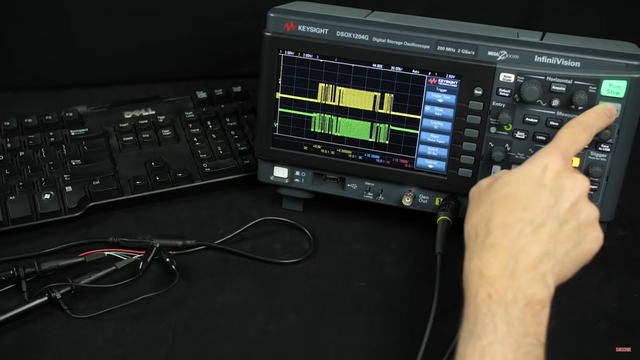
To help us make sense of USB's more complicated transactions, [Ben] prints out the oscilloscope trace of a USB exchange between a PC and keyboard and deciphers it using just a pen and the USB specification. We were surprised to see that USB D+ and D- lines are not just a differential pair but also have more complicated signaling behavior. To investigate how USB handles multi-key rollover, [Ben] even borrowed a fancy oscilloscope that automatically decodes the USB data packets.
It turns out that newer isn't always better—the cheap low-speed USB keyboard [Ben] tested is much slower than his trusty PS/2 model, and even a much nicer keyboard that uses the faster full-speed USB protocol is still only just about as fast as PS/2.
If you'd like to delve deeper into keyboard protocols, check out [Ben]'s guide to the PS/2 keyboard interface, complete with a breadboarded hardware decoder. If these keyboards have too many keys for your taste, you might consider this USB Morse code keyboard. Thanks to Peter Martin for the Tip!
#peripheralshacks #hidusb #keyboard #reverseengineering #usb #usbhid #usbkeyboard
 GeekProjects News
 Valvin (framapiaf)
 hackaday unofficial