GOWERTON: ‘Surely they should have foreseen this?’ — the decade-long fight over homes, schools and mine shafts now in the hands of a Welsh Government inspector

Swansea Council says claims about the Fairwood Terrace development are “misleading and inaccurate”. Campaigners say a village that maintains a memorial to its mining past is being asked to believe the mines came as a £10m surprise. The documents tell a story a decade in the making.

A bitter dispute over one of Swansea’s biggest housing schemes has erupted into the open — with the council accusing campaigners of spreading “misleading and inaccurate claims”, and campaigners accusing the council of hiding the numbers behind proposed cuts to affordable housing and school funding.

At its centre is the plan for 216 homes at Fairwood Terrace in Gowerton — refused by the council’s own planning committee, and now in the hands of a Welsh Government inspector.

Persimmon Homes is proposing 10.2% affordable housing on the site, against the 20% the council’s development plan seeks for the wider area — and no money towards schools.

Those are the developer’s proposals, set out in a legal undertaking offered as part of its appeal to the Welsh Government — not terms the council has accepted, and nothing is yet decided. It will fall to the inspector to determine whether the scheme, and what it would offer Gowerton, is acceptable.

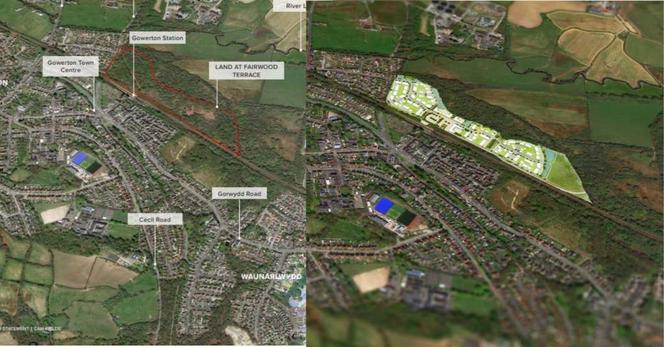
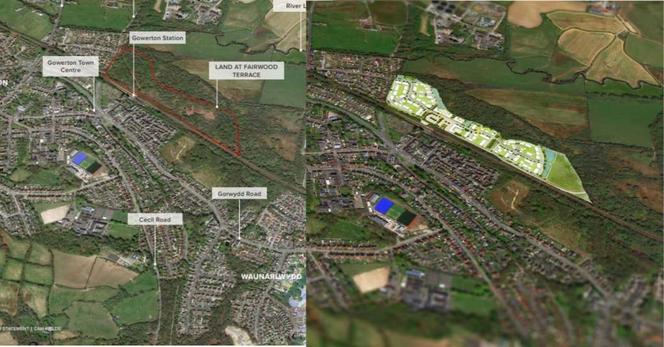
Planning map showing the red‑line boundary of the proposed 216‑home development off Fairwood Terrace, Gowerton. The scheme, refused by Swansea Council in 2024, is now the subject of an appeal by Persimmon Homes and Urban Style Land.

The justification is around £10m in “abnormal” site costs: stabilising old mine workings, dealing with contamination, and other ground problems — costs the appraisal puts at roughly £47,000 for every home built.

Campaign group Save Gowerton From Gridlock, which says it represents some 1,400 residents, believes those costs were foreseeable — and should have been reflected in what was paid for the land, not in lost contributions to the community.

The council and the developer’s appraisal say the costs went beyond what could reasonably have been allowed for when the site was earmarked for housing.

Who is right would help decide what Gowerton gets from the biggest development in its history. And it is a question with a very long tail.

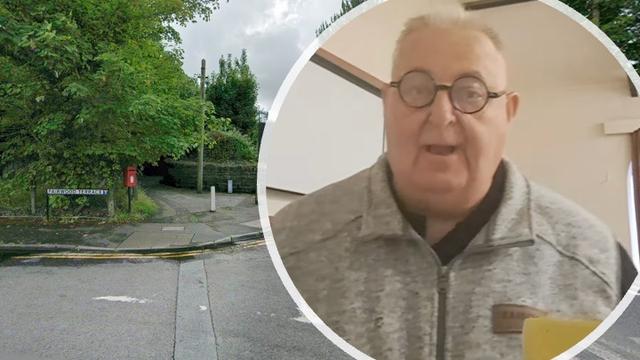
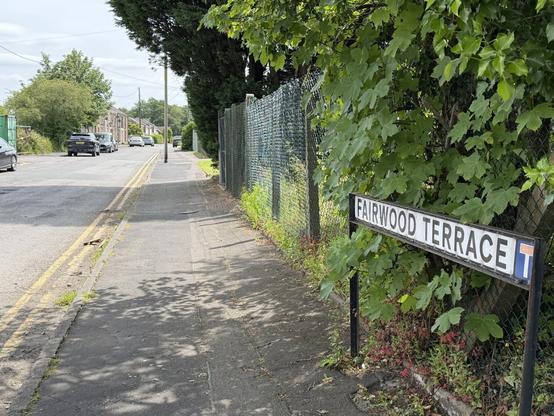
The end of Fairwood Terrace, where Persimmon wants to build 216 homes on former colliery land. (Image: Swansea Bay News)

A village built on coal

The land in this corner of Gowerton was worked for coal for most of the Victorian age — Gorwydd Colliery opened in 1855 and closed in 1890.

The village has never forgotten it. In the centre of Gowerton, schoolchildren spent last year tiling mosaics for the refreshed Mining Disaster Memorial Garden.

And when the former colliery land was first proposed for housing a decade ago, nobody pretended the pits weren’t there.

The site promoter’s own submission to the council’s development plan acknowledged uncapped mine shafts, a structurally unsound colliery chimney, and more than four hectares of colliery waste.

Residents, petitioning alongside their ward councillor, went further — warning the council in formal representations that remediating the land would be so expensive it “raises the question whether the site would be commercially viable to develop”.

They also warned, citing Welsh Water’s own assessment, that the public sewers were unlikely to cope — and that the foul water would end up in the protected Burry Inlet. The site’s promoters said at the time that Welsh Water had confirmed capacity was available.

A decade on, both warnings sit at the heart of the row.

A Save Gowerton From Gridlock campaign sign near the site, reading “No Access Road, No Houses!” (Image: Swansea Bay News)

‘Gold bars’: the first time around

Because this is not the first time a developer on this coalfield has come back after winning permission to say the ground was worse than expected.

Across the railway line from the Fairwood Terrace site, housing association Pobl won consent in 2018 to build 99 homes on the former colliery itself — agreeing to pay £369,076 towards local schools, £35,000 for a crossing, and to make 30% of the homes affordable.

Then the trees came down — lawfully, under the terms of the permission — and the ground was investigated. Pobl told the council the costs were “far greater than was originally anticipated”, and asked to strip most of the school money out.

Swansea’s planning committee refused the first attempt in March 2021, in the face of 342 objections.

“The difficulties that Pobl have found were very clearly highlighted,” Cllr Peter Black told that meeting, citing a previous planning report. Cllr Mary Jones agreed: “We all knew this site would be difficult.”

Cllr Richard Lewis put it more bluntly: “We are giving gold bars away.”

Others argued for pragmatism. Cllr Des Thomas said that if members wanted homes for people in need, “we need to think of where we are today and look for a way forward” — and a second, revised application succeeded a month later.

The contribution to Gowerton Primary School — £272,659 — was removed, with the council’s education department recording it had “no option but to agree”. Welsh-medium school contributions were kept.

Gowerton Community Council objected in terms that read differently five years on: “The promise of the investment was made to secure the application and now Pobl are trying to get out of it due to increased costs. Surely they should have foreseen this?”

And the village’s then sole ward councillor, Susan Jones, issued a warning in her formal objection: “There may be developers looking at this decision and I am sure will be applying to do the same.”

The contractor’s records show mine remediation on that site — drilling and grouting across half the development and the capping of several shafts — was finished by the end of October 2021.

The estate built on the cleared woodland was named Woodland Grove.

The completed Woodland Grove estate, built by Pobl on the former Gorwydd Colliery — where school contributions were stripped out after the ground proved costlier than expected. (Image: Pobl / Codi)

Fairwood Terrace: refusal, appeal and a major blow

By then, Persimmon was already at work across the railway line. According to information later released by the council under environmental information laws, its detailed site investigations at Fairwood Terrace were completed in March 2022 — months before the 230-home plans went to public consultation that December.

The viability appraisal that now underpins the 10.2% affordable offer was commissioned in March 2023 and concluded in January 2024.

It found the scheme could support a blended profit of 19% — at the top of the Welsh Government’s accepted 15–20% range — on homes expected to sell for between £220,000 and £365,000.

In September 2024, the council’s planning committee refused the application on traffic grounds, against officers’ advice — and Persimmon appealed.

In April, the inspector dealt the scheme a major blow, ordering a full environmental impact assessment expected to take six months to a year — accepting the campaigners’ argument that the site cannot be judged in isolation from the development planned around it.

That wider picture includes a 600-home scheme that could create a continuous ribbon of housing from Penllergaer to Gowerton — on a strategic site where the council’s housing blueprint has so far delivered a fraction of what it promised.

Map showing proposed housing developments between Fforestfach, Waunarlwydd and Gowerton, including links to the Fairwood Terrace site and their position opposite Parc Mawr in Penllergaer.
(Image: Litchfields)

Where did the school money go?

The sharpest dispute is over schools.

When the Fairwood Terrace application was assessed in 2024, the council’s own education department set out that the development would generate around 90 pupils, with a total education value of more than £1.7m across all age groups.

It requested full developer contributions for Welsh-medium primary, and for English and Welsh-medium secondary and post-16 places — and warned that rejecting such requests “risks Education being in a position that it is unable to accommodate catchment area pupils in their local school”.

It did not request a contribution for English-medium primary places, because Gowerton Primary was forecast to have spare capacity.

Yet the council’s published summary of the viability appraisal records simply that no education contribution was requested “since there was sufficient capacity identified by the Education Department”.

Asked by Swansea Bay News to explain the gap between the department’s detailed requests and warnings and that summary, the council said children from the development “were assessed as being likely to attend schools in Gowerton where capacity was identified, rather than in existing or proposed schools elsewhere”.

The campaign group also points to the council’s own 2017 evidence for its development plan, which stated the western part of the strategic site would contribute £1.34m towards a new primary school.

The council says it “does not recognise” that figure, adding “it would be wrong to suggest that future contributions towards education provision have been erased” — and that future applications on the wider site may still be required to contribute.

Gowerton Primary School (Image: Tilbury Douglas)

The £10m nobody has seen

Nobody outside the council and the developer has seen what makes up the £10m of abnormal costs.

The group asked for the full appraisal under environmental information laws. The council answered that first request but withheld the appraisal itself, citing commercial confidentiality — then published a summary with Persimmon’s agreement in May, before refusing a 12-question follow-up as “manifestly unreasonable”. The group says it has now complained to the Information Commissioner’s Office, and a separate complaint remains in the council’s own system.

Asked whether it would publish a breakdown of the £10m, the council said an itemised breakdown “would have included some commercially sensitive information” — covering contractual confidentiality, supplier pricing schedules, and “information that could materially affect competitive positions in land transactions”.

Persimmon defended the process robustly. The viability position “is not new”, it said — it was tested during the application through an open-book assessment, “independently scrutinised by viability consultants acting on behalf of Swansea Council”.

Before the committee’s refusal, the developer pointed out, the council’s own planning officers had recommended approval — having “reviewed the viability evidence in detail and negotiated the proposed obligations accordingly”.

Persimmon also points to a safeguard written into the undertaking. Under Schedule 5, a fresh viability appraisal must be submitted with the detailed designs if the appeal succeeds — a review that could see the affordable housing rise above 10.2% should the scheme’s finances improve.

The review can only push the proportion upwards: the resolution underpinning it sets a floor of 10% affordable housing, against the 20% the council’s plan seeks for the wider site.

Asked whether the council will argue against the developer’s viability case at the appeal — or accept it — the council explained how its policy works but did not say. The question is pointed: the package now offered at appeal reflects obligations the council’s own officers reviewed and negotiated before the committee refused the scheme on traffic grounds.

The Welsh Government confirmed the viability evidence will be examined either way. “All relevant matters will be before the Inspector for consideration, including financial viability if this has been raised as an issue in the case,” a spokesperson said — adding that campaigners and other interested parties can submit their own documents to the inquiry. The appeal papers are public on the planning casework portal.

The junction of Fairwood Terrace and Victoria Road, where a new signal-controlled junction is proposed beneath the low railway bridge, opposite Gowerton Rugby Club.
(Image: Swansea Bay News)

What’s actually on offer

The legal undertaking sets out what the 216-home scheme would provide for the community: £60,000 towards a bike hire scheme, £60,000 towards the Elba multi-use games area, £40,000 towards traffic signal upgrades, and £15,000 for a solar-powered air quality sensor.

That £175,000 total, the campaigners say, stands against the millions the council’s own infrastructure plan envisaged for the wider site. The affordable homes that would be built — just over one in ten — would be 82% social rent and 18% intermediate.

The group raises a further question about what the wider site was meant to deliver. It says the infrastructure plan supporting the council’s development plan required a relief road for the strategic site, costed at close to £3m — and that when Fairwood Terrace came forward as the first of the site’s three parcels, it was able to point to the later schemes to provide the road. None of the applications now submitted across the site includes it, the group says. That claim has not been independently verified by Swansea Bay News.

One of the Save Gowerton From Gridlock campaign boards, now weathered and leaning in the grass beside the Fairwood Terrace site.
(Image: Swansea Bay News)

Seller and judge: the council’s own land

There is one more thread: the council is not just the planning authority here. It is also a landowner within the strategic site.

Barratt Redrow confirmed it is in talks with the council. A spokesperson said the company was “engaged in positive discussions with Swansea Council regarding the delivery of a mix of private and affordable homes, alongside new community facilities, at the allocated strategic site in Gowerton/Waunarlwydd to help meet local housing needs”.

Persimmon, asked about similar discussions, did not deny them. “Persimmon routinely engages with a range of stakeholders, including local authorities and landowners, in relation to strategic development opportunities,” it said. “However, we do not comment on commercially sensitive discussions.”

So the council is in discussions to sell land to housebuilders whose applications it will itself determine. The campaign group calls that a conflict of interest.

The council says the allegation is “unfounded”. It “regularly determines planning applications for development on land under its own ownership”, a spokesperson said; decisions rest on planning grounds alone, “entirely, independently of issues of land ownership”, and any decision driven by its financial interests “would leave the decision open to challenge and quashing of the decision by the courts”.

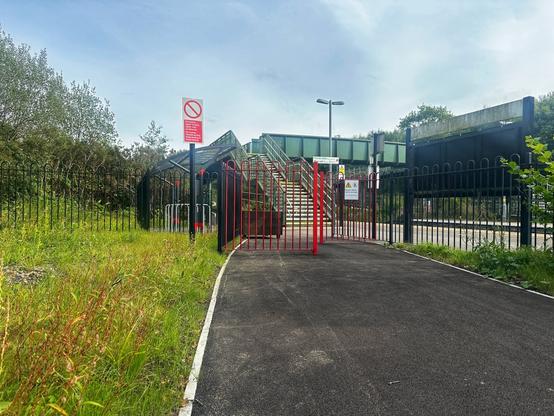
A recently completed walking and cycling path linking Gowerton train station to Gorseinon, skirting the front of the proposed Fairwood Terrace development site.
(Image: Swansea Bay News)

The developers’ case

Urban Style Land, the site’s promoter, set out the developers’ case in robust terms. The company has an agreement with the landowners to appoint a housebuilder and bring it in as joint applicant, director Tim Holder explained — Persimmon having been chosen through a tender process — with targets for housing, density and access all drawn from the council’s adopted development plan.

The application was “totally compliant with the LDP”, Mr Holder said, had addressed every technical issue, and won the support of council officers — who declined to act for the authority at appeal. Despite that, it was refused “by one vote and based on one unrelated reason for refusal”.

“As investors who would go on to become involved in high expenditure and time commitment, Urban Style Land Ltd and the whole team deserved to rely on the policies set out and adopted by the Council,” he said — warning that the refusal left the council facing its own costs and the developers’ costs if the appeal succeeds, and that “future investment in Swansea will no doubt be on a more cautious basis”.

Of the neighbouring Gorwydd Road site, Mr Holder confirmed land remediation had formed part of the project, which he described as “a successful development of Affordable units by Pobl Housing Association”.

A computer-generated image of phase two at Woodland Grove, the Pobl development on the former Gorwydd Colliery. (Image: Pobl / Codi)

The warning that came true

Meanwhile, the warning residents made about sewerage a decade ago has resurfaced — this time from the regulator.

Natural Resources Wales told the council last month that another application on the strategic site — a hybrid scheme including a new school — had not demonstrated sufficient sewer capacity or shown it would avoid adding nutrients to the protected Burry Inlet, and noted parts of the school site sit in flood zones.

Barratt Redrow said it was “working closely with Swansea Council, Dŵr Cymru Welsh Water and industry experts to address the concerns raised by Natural Resources Wales regarding the Burry Inlet catchment, to ensure the development has no detrimental impact on water quality”.

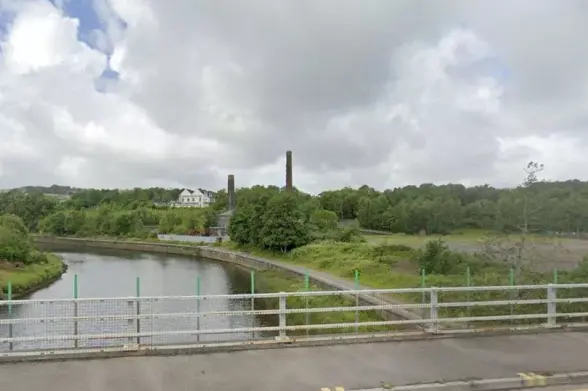
The Burry inlet, a large, biologically rich estuarine complex in South Wales that forms the tidal estuary of the River Loughor.

What happens next

Campaign group Save Gowerton From Gridlock dismissed the council’s statement as “a classic exercise in bureaucratic spin, designed to deflect from a profound lack of transparency”.

“The community is not ‘misunderstanding’ the planning process,” its spokesman Carl Jones said. “We are actively exposing it.”

He returned to the withheld appraisal: “If the developer’s financial excuses are robust, why hide the mathematics from the very tax-paying residents who will have to live with the consequences? This is a community fighting to ensure Gowerton is not treated as a cash cow.”

For now, the scheme is in limbo. The Welsh Government confirmed the appeal “cannot progress further” until Persimmon submits its environmental impact assessment, and that there is no timetable yet for a decision.

When it comes, the inspector will report to the minister with a recommendation — the final word resting with the Welsh Government, not the council that refused the scheme. It will determine more than one field on the edge of one village: it will signal whether, on Swansea’s coalfield sites, the cost of history is carried by the developer who buys the land, or by the communities who live on it.

And in Gowerton, where the children are still tiling the memorial to the men who worked these seams, nobody needed a viability appraisal to know the mines were there.

Related stories from Swansea Bay News

GOWERTON: Housing row — ‘we’re still fighting,’ says councillor as Fairwood Terrace appeal enters decisive phase
Cllr Dai Jenkins vowed the village would keep up the fight as the appeal reached a critical stage.

GOWERTON: Persimmon’s Fairwood Terrace plans dealt massive blow as Welsh Government orders full environmental assessment
The inspector accepted the cumulative-impact argument, ordering a full EIA expected to take up to a year.

7,000 homes promised, just 300 built: Swansea’s housing blueprint falters
How the strategic sites at the heart of the city’s plan have so far delivered a fraction of what was promised.

Continuous ribbon of housing could stretch from Penllergaer to Gowerton as new 600-home scheme unveiled
The wider development picture around the contested Fairwood Terrace site.
#AffordableHousing #BarrattHomes #FairwoodTerrace #featured #Gowerton #homepage #PersimmonHomes #planning #SaveGowertonFromGridlock #SwanseaCouncil #UrbanStyle
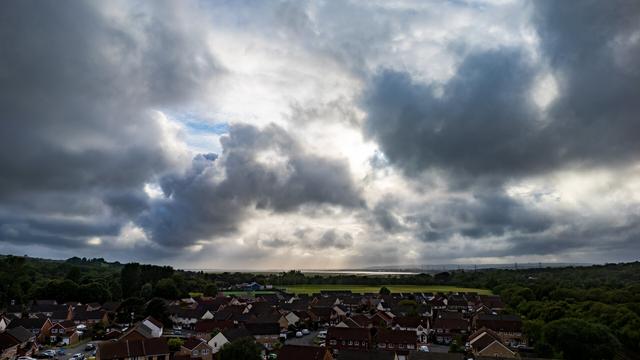
Bit of a dull sunset tonight. Guess it's going to save me watering the plants.
#sunset #Gowerton #South Wales #Wales #gower
Sunset looked good but I only had my DJI Neo 2 to hand so it was jpeg all the way. Still quite happy with these.
#Gowerton #Swansea #SouthWales #DJI #sunset-pics

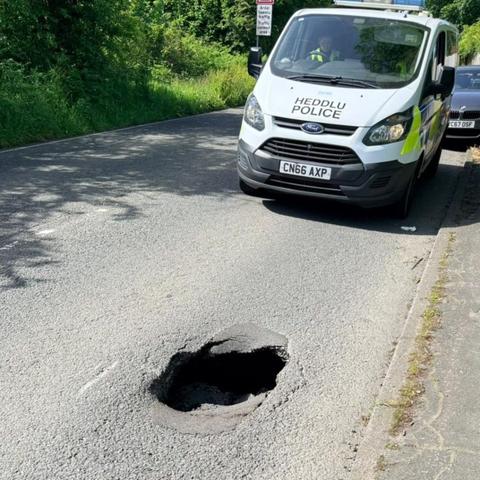
GOWERTON: Council still investigating cause of Cecil Road sinkhole — one month after residents first raised the alarm

The cause of the sinkhole that opened up on Cecil Road in Gowerton remains unknown, Swansea Council has confirmed, with temporary traffic lights now in place while highways teams continue to investigate — almost a month after residents first warned that the ground was sinking.

The local authority confirmed in a statement to Swansea Bay News that one lane of the B4296 between Gowerton and Dunvant remains controlled by temporary lights while officers work to establish what is causing the road to give way. Repairs will follow once the cause has been identified.

Council statement

Responding to questions from Swansea Bay News, the council said its highways team had attended the site after reports of a sinkhole forming at the junction of Cecil Road and Garrod Avenue.

“Our highways teams have recently attended Garrod Avenue/Cecil Road, following reports of a sinkhole,” the statement said.

“The road remains open to traffic and temporary traffic lights have been installed while investigations take place into the cause of the sinkhole.

“Once we have established the cause, repairs will be undertaken as quickly as possible.”

Reported a month ago

The council has now confirmed that the sinkhole was first reported to its highways team around a month ago. Officers responded to those initial reports and carried out a patch repair at the time — but the ground continued to move, opening up further over the bank holiday weekend and reaching the point at which one lane had to be closed and temporary lights installed.

The earliest public warning came from local residents on social media. Writing in a community Facebook group on 29 April, Gowerton resident Ramesy Awad said he had spotted a “new sinkhole appearing opposite Gowerton Comp,” describing a wet patch in the middle of the road that was visibly sinking by the day and “heading towards Garrod Avenue.”

Mr Awad said he had already reported the problem to local councillors the day before — and made what has turned out to be an accurate prediction: “Watch this space for a road closure in the near future.”

Four weeks later, that prediction has come true.

Councillors raised early concerns

In the same Facebook thread, Mr Awad confirmed he had contacted Labour councillor Cllr Louise Gibbard about the problem. He was also responded to publicly by Cllr Susan Jones, who said she had referred the matter to the council’s highways team for further checks.

Patch repair did not hold

The fact that a patch repair was carried out at the time of those initial reports — only for the ground to open up again weeks later — underlines why the council is now looking more closely at what is causing the road to subside.

A routine pothole or surface fault would normally be resolved by such a repair. The continued movement of the ground at Cecil Road suggests a deeper underlying issue, which is what highways officers are now working to identify.

Road remains open

The B4296 between Gowerton and Dunvant remains open in both directions, but drivers should expect delays through the morning and evening rush hours while temporary lights manage flow through the affected section.

The council has not yet given any timetable for completing the investigation, identifying the cause, or starting repairs.

Form for Gowerton sinkholes

This is not the first sinkhole to affect roads in the Gowerton area in recent years. In March 2024 a separate sinkhole forced the closure of another road in the area while investigations and repairs took place over the course of several days.

With the cause of the Cecil Road sinkhole still unknown and no timetable for repairs, residents and commuters using the B4296 face an indefinite period of disruption — a month after the first warning signs were spotted, and despite an earlier attempt to patch the road over.

Related stories from Swansea Bay News

GOWERTON: Sinkhole closes lane on main route to Dunvant — commuters warned to expect delays as month-old warning becomes reality
Our original coverage of the Cecil Road sinkhole and the resident warning that preceded it.

Sinkhole causes Gowerton road to be closed off (March 2024)
A separate Gowerton sinkhole caused road closures and several days of repair work just over two years ago.

More news from Gowerton
Our latest coverage from Gowerton and the surrounding area.

#CecilRoad #CllrLouiseGibbard #CllrSusanJones #Gowerton #Sinkhole #SwanseaCouncil

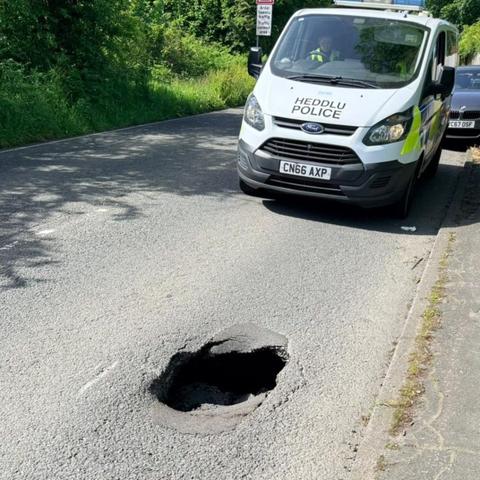
GOWERTON: Sinkhole closes lane on main route to Dunvant — commuters warned to expect delays as month-old warning becomes reality

Drivers using one of the main routes out of Gowerton are being warned to expect delays after a sinkhole opened up on the road heading towards Dunvant.

The hole appeared on Cecil Road — the B4296 — just south of Gowerton Comprehensive School’s main gate, heading in the direction of Dunvant.

Lane closed, lights in place

Temporary traffic lights have been put in place at the site, with one lane closed off around the hole. Officers from South Wales Police were on the scene yesterday evening with vehicles positioned to manage traffic past the closure.

Cllr Andrew Williams, who represents the neighbouring Penclawdd ward and serves as Swansea Council’s Cabinet Member for Development, also confirmed the closure on Facebook last night, alerting residents to the disruption and warning that delays are likely during the morning commute.

In a post on a local community group, Cllr Williams said temporary lights had been installed and one lane was closed, adding that highways engineers were expected to attend in the morning to assess the damage.

A separate report from local resident Paul Terry, shared in another Gowerton community Facebook group, also confirmed the hole had appeared roughly 200 to 300 yards past the school’s main gate heading towards Dunvant.

Spotted weeks ago by local residents

The Cecil Road sinkhole did not appear overnight. A post in the Gowerton Residents Facebook group on 27 April flagged a “wet patch sinking day by day in the middle of the road heading towards Garrod Avenue,” opposite Gowerton Comprehensive School — the same spot where the road has now collapsed.

Local resident Ramsey Awad, who flagged the deteriorating road surface, said at the time he had passed the warning on to local councillors and predicted a road closure “in the near future.”

Replying in the same group, Cllr Susan Jones — Independent councillor for Gowerton ward and the newly-named Deputy Lord Mayor of Swansea — said she had passed the matter on to Swansea Council’s Highways team for inspection.

Swansea Bay News has approached Swansea Council to ask what action was taken between the original report and the road’s collapse.

Key commuter route

Cecil Road forms part of the B4296, one of the principal routes linking Gowerton to Dunvant, and continues as Garrod Avenue as it heads south towards Dunvant village.

The road carries significant volumes of commuter traffic during morning and evening peaks, with parents and pupils heading to Gowerton Comprehensive School also affected.

Alternative routes between the two villages are limited, with most options involving narrow single-track lanes — meaning traffic is likely to back up at the temporary lights through the morning rush.

What happens next

Highways engineers from Swansea Council are expected to visit the site this morning to determine the cause of the sinkhole and the scale of repairs required.

Sinkholes on residential roads can be caused by a range of factors, including failure of underground utility infrastructure, water main leaks, or the collapse of older drainage culverts. The “wet patch” reported by residents weeks ago will be of particular interest to engineers in determining the cause.

The duration of the closure will depend on what is found beneath the surface. Some sinkhole repairs can be completed within a single working day; others — particularly those linked to deeper infrastructure failures — can require lane closures lasting days or even weeks.

Swansea Council has been approached for an updated statement.

This is a breaking story. Swansea Bay News will update as further information becomes available from the council and highways engineers.

Related stories from Swansea Bay News

More Gowerton news from Swansea Bay News
Our latest coverage from Gowerton and the surrounding area.

More Dunvant news from Swansea Bay News
Our latest coverage from Dunvant and the western Swansea suburbs.

#CecilRoad #CllrAndrewWilliams #CllrSusanJones #Dunvant #Gowerton #GowertonComprehensiveSchool #Sinkhole #SouthWalesPolice #SwanseaCouncil

CARMARTHEN: Lumo to launch direct Carmarthen to London Paddington service in December 2027 — with stops at Llanelli and Gowerton

The long-awaited direct rail service between Carmarthen and London Paddington is set to launch in December 2027, after train operator Lumo confirmed it has five new Hitachi trains on order for the route.

The route was first approved by the rail regulator in 2022 after a drawn-out battle with Great Western Railway, which operates its own south Wales to London Paddington services and had opposed the application. The original proposals were submitted by Grand Union Trains, which secured regulatory approval before selling its rights to the route to FirstGroup in 2024.

Lumo – FirstGroup’s open access train brand – will now operate the service, running five return journeys a day between Carmarthen and London Paddington. The service will call at Llanelli, Gowerton, Cardiff, Newport, Severn Tunnel Junction and Bristol Parkway.

A Lumo spokesperson confirmed the launch plans. The service will use single-class standard seating across all five new trains, with the operator describing its aim as bringing affordable open access travel to even more communities.

The route puts Lumo in direct competition with GWR on the south Wales to London corridor – and there is an added layer of complexity to that rivalry. Both Lumo and GWR are owned by FirstGroup, meaning the parent company will effectively be competing with itself on the route.

GWR is also scheduled to be absorbed into Great British Railways as part of the UK Government’s rail nationalisation programme – though the timeline for that transition remains unclear.

GWR said it welcomed enhancements on the route but cautioned that any new services should not be detrimental to existing services or to future services already agreed.

A spokesperson said the company would continue working with industry partners to ensure railway services were developed in the best way for passengers and taxpayers.

Carmarthenshire County Council threw its support behind the original Grand Union proposals when they were being considered by the regulator, making the case that a direct London service would bring significant economic benefits to west Wales.

The confirmation of a December 2027 launch date comes as Welsh Labour separately pledged a direct Milford Haven to London service as part of its Senedd election manifesto, backed by £50 million of investment in the Milford Haven to Carmarthen line.

The Lumo service would not serve Milford Haven or Pembroke Dock directly, but would give passengers at Carmarthen, Llanelli and Gowerton a genuine alternative to GWR on the London route for the first time.

Lumo declined to provide projected passenger numbers for its first years of operation.

Our coverage of the Carmarthen to London rail route

Regulator approves new Grand Union train service from Carmarthen to London Paddington
The 2022 decision that set the route on its current path.

Grand Union Trains submits fresh proposals to run service from Carmarthen to London
The original proposals that started the process.

Council throws support behind new intercity train service between Carmarthen and London Paddington
Carmarthenshire County Council’s backing for the route.

Union flag rail designs unveiled – south-west Wales impact comes later
What GBR nationalisation means for rail services in our region.

#BristolParkway #Carmarthen #featured #Gowerton #GreatWesternRailway #Llanelli #LondonPaddington #Lumo #MilfordHaven #trains #TransportForWales

SWANSEA: Could the city be home to a new Eden Project-style resort? The team behind Xanadoo are actively looking for a site

A world-class visitor attraction inspired by Cornwall’s Eden Project is being considered for Swansea – but the developers say no site has yet been identified and they are actively inviting anyone with a suitable location to get in touch.

The project is called Xanadoo – a name that echoes Samuel Taylor Coleridge’s famous 1797 poem Kubla Khan, in which Xanadu is the pleasure dome of Kublai Khan, a place of magnificence and wonder. Xanadu also featured in Olivia Newton-John’s 1980 hit of the same name, giving the word a warm pop culture resonance for many visitors who would be the target audience. The developers have given it their own distinctive spelling.

Behind the plans is Gaynor Coley, one of the founders of Cornwall’s Eden Project, which transformed a former clay mine into a botanical garden and generated an estimated £6 billion in economic impact for Cornwall and the West Country over 30 years. Coley’s firm, Road to Happiness, which she runs with partner Susan Hill who also worked at the Eden Project, is behind the Xanadoo concept.

Coley, who is originally from Cwmbran, said she believed Xanadoo could do for south Wales what the Eden Project did for Cornwall. “We believe Xanadoo can do the same for south Wales as the Eden Project did for Cornwall. It will bring sustainable tourism, support hospitality and creativity, storytelling, digital and health and wellbeing,” she said.

The prospectus for the project estimates a site could attract 600,000 visitors a year and generate £15 million in annual revenue while employing 250 full-time staff, with an overall economic impact of £840 million over 30 years. The resort would have four core elements – a Gallery of Marvellous Solutions showcasing exhibits currently in storage in galleries and museums across the world; a food and craft market; a Tomorrow’s World innovation exhibit using VR and augmented reality; and a giant playground.

The primary focus of the developers appears to be south-east Wales, with Road to Happiness currently in discussions with Torfaen Borough Council, having previously worked with them on redesigning Greenmeadow Community Farm in Cwmbran. Sites in Torfaen and Blaenau Gwent are being actively considered. Swansea is mentioned as an additional possibility – with Coley saying she is “still open minded” and “actively looking for sites” in Swansea alongside Torfaen and Blaenau Gwent.

No specific Swansea site has been named and no discussions with Swansea Council have been confirmed. Online commenters have already begun speculating about potential locations – with the former Felindre Steelworks site emerging as one suggestion. The 16-hectare Parc Felindre site on the northern fringe of Swansea is the former Felindre Tinplate Works, remediated by a joint venture between Swansea Council and the Welsh Government, but it has remained largely undeveloped despite years of attempts to market it as a business and industrial park.

The steelworks employed 2,500 people at its peak in the 1970s before closing in 1989 – giving the site an industrial heritage that could echo Eden’s own clay mine origins. The site is well connected to the M4 at junction 46, though it sits well north of the city centre and the main tourist corridors.

If Swansea were selected, it would join a city that has been steadily building its credentials as a visitor destination. The Skyline development on Kilvey Hill is transforming one of the city’s most prominent landmarks into a major tourist attraction. The Hafod Morfa Copperworks – where Penderyn Distillery has opened a visitor experience – is being brought back to life as a heritage and hospitality destination in the Lower Swansea Valley.

Plans for an aquarium and lido at the Civic Centre site are also advancing, and beyond the city itself, the Gower Peninsula – the UK’s first Area of Outstanding Natural Beauty – remains one of Wales’s most powerful draws for visitors, giving any major attraction in the area access to an already-established tourist catchment.

Torfaen Borough Council has discussed the project formally, though its deputy chief executive described it as a “potential tourism product” at “very, very early stages.” The concept film produced for Xanadoo describes it as seeking an iconic new-build or heritage site in south-east Wales – a region with a “powerful industrial legacy, dramatic landscapes and major nearby catchments.”

Whether Swansea ultimately features in those plans remains to be seen. Coley has encouraged anyone who thinks there is a location that could be right for Xanadoo to get in touch with Road to Happiness directly.

Swansea’s growing visitor economy

Council approves plan for Skyline development on Kilvey Hill
The ambitious hilltop attraction already transforming Swansea’s skyline.

Welsh business chosen to bring new life to Swansea heritage buildings
The Hafod Morfa Copperworks coming back to life as a heritage and hospitality destination.

New artist’s impression reveals dramatic transformation planned for Swansea’s Civic Centre
Plans for an aquarium, lido and major redevelopment of the civic centre site.

Gower: The UK’s first Area of Outstanding Natural Beauty turns 70
Why Gower remains one of Wales’s most powerful draws for visitors.

All the exciting plans for Swansea as part of the £1bn regeneration programme
The full picture of Swansea’s transformation ambitions.

#EdenProject #Gowerton #SwanseaCouncil

GOWERTON: Persimmon’s Fairwood Terrace plans dealt massive blow as Welsh Government orders full environmental assessment

Campaigners fighting Persimmon Homes’ proposed 216-home development at Fairwood Terrace in Gowerton have won a landmark ruling after a Welsh Government planning inspector ordered the scheme to undergo a full Environmental Impact Assessment – directly accepting their argument that the developer cannot treat each planning application in the area as if the others do not exist.

The ruling, issued by Planning and Environment Decisions Wales (PEDW), reverses previous decisions on the Fairwood Terrace site and represents a significant setback for Persimmon Homes, which had been appealing Swansea Council‘s 2024 refusal of the scheme on traffic grounds. The inspector has ruled that the 216-home proposal cannot be looked at in isolation – it must be assessed alongside the wider strategic allocation, including a 460-home site and a 600-home scheme also promoted by Persimmon in the same corridor.

Save Gowerton from Gridlock, the community group led by Carl Jones which has fought the development for years, described the ruling as incredible news. The group said the inspector’s acceptance of what they call the “salami-slicing” argument – the practice of breaking a large strategic site into separate applications to avoid cumulative scrutiny – was a “massive victory.”

The ruling also found there was “insufficient certainty” that pollution and nutrient levels in the Burry Inlet could be mitigated, triggering what campaigners describe as the precautionary principle – meaning the law now demands the highest level of environmental scrutiny before any decision can be made.

Persimmon Homes now have 21 days to decide their next move. They can accept the ruling and commission the full Environmental Impact Assessment – a process expected to take between six and twelve months and involving expensive, large-scale environmental studies covering traffic, flood risk, pollution and ecological impact. Alternatively, if they refuse to provide the required report, the inspector can effectively dismiss the appeal entirely.

Save Gowerton from Gridlock say they have already contacted PEDW to ensure the group is formally consulted on the scoping of the new studies, giving them the opportunity to ensure that every traffic bottleneck and flood risk is included in the environmental workload.

The Fairwood Terrace site has been at the centre of one of Swansea’s most fiercely contested planning disputes. Plans were first drawn up in 2022, when Persimmon proposed around 230 homes on land between the River Llan and the railway line beside Gowerton station. The scheme also included a new station forecourt with a potential park-and-ride, a bus-only link eastward toward Waunarlwydd, upgraded traffic lights at Fairwood Terrace’s junction with Victoria Road, and a walking and cycling connection through to the neighbouring development site.

The proposal attracted nearly 900 objection letters and a 300-signature petition from residents who feared it would overwhelm already-congested junctions, increase flood risk and damage the character of the village. Swansea Council rejected the scheme on traffic grounds in 2024, despite planning officers advising that refusal would be difficult to defend at appeal. Persimmon subsequently appealed to the Welsh Government, and the case has been with PEDW ever since.

The Fairwood Terrace story so far

December 2022 – Persimmon first drew up plans for 230 homes at Fairwood Terrace, beside Gowerton station, as part of the Waunarlwydd North LDP allocation.

2024 – Swansea Council refused the application on traffic grounds despite officer support for approval, after nearly 900 objection letters and a 300-signature petition from local residents.

October 2025 – Persimmon unveiled a separate 600-home scheme south of the A484, directly opposite Bellway’s Parc Mawr development in Penllergaer, designed to link via an active travel route into Fairwood Terrace – raising fears of a continuous ribbon of housing along the entire A484 corridor.

April 2026 – Barratt and David Wilson Homes submitted a planning application for 430 homes on the Fforestfach/Waunarlwydd site – part of the same wider 716-home strategic allocation – further intensifying pressure on the corridor.

April 2026 – Welsh Government inspector rules the 216-home appeal must undergo a full Environmental Impact Assessment, accepting the “salami-slicing” argument. Persimmon now have 21 days to decide whether to commission the studies or walk away.

The backdrop to the dispute is a proposed continuous ribbon of housing stretching from Penllergaer through Gorseinon, Waunarlwydd and Gowerton along the A484. Persimmon’s separate 600-home scheme sits directly opposite Bellway’s Parc Mawr development in Penllergaer, designed to connect via an active travel route westward into Fairwood Terrace. Further along the same wider 716-home strategic allocation, Barratt and David Wilson Homes have now submitted a full planning application for 430 homes at Fforestfach.

If all the schemes along the corridor proceed, close to 3,000 new homes would be built in a continuous stretch – an amount campaigners say amounts to a new town stitched together along the A484. Today’s ruling that the Fairwood Terrace appeal must be assessed alongside those neighbouring sites is precisely the argument Save Gowerton from Gridlock has been making since the campaign began.

In February, Cllr Dai Jenkins told residents the fight was far from over as the appeal process stretched weeks beyond its original timetable. Jenkins had been pressing PEDW and Natural Resources Wales not to grant further extensions to Persimmon while the developer still owed information on nutrient neutrality and flood risk, and had called for a face-to-face hearing rather than a virtual process.

A montage showing the Fairwood Terrace and Victoria Road junction in Gowerton, with Cllr Dai Jenkins pictured in an inset as he updates residents on the ongoing planning appeal.
(Images: Google Maps / Dai Jenkins)

Today’s ruling vindicates that position. The inspector has accepted that the cumulative impact of the Fairwood Terrace scheme alongside the 460-home and 600-home sites must be formally assessed, and that the environmental uncertainty around the Burry Inlet is too significant to be set aside.

Carl Jones said the group had not yet won the war but had won a “massive battle.” He added that campaigners would continue to monitor the 21-day window closely and push for full consultation rights over whatever environmental studies Persimmon choose to commission, to ensure that every traffic pinchpoint, flood risk and pollution concern is properly included in the scope.

The decision is likely to be studied closely by communities facing similar large-scale planning applications across Swansea and the wider region, where cumulative development pressure along key arterial routes has been a recurring flashpoint.

More updates will follow as the 21-day deadline approaches.

Related stories from Swansea Bay News

Gowerton housing row: ‘We’re still fighting’ says councillor as Fairwood Terrace appeal enters decisive phase
Cllr Dai Jenkins’ February update as Persimmon faced pressure to provide nutrient neutrality and flood risk information.

Continuous ribbon of housing could stretch from Penllergaer to Gowerton as new 600-home scheme unveiled
How Persimmon’s linked schemes could create close to 3,000 homes along the A484 corridor.

Fforestfach: Planning application put in for major housing development
Barratt and David Wilson Homes’ 430-home application on the wider Waunarlwydd North strategic allocation.

Plans drawn up for 230-home development near Gowerton train station
Where it all started – Persimmon’s original 2022 proposals for the Fairwood Terrace site.

#BurryInlet #Environment #EnvironmentalImpactAssessment #FairwoodTerrace #Gowerton #PEDW #PersimmonHomes #planning #PlanningAndEnvironmentDecisionsWales #planningApplication #SaveGowertonFromGridlock #Swansea #SwanseaCouncil

A484: Average speed cameras to be installed between Cadle and Loughor Bridge after years of fatal accidents

A new average speed camera system is set to be installed on the A484 between the Cadle roundabout and Loughor Bridge, as Swansea Council moves to tackle a road that has seen a number of fatal accidents in recent years.

Swansea Council’s cabinet has confirmed the cameras will be accompanied by improved road markings and signs along the route. The scheme forms part of the council’s 2026/27 transport investment programme, backed by Welsh Government regional transport fund money.

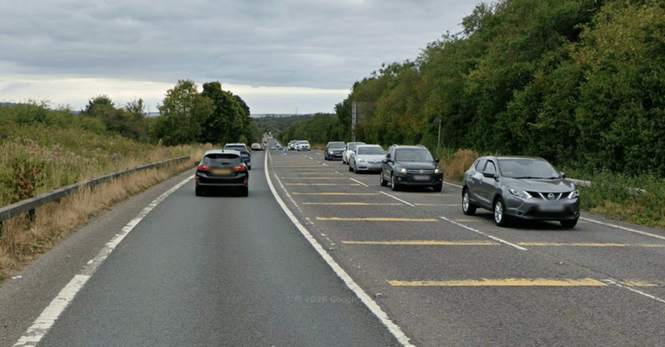
The A484 between Cadle and Loughor Bridge was built as a bypass in phases during the 1980s and 1990s, relieving the original route through Penllergaer, Gorseinon and Loughor of through traffic. The bypass nature of the road means it carries significant volumes of fast-moving traffic, and the junction at Victoria Road in Gowerton is a known congestion hotspot, particularly during peak hours.

Unlike fixed speed cameras — which only capture vehicles at a single point — average speed cameras measure a driver’s speed across the entire length of the monitored zone, making it much harder to slow down at a known camera location and accelerate again in between.

The decision to use average speed cameras rather than fixed cameras reflects the nature of the route, which has seen persistent speeding problems across its full length rather than at isolated spots. The road has been the scene of a number of fatal accidents in recent years, and the case for stronger enforcement has been building for some time.

A businessman based along the affected stretch welcomed the move, saying the road was badly in need of action. “It could do with it — it’s a very fast road. And it’s a lot faster at night-time. They race up and down there,” he told reporters covering last week’s cabinet meeting.

The route links Swansea’s western suburbs with Gowerton and Gorseinon, continuing to Loughor and on towards the Carmarthenshire boundary and Llanelli — making it a key commuter corridor for communities along Swansea’s western fringe.

Average speed camera systems have been widely deployed across Wales on roads where persistent speeding has been linked to serious collisions. They are generally credited with producing more sustained reductions in average speeds than fixed cameras, because drivers cannot predict exactly where enforcement is occurring along the monitored stretch.

The scheme forms part of a broader £6.7 million transport investment package for Swansea in 2026/27, which also includes a new mile-long riverside walking and cycling path along the River Tawe, flood alleviation work at Killay Square and on the Gower road at Llandewi, new EV charging infrastructure and a £750,000 e-bike hire scheme.

Swansea Council’s Head of Service for Transport and Highways, Stuart Davies, said the funding would enable the council to deliver “a wide range of transport related projects that will benefit motorists, public transport users as well as pedestrians and cyclists.”

Road safety education programmes will also continue to be funded as part of the same settlement, the council’s cabinet heard — including the Kerbcraft scheme for children learning to cross roads safely, cycle safety training and Bike Safe courses for motorcyclists.

The A484 camera scheme is expected to be delivered during the current financial year, though the council has not yet confirmed when the cameras will become operational.

Related stories from Swansea Bay News

Flood fix: Funding confirmed to finally tackle Killay Square and Gower road misery
Two of Swansea’s worst flood hotspots are part of the same transport investment package.

Barges needed to build new £8m riverside cycle path linking city centre to Swansea.com Stadium
The headline project from the same 2026/27 transport settlement.

#A484 #averageSpeedCameras #Cadle #featured #Gowerton #Kingsbridge #Loughor #LoughorBridge #RoadSafety #SpeedCamera

SWANSEA: Barges needed to build new £8m riverside cycle and walking path linking city centre to Swansea.com Stadium

A new walking and cycling route along the River Tawe has been given the green light by Swansea Council — with the project set to become one of the most ambitious pieces of active travel infrastructure the city has seen.

The path will run for a mile along the west bank of the Tawe, from a point north of the Tawe bridges through to the Hafod-Morfa Copperworks area — linking the city centre with the copperworks, Swansea.com Stadium and Morfa Retail Park for cyclists and pedestrians. It will be built in three phases and is expected to take three years to complete.

The total cost of the scheme, including design and project management, is £8.25 million. That will be funded through a combination of £6.6 million from the Welsh Government’s regional transport fund, £1.4 million from the UK Government, and a £250,000 developer contribution linked to a separate planning permission.

The council has confirmed the project will be a complex engineering undertaking. A new revetment — a reinforced structure to support the walkway along the riverbank — will need to be constructed, and sections of the work will have to be carried out from barges because of access restrictions along parts of the river corridor.

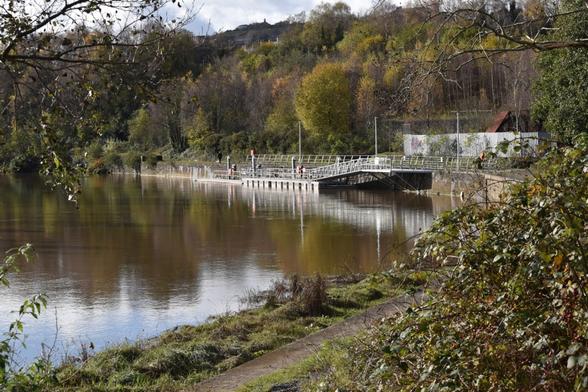
View of the Hafod Morfa Copperworks and the River Tawe

Once complete, the new path will connect with an existing stretch of shared-use path near the Hafod-Morfa Copperworks — an area undergoing a major heritage restoration that has attracted significant investment in recent years, including the arrival of Penderyn Distillery at the site. The new route will add to the 85 miles of shared-use paths already available across Swansea.

For cyclists and pedestrians, the route will offer a traffic-free connection between the city centre and a cluster of major destinations to the north — including Swansea.com Stadium, home of Swansea City AFC, and the growing Morfa Retail Park. The Hafod-Morfa Copperworks, one of Wales’ most significant industrial heritage sites, sits at the northern end of the route.

The three-phase approach to construction reflects both the engineering complexity of the project and the need to keep disruption manageable along a stretch of riverside that already attracts walkers and recreational users.

The Tawe path forms the headline project in a wider programme of cycling and walking investment confirmed for Swansea in 2026/27. Also included in the settlement is a £700,000 shared-use path linking Ffordd Beck in Gowerton to Pont Y Cob Road — a route that would finally deliver a safe connection between the two communities that has been in planning since 2022. At the moment there is no footpath between the two locations and the only provision for cyclists is a painted advisory route on a narrow main road.

Cycle and walking link at Gowerton train station
(Image: Swansea Council)

A £500,000 upgrade of the existing shared-use path between Dunvant and Gowerton is also confirmed, widening the route to improve safety and capacity. Gowerton has been the focus of active travel investment in recent years — a new cycling and walking link to Gowerton station opened after significant delays, and the latest round of funding continues to build on that network.

Taken together, the three cycling and walking schemes represent a significant step forward for active travel connectivity across the western side of Swansea — connecting the city centre to the river corridor, and linking Gowerton more effectively to both Dunvant and Loughor.

Stuart Davies, Head of Service for Transport and Highways at Swansea Council, said the funding would enable the council to deliver “a wide range of transport related projects that will benefit motorists, public transport users as well as pedestrians and cyclists.”

The broader transport package for 2026/27 also includes a £750,000 e-bike hire scheme with up to 500 bikes to be made available for short trips across Swansea, further strengthening the active travel offer alongside the new infrastructure. Locations for the e-bike hire points have yet to be confirmed.

Related stories from Swansea Bay News

New walking and cycling route proposed between Gowerton and Loughor
The long-planned Pont Y Cob Road route between Gowerton and Loughor — now funded for construction.

Gowerton’s long-awaited cycle and walking link to station finally opens after delays
The most recent active travel milestone in Gowerton, which the new investment builds on.

Penderyn Distillery handed keys to new Morfa Copperworks site in Swansea
One of the major regeneration projects at the northern end of the new Tawe riverside path.

New images show how heritage sites at Swansea’s Strand, Hafod Copperworks and museum could be transformed
The wider regeneration vision for the area at the northern end of the new Tawe path.

#ActiveTravel #Gowerton #HafodMorfaCopperworks #Loughor #PontYCobRoad #RiverTawe #StuartDavies #Swansea #SwanseaCouncil #SwanseaComStadium