 Anthk
AnthkSad news at the #gopherverse, I wasn't aware that Jynx from https://leveck.us and
gopher://1436.ninja died. He will be missed, for sure.
gopher://zaibatsu.circumlunar.space/0/~solderpunk/phlog/rip-jynx.txt
Sad news at the #gopherverse, I wasn't aware that Jynx from https://leveck.us and
gopher://1436.ninja died. He will be missed, for sure.
gopher://zaibatsu.circumlunar.space/0/~solderpunk/phlog/rip-jynx.txt
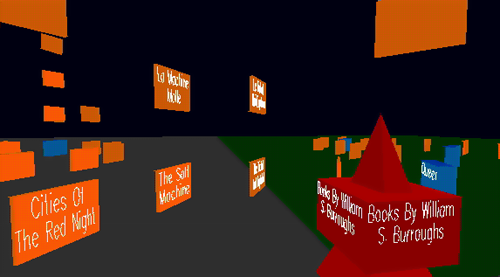
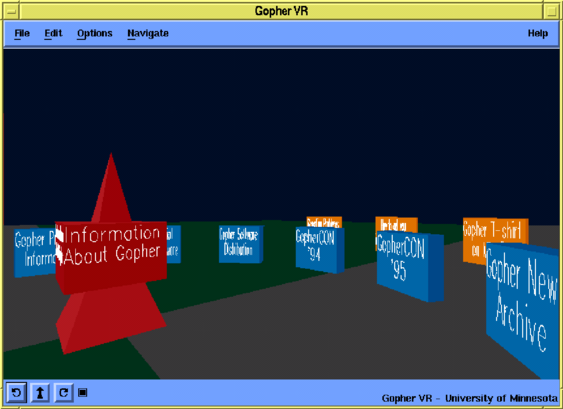
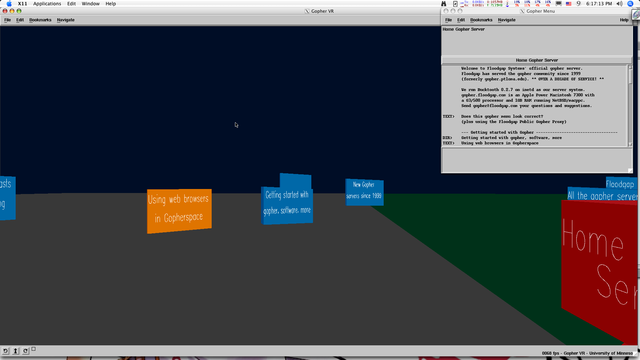
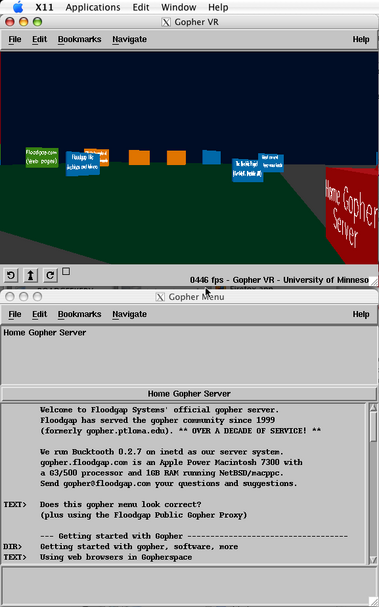
Do you know about GopherVR?
https://en.wikipedia.org/wiki/GopherVR
I used #gopher back in the 1990s.
But there has been a gopher revival going on
I.e., gopher is used today!
I wonder how many in the new Gopher community are aware of #gopherVR ?
.
( #gopherHole #gopherProtocol #gopherverse )
( #virtualReality #VR )
H/T @atomicpoet
4/
I used #gopher back in the 1990s.
But there has been a gopher revival going on
I.e., gopher is used today!.
The new gopher community should be open to creating new line-type codes.
That is part of how the #gopherProtocol was future-proofed.
Creating new line-type codes is using gopher as intended by the specification writer(s).
3/
An excerpt from #IETF #RFC1436
( https://www.rfc-editor.org/rfc/rfc1436 )
“[…] This removes the need to be able to anticipate all future needs and hard-wire them in the basic Internet Gopher protocol; it keeps the basic protocol extremely simple. In spite of this simplicity, the scheme has the capability to expand and change with the times by adding an agreed upon type-character for a new service.”
2/
An excerpt from #IETF #RFC1436 specification
( https://www.rfc-editor.org/rfc/rfc1436 )
“The first character of each line in a [ #Gopher ] server-supplied directory listing indicates whether the item is a file (character '0'), a directory (character '1'), or a search (character '7'). This is the base set of item types in the Gopher protocol. It is desirable for clients to be able to use different services and speak different protocols […] as needs dictate […]”
The Phetch #gopher client has reached v1.0 ⌘ https://github.com/xvxx/phetch
Now is a good time to rediscover the #gopherverse.
One thing I’ve noticed from following the #gopher phlogs that are aggregated on bongusta and moku-pona is that they have a style that is very different from what I’ve cultivated on my #blog (maybe accidentally).
They tend to be short, often only one long paragraph or a couple of short ones. They tend to be daily or at least several times a week. And they tend to be very personal, which is something that I definitely don’t do on my blog.
My blog entries tend to be long, and they tend to be pretty far between. Even my link blogs entries are about a week apart. And they tend to not be personal; they tend to be on topics that are technical, political, or philosophical. I wouldn’t feel comfortable posting many of the things I’ve seen on phlogs in a public forum; even on my locked fediverse account, I’d likely refer to some of the things obliquely. My #phlog is just a plain-text mirror of my blog, so anything I publish to it is also published to the web, which makes me unwilling to try to match the #gopherverse style…
I’m wondering what the factor is that creates this style. Age? A sense of intimacy and privacy that comes from using an obscure medium?
 @reiver ⊼ (Charles)

 Klaus Alexander Seistrup
 GCU Prosthetic Conscience (catgirl aspect)