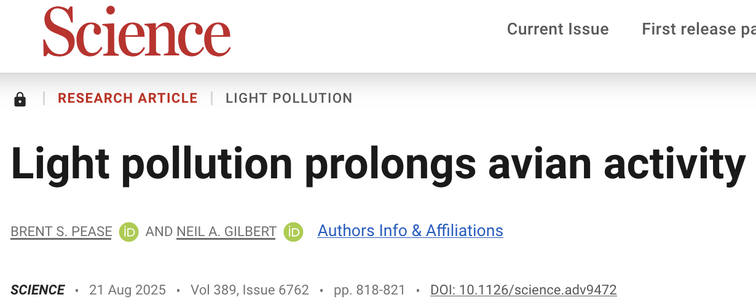
A really interesting paper just came out in Science a few weeks ago: https://www.science.org/doi/10.1126/science.adv9472

The authors compared satellite measurements of #LightPollution from #VIIRS_DNB to 2.6 million bird calls recorded at 7,824 locations around the world. They show not only that birds sing longer at both morning and night in areas that are brighter, but that the response is different for different species.

For example, species with larger eyes are more strongly affected, and species that nest in cavities (protected from light exposure) are less affected.

Very cool work!
#RemoteSensing #GlobalEnvironmentalChange #Birds #Science

A study from the Berlin Senate showed that highway lights have no measurable influence on collision statistics. After this result, and further improvement of retroreflectors and other markings, the Berlin highway lighting wil be almost entirely extinguished step-by-step during 2025: https://viz.berlin.de/aktuelle-meldungen/beleuchtung-auf-den-stadtautobahnen-wird-abgeschaltet/

Belgium also turned off a huge fraction of its highway lighting two years ago without incident.

#RoadStandards #LightPollution #Safety #GlobalEnvironmentalChange

Beleuchtung auf den Stadtautobahnen wird abgeschaltet - Verkehrsinformationszentrale

Cosmic oversight : examining the US Federal Communications Commission’s regulation of the environmental impacts of satellite mega-constellations

Before 2020, 9,115 satellites had been launched into space. It is estimated that by 2030 the number of satellites will surpass 100,000. This surge is largely the responsibility of one US commercial space company which has launched a mega-constellation of thousands of satellites,

Hi all, I am new and looking forward to connecting with researchers and practitioners in the areas of #conservation, #sustainability, #globalEnvironmentalChange, #ecosystemServices