 Jef KoeleWijn - Photography
A photo of glass bricks.
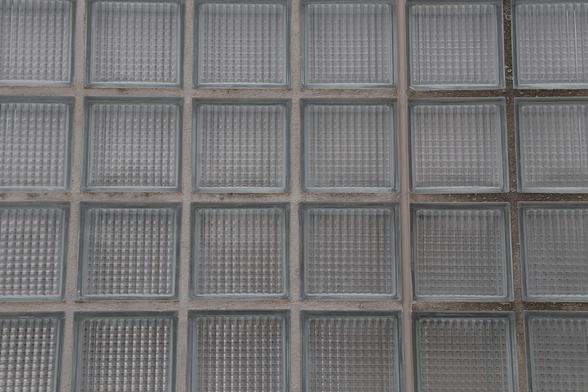
Old German Train Station, 2008
The train station of a small city. Since than it has been renovated.
This entrance to an underpass looked eeriely abandoned, when I had to wait, in the early dawn. The actual tunnel the led to the station looked and smelled worse. Not a single soul in the station, not even a vending machine for coffee.
#Architecture
#TrainStation
#Underpass
#GlassBricks
#Photography
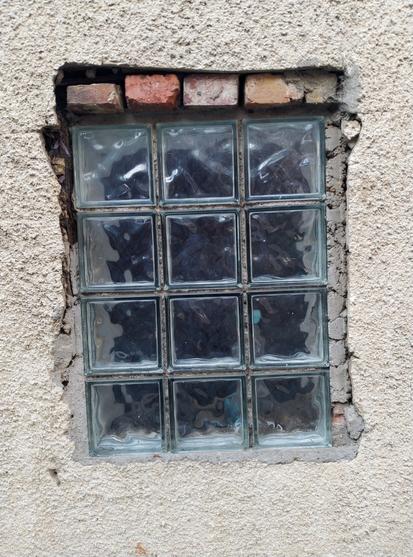
Vorderer Rebstock, Montabaur
#Montabaur #RheinlandPfalz #RhinelandPalatinate #Glasstenen #GlassBricks #Photography #Snapshot #PublicDomain #VensterVrijdag #FensterFreitag
📷 CC0 by @reinoudk
Studio Rhonda uses saturated colours and glass bricks to revamp Zetteler's headquarters
Interiors firm Studio Rhonda has redesigned communications agency Zetteler's London office using contrasting colours and tactile vegan and deaf-friendly materials.
The studio, which is led by Rhonda Drakeford, created a distinctive feeling for each of the headquarter's three zones – a main work area, a smaller cafe-style space for meals and relaxing, and a meeting space.
The Zetteler headquarters is located in east London
As Zetteler founder Sabine Zetteler has severe conductive hearing loss, it was also important that the office didn't feature details such as hard floors and high ceilings, which can create a disruptive atmosphere.
"The space was to be split into three zones, each with a different ambience and function, with an emphasis on the whole space to be deaf-friendly, plus there was the need for the materials used to be vegan," Drakeford explained.
Plants are dotted throughout the space
The choice to use vegan materials was based on the fact that most of Zetteler's staff is vegan or vegetarian.
"The research process was enlightening; for example, I was surprised to learn that some paints include casein, a dairy product," Zetteler told Dezeen.
"I'm proud that we've been able to find vegan options for all our integral building materials, but I would really like to see manufacturers take more responsibility for transparency, so we can all make more informed decisions."
A duck-egg blue decorates the main workspace
To create distinctive zones in the office, located in a mid-century industrial block off Broadway Market in east London, Drakeford used different colours and materials to define the spaces.
A pale duck-egg blue was used for the main work area, which also features a large desk in natural wood and a jute carpet that gives the room an organic feel.
Glass bricks create a light meeting room
The adjacent meeting room is enclosed in glass brick walls, which Zetteler had requested to allow for light to flow through the space.
"I sourced some Czech glass bricks with graphic linear mouldings for a contemporary edge," Drakeford explained.
[
Read:
Fathom Architects designs London office with more meeting areas than desks
"I devised an anchor line of 2,300 millimetres from the ground as the top height of any structures so as to maintain coherence in all three zones and also to help the space retain an open-plan feel," she added.
"The roof of the glass-brick 'pod' stops at the 2,300 millimetres anchor line, allowing light to travel over it."
The Zetteler kitchen features wood and Valchromat surfaces
In the kitchen, the interior designer used furniture from brand Hølte, a Zetteler client whose showroom is close to the office.
"I specified custom oversize recessed handles and an unusual matching oak splash-back combined with a beige tap by Toniton for a mono-material/colour effect 'block'," Drakeford said.
"We also used the oversize circular handles on the adjoining orange Valchromat storage cupboards, which were also produced by Hølte, and the green Valchromat sliding doors to the right of the kitchen block,"
Pale blue walls meet green storage spaces and a glass-brick meeting room
The use of colour was defined by the light in the different rooms of the office, which sits on a north-south axis.
"I worked with a cool, duck-egg blue at the front, south-facing area as I knew that the space tends to get very warm in the summer," Drakeford explained.
"A warmer, buff colour was used at the rear, north-facing section, to counteract how cold that area can feel in the winter months."
Warmer hues were used at the north-facing rear of the building
The neutral backdrop hues were complemented by pops of colour in a variety of textured materials and chalky tones. To make the space deaf-friendly, the designer chose to add plenty of soft materials to the interiors.
"Curtains and rugs are used throughout to help with zoning and privacy as well as optimising the acoustics," Drakeford said.
"The meeting pod is purpose-built, very solid and lined with acoustic vegan wool, creating a quiet sanctuary from the more open-plan spaces. Planting is also a key part of the acoustic softening, as well as making the space more welcoming."
A deep blue hue makes the meeting room feel cosy
The overall design aimed to create an office that didn't have the "matchy-matchy" feel of many corporate office spaces, Drakeford said.
"I approached this space in the same way I would treat a residential interior, with the warmth and comfort of a mismatched but visually coherent family of furniture and materials," she added.
Other notable London offices include The Crown Estate's Fathom Architecture-designed space in St James's and a "homely" office in the brutalist Smithson Tower.
Photography is byTaran Wilkhu.
The post Studio Rhonda uses saturated colours and glass bricks to revamp Zetteler's headquarters appeared first on Dezeen.
#all #interiors #instagram #london #uk #officeinteriors #glassbricks #colour

Ten interiors that use glass-block walls to play with light and shadow
As glass bricks are experiencing another renaissance, our latest lookbook features ten projects that showcase how glazed masonry can illuminate any interior – even cramped bathrooms and hallways.
Originally invented and popularised in the 1930s, as seen in Pierre Chareau's Maison de Verre and Villa Stenersen by Norwegian architect Arne Korsmo, glass blocks went in and out of style over the following decades.
The hollow bricks, which simultaneously reveal and obscure, were beloved by Japanese architect Tadao Ando, who used them to form the interior courtyard of his Ichihara House and the facade of Horiuchi House, both designed in 1979.
After they largely fell out of favour after their 1980s heyday, we've collated a number of recent interiors projects for this lookbook that have resuscitated the trend.
This is the latest roundup in our Dezeen Lookbooks series providing visual inspiration for the home. Previous lookbooks feature kitchen extensions, modernist open-plan living rooms and interiors with indoor trees.
Top and above: photography is by Felix Speller
When Child Studio converted a 1960s post office in London's Saint John's Wood into a sushi restaurant, the practice set out to pay homage to the building's late-modernist origins.
This is achieved through a mixture of dark cherry wood panelling, a soft-blue coffered ceiling and a semi-circular wall of glass blocks, which also accommodates a generous, leather-upholstered alcove seat in its curvature.
Optical Glass House, Japan, by Hiroshi Nakamura& NAP
A two-storey wall made of 6,000 specially-made glass bricks separates this house and its planted courtyard from the busy streets of downtown Hiroshima, casting shadows and refractions onto the living spaces beyond.
Both its lounge and dining room open up completely onto the garden via pocket doors, allowing the towering glazed partition to feel like part of the interior.
Find out more about Optical Glass House ›
Maryland House, UK, by Remi Connolly-Taylor
Glazed inserts help filter light into this small statement staircase in the self-designed London home of Remi CT Studio-founder Remi Connolly-Taylor.
Glass bricks were also used to form the balustrade of the adjacent balcony, creating privacy from the outside without obstructing the sun from streaming into the two bright-white bedrooms.
Find out more about Maryland House ›
Buckle Street Studios, UK, by Grzywinski+Pons
A glass-brick facade with radiused corners surrounds the top floors of the Buckle Street Studios hotel in east London, making the building appear like a glowing lantern at night.
New York studio Grzywinski+Pons, which designed both the exterior and interiors, celebrated these curves in the guest suites by introducing custom-made furniture with a matched radius to fit into those rounded corners.
Find out more about Buckle Street Studio ›
10AM Lofts, Greece, by Studio Andrew Trotter
To create a bright, sunny atmosphere inside this converted 1970s warehouse in Athens, Studio Andrew Trotter inserted new windows on the ground floor and replaced almost an entire concrete wall with glass masonry.
The space, which can now be rented for private events alongside a rooftop penthouse, is rounded off with vintage furnishings that provide a homely counterpoint to the otherwise industrial environment.
Find out more about 10AM Lofts ›
Photo courtesy of ROOM+ Design & Build
Glass-Block Micro House, Vietnam, by ROOM+ Design & Build
In this Dezeen Awards-shortlisted renovation, Vietnam architecture studio ROOM+ Design & Build replaced the walls of a small house in Ho Chi Minh City entirely with frosted glass bricks.
This even includes the second-floor bathroom, which was transformed from a dark, cramped space into a sun-dappled sanctuary without sacrificing privacy.
Find out more about Glass-Block Micro House ›
Spacial co-working space, Canada, by Ivy Studio
A glazed-block wall separates the public area of this co-working space in Montreal from the private offices beyond, while still allowing light to filter through the gridded glass.
Finishes and furnishings throughout the interior are largely kept to a greyscale palette, save for a few huge circular blue mirrors and a reception desk plated in anodised zinc.
Find out more about Spacial Montreal ›
Photo is by Jun Murata
Diamant Glass Art Gallery, Japan, by Jun Murata
Glass bricks of varying textures and translucencies, from stippled to frosted, cast glistening refractions into this antiques showroom by Japanese architect Jun Murata to create the impression of light being filtered through water.
Beyond the feature wall, the interior is sparsely furnished, housing one of Ludwig Mies van der Rohe's classic Barcelona chairs and not much else in order to leave space for temporary product showcases.
Find out more about the Diamant Glass Art Gallery ›
Photo is by Schran Images and Hu Yanyun
J Boroski, China, by Atelier XY
This bar in Shanghai's former French Quarter was designed to reflect the owner's fascination with insects and is bisected by a glazed wall.
This divides the main bar from an intimate lounge area with comfy low-slung seats and offers revellers a ledge on which to rest their drinks. For an unusual interior design, it also displays a collection of 42 preserved Thai Black tarantulas in illuminated resin cubes.
Find out more about J Boroski ›
Photo is by Dmitry Tsyrencshikov
Vizor office, Belarus, by Studio 11
Studio 11 reinterpreted traditional Soviet-era design details for the office of gaming company Vizor in Minsk, incorporating signage informed by the city's 1970s and 1980s underground stations alongside a deep red colour palette and geometric flooring tiles reminiscent of the eras' public buildings.
This same theme also pops up again in the wall of glass blocks, which snakes its way through the workplace underneath a row of hanging ferns.
Find out more about the Vizor office ›
_This is the latest in our series of lookbooks providing curated visual inspiration from Dezeen's image archive. For more inspiration see previous lookbooks showcasingkitchen extensions, modernist open-plan living rooms and interiors with indoor trees. _
The post Ten interiors that use glass-block walls to play with light and shadow appeared first on Dezeen.
Seves glass bricks front Mexican restaurant in Texas by Olson Kundig
Dezeen promotion:glass bricks designed by Seves animate the pared-back exterior of the Comedor Restaurant, which US architecture studio Olson Kundig has completed in Austin, Texas.
Located in the city's business district, the contemporary Mexican eatery is designed by Olson Kundig to disguise its interiors and create a sense of intrigue.
Olson Kundig has used glass bricks by Seves at the Comedor Restaurant in Austin
The utilitarian exterior features black brickwork and doors, broken up by a wall of Vetropieno Solid Glass Bricks that were produced by the glass block manufacturer Seves.
This glass brickwork provides distorted views of movements and colours inside the Comedor Restaurant without revealing its interior, which is intended to entice passersby.
The Vetropieno Solid Glass Bricks feature on the restaurant's facade
Seves' Vetropieno Solid Glass Bricks were chosen for the project by Olson Kundig in collaboration with the on-site architect called Mckinney York Architects.
Navvab Taylor, an architect at Mckinney York Architects, said the glass bricks help create "a process of discovery upon entering the building".
The bricks were chosen to create a sense of intrigue
"It was important to the owner to create a sense of mystery and not give away the view of the interior," Taylor added.
While creating this sense of intrigue, the Vetropieno Solid Glass Bricks ensure the building meets building regulations in Austin that require a certain percentage of transparency on exterior facades.
The glass bricks conceal the industrial interior of the restaurant
The design of the glass bricks also allowed them to be toothed and coursed together in continuous rows with the black bricks on the rest of the restaurant's facade.
The mystery created by the glass brickwork is matched by brass lettering outside the restaurant, which is designed to be obscure.
Inside, visitors are welcomed by an industrial bar and dining area. It features unexpectedly tall ceilings and large hand-cranked glass doors, which lead out to a brick-walled courtyard containing trees and a fountain.
To find out more about Seves products visit its website.
Partnership content
This article was written by Dezeen for Seves as part of a partnership. Find out more about Dezeen partnership contenthere.
The post Seves glass bricks front Mexican restaurant in Texas by Olson Kundig appeared first on Dezeen.
#publicandleisure #all #architecture #promotions #usa #glass #restaurants #texas #austin #olsonkundigarchitects #glassbricks


Remi Connolly-Taylor creates her own glass brick-walled London home
Designer Remi Connolly-Taylor has designed Maryland House in London, which features a glass brick enclosed staircase, as her own home and studio.
Set at the end of a row of terraced houses in east London, the brick house was designed as a home that has a dedicated workspace for Connolly-Taylor, who is the founder of London studio Remi CT.
Maryland House was designed by Remi Connolly-Taylor
"When I returned from New York, I noticed the current housing market didn't reflect my needs," Connolly-Taylor told Dezeen. "I started Remi CT in 2017 and like most young professionals, needed a space to work and create from home."
"Maryland House's core concept was the desire to shine a light on other lifestyles in London as the traditional layout does not reflect the diversity of the city and functional homes are lacking for young professionals," she added.
The kitchen is located in the basement
The home's functions are stacked vertically with two bedrooms located on the ground floor and an open-plan kitchen, dining and living space placed in the basement.
The entire top floor of the house is given over to a dedicated studio space that opens onto a small balcony with a glass brick balustrade.
A studio space is at the top of the house
"The traditional hierarchy of the home was challenged during the development of the design," said Connolly-Taylor.
"Usually, traditional home layouts place emphasis on larger kitchens or family sitting rooms. We wanted to speak to the younger generation and young professionals through this design," she continued.
"We focused on creating a workspace that wasn't an afterthought. We wanted the space to be a destination within the home that one would want to work from."
The floors are connected by a glass brick-enclosed staircase
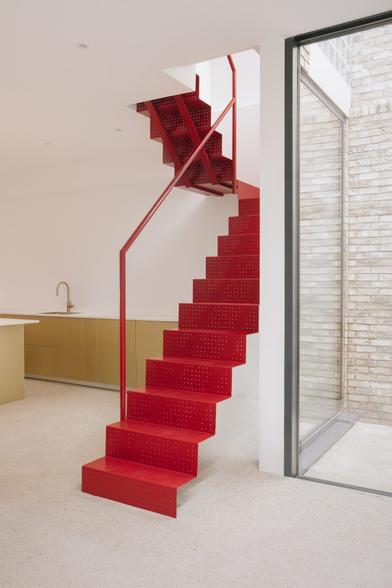
Connolly-Taylor designed the home around a red, statement staircase that is wrapped in a glass-brick wall.
This allows natural light into the home and, along with a lightwell, helps to make the basement feel like a bright space.
[
Read:
ROOM+ Design & Build replaces walls of house in Ho Chi Minh City with glass bricks
](https://www.dezeen.com/2020/11/18/glass-brick-house-ho-chi-minh-city-room-design-build/)
"The glass blocks were a strategic design choice," said Connolly-Taylor. "The dwelling's mass was curated around how the natural light would enter the home."
"I wanted to create a naturally-lit staircase that acts as a spine to the house," she continued. "We needed to maintain natural light standards to the adjoining neighbours and within the home so the glass blocks were able to allow light to filter through while creating privacy."
The red metal staircase adds colour to the interiors
Overall Connolly-Taylor aimed to create a calm, pared-back series of spaces that are punctuated with "grand moments", like the staircase.
"Beauty in minimalism and creating grand moments on an 8.5 by nine-metre plot were also very important to this build," said Connolly-Taylor.
The golden kitchen also adds a moment of grandeur
"For instance, when standing in the living room you do not feel like you are standing in a traditional basement," she continued.
"Natural light floods down from the skylight, garden, and staircase creating an illusion you are above ground. Elements of grandeur are felt by the 3.1-metre ceiling heights in the basement, and the open staircase views to the first floor."
Other recent London houses featured on Dezeen include a row of "ghostly" terraces designed by Fraher & Findlay, a home by Satish Jassal Architects that peaks above a brick wall and a compact house on the site of a former garage.
Photography is by James Retief.
The post Remi Connolly-Taylor creates her own glass brick-walled London home appeared first on Dezeen.
#residential #all #architecture #london #uk #bricks #houses #londonhouses #architectsanddesignershouses #glassbricks
Remi Connolly-Taylor creates her own glass brick-walled London home
Architect Remi Connolly-Taylor has designed Maryland House in London, which features a glass brick enclosed staircase, as her own home and studio.
Set at the end of a row of terraced houses in east London, the brick house was designed as a home that has a dedicated workspace for Connolly-Taylor, who is the founder of London studio Remi CT.
Maryland House was designed by Remi Connolly-Taylor
"When I returned from New York, I noticed the current housing market didn't reflect my needs," Connolly-Taylor told Dezeen. "I started Remi CT in 2017 and like most young professionals, needed a space to work and create from home."
"Maryland House's core concept was the desire to shine a light on other lifestyles in London as the traditional layout does not reflect the diversity of the city and functional homes are lacking for young professionals," she added.
The kitchen is located in the basement
The home's functions are stacked vertically with two bedrooms located on the ground floor and an open-plan kitchen, dining and living space placed in the basement.
The entire top floor of the house is given over to a dedicated studio space that opens onto a small balcony with a glass brick balustrade.
A studio space is at the top of the house
"The traditional hierarchy of the home was challenged during the development of the design," said Connolly-Taylor.
"Usually, traditional home layouts place emphasis on larger kitchens or family sitting rooms. We wanted to speak to the younger generation and young professionals through this design," she continued.
"We focused on creating a workspace that wasn't an afterthought. We wanted the space to be a destination within the home that one would want to work from."
The floors are connected by a glass brick-enclosed staircase
Connolly-Taylor designed the home around a red, statement staircase that is wrapped in a glass-brick wall.
This allows natural light into the home and, along with a lightwell, helps to make the basement feel like a bright space.
[
Read:
ROOM+ Design & Build replaces walls of house in Ho Chi Minh City with glass bricks
](https://www.dezeen.com/2020/11/18/glass-brick-house-ho-chi-minh-city-room-design-build/)
"The glass blocks were a strategic design choice," said Connolly-Taylor. "The dwelling's mass was curated around how the natural light would enter the home."
"I wanted to create a naturally-lit staircase that acts as a spine to the house," she continued. "We needed to maintain natural light standards to the adjoining neighbours and within the home so the glass blocks were able to allow light to filter through while creating privacy."
The red metal staircase adds colour to the interiors
Overall Connolly-Taylor aimed to create a calm, pared-back series of spaces that are punctuated with "grand moments", like the staircase.
"Beauty in minimalism and creating grand moments on an 8.5 by nine-metre plot were also very important to this build," said Connolly-Taylor.
The golden kitchen also adds a moment of grandeur
"For instance, when standing in the living room you do not feel like you are standing in a traditional basement," she continued.
"Natural light floods down from the skylight, garden, and staircase creating an illusion you are above ground. Elements of grandeur are felt by the 3.1-metre ceiling heights in the basement, and the open staircase views to the first floor."
Other recent London houses featured on Dezeen include a row of "ghostly" terraces designed by Fraher & Findlay, a home by Satish Jassal Architects that peaks above a brick wall and a compact house on the site of a former garage.
Photography is by James Retief.
The post Remi Connolly-Taylor creates her own glass brick-walled London home appeared first on Dezeen.
#residential #all #architecture #london #uk #bricks #houses #londonhouses #architectsanddesignershouses #glassbricks
 Alami
Alami Martin Liebermann
 reinoud kaasschieter
 dezeen (unofficial)
