 Bible Science Forum
Is Dark Matter the Unknown God?
Published in Creation magazine 37(2):22-24, 2015.
Over years of researching cosmology and astrophysics, I have argued that ‘dark matter’ is a sort of ‘god of the gaps’,1 the ‘unknown god’. It is proposed mainly to rescue the standard big bang model from problems when a mismatch is found between the theory and some observations. However, secular cosmogonists (scientists who study the beginning of the universe) usually believe the big bang worldview to be correct as well as all its associated astrophysics. So they must postulate something invisible to explain the discrepancy. This ‘something’ is ‘dark matter’, a hypothetical substance that emits no light or radiation, so cannot be seen.
Several years ago, astronomers claimed that they now had direct empirical proof of the existence of ‘dark matter’.2 This was dutifully repeated in the popular media.3 It was claimed that this demolishes the criticisms of ‘dark matter skeptics’. The section entitled “Dark Matter Proof?” (below) explains this further, and shows how there are many competing explanations for the same evidence.
However, even if those alternate gravity theories were disproven, this would still not prove dark matter. Let’s be clear: ‘dark matter’ is not an explanation for what we see; it’s an admission that no one has an explanation. Perhaps a more accurate headline would have been, ‘Scientists have proved that they haven’t got a clue what the universe is made of’, rather than, ‘Dark matter revealed!’4 because it isn’t revealed. But if you give a name to an admission of gross ignorance—‘dark matter’, ‘dark energy’—then you may eventually believe you have explained something!
Fudge factor eliminated by correct physics
Dark matter is also invoked to explain certain motions in galaxies that appear not to follow the laws of physics. In spiral galaxies, outer stars often orbit faster than inner ones, unlike the solar system where inner planets orbit faster because of the stronger gravity close to the sun. Most astronomers propose a dark matter halo around the galaxy to explain these anomalies.
But dark matter is reminiscent of the scientific proposal, popular in the late 1800s to early 1900s, about the existence of another planet, Vulcan. No, not the home of Mr Spock, but a hidden planet that allegedly perturbed Mercury’s orbit and thus explained why it did not follow Newtonian physics. But the proposed planet Vulcan could not be observed, because it was postulated that it orbited such that the sun would always hide it from observers on the earth. But that makes no sense, since any planet near Mercury must orbit the sun much faster than Earth does.
Nowadays, this proposal is regarded as quaint, because Einstein’s theory of general relativity explained the anomaly in the orbit of Mercury. That is, rather than introducing a fudge factor that really explained and predicted nothing, what was needed was new physics that both explained observations at the time and predicted new ones.
I am not the only modern physicist/cosmologist who thinks that ‘dark matter’ is the Vulcan of today. It is a ‘god of the gaps’ for modern astrophysicists. It is a ‘fudge’, with unknown properties, and strange behaviour, such as being in a non-collapsing spherical halo around galaxies, and concentrated outside the galaxy more than in its centre. In fact, it is invoked many times in big bang cosmology to explain away anomalies.
The equivalent of general relativity in the Vulcan saga, i.e. the new physics required to do away with this whole ‘dark matter fudging’, could well be a new theory such as that proposed by the late Israeli cosmologist /physicist Moshe Carmeli. His 4D space-velocity metric explains the flatness of the universe (the fact that the universe has Euclidean geometry)5—without dark matter or other fudge factors. It also explains perfectly the anomalous galaxy rotation issues mentioned earlier.6 Just as Einsteinian relativity did to Newtonian physics, Carmelian relativity encompasses today’s physics but explains more data.
Dark matter—vital for big bang believers
The most powerful driver and motivator behind the ‘dark matter’ proposal is the perceived need to prop up the failing paradigm of the standard big bang cosmology. This includes not only the hypothetical beginning of the universe in a ‘big bang’, but also its structure and evolution.
For example, the big bang would result in hot gas, which could not form stars, galaxies and galaxy clusters without dark matter to help condense the gas. Also, testing of the big bang model with type Ia supernova measurements supposedly shows accelerating expansion where dark energy is also needed.7 Dark matter is also invoked to explain tiny irregularities in the Cosmic Microwave Background radiation, allegedly the fireball from the big bang. Also, without dark matter, big bang nucleosynthesis (formation of light elements like helium and the hydrogen isotope deuterium in the hot big bang fireball) won’t work, either.8
In short, to get the big bang theory to work, the matter content of the universe must comprise 85% dark matter, hence only 15% normal matter, like protons and neutrons. That’s you, me, the magazine you’re reading, everything—to which add 85% dark matter.9 So there is a huge incentive to prove that the dark-matter skeptics (like me), who dispute the existence of the stuff, are wrong.
Conclusion
The solution is simple—dark matter never existed in the first place. That is why it is missing. It is invisible because it is not there. The standard big bang universe formation theory is wrong. Dark matter is needed to form stars and galaxies in the big bang theory. But galaxies don’t form naturalistically by themselves. They can’t.
The Bible says that on Day 4 of Creation Week, God “… made the stars also.” (Genesis 1:16) That means God created the stars, and hence the galaxies also, at that time.
Dark matter (an unknown god) is not needed when you have the Creator.
References and notes
Dark Matter Proof?
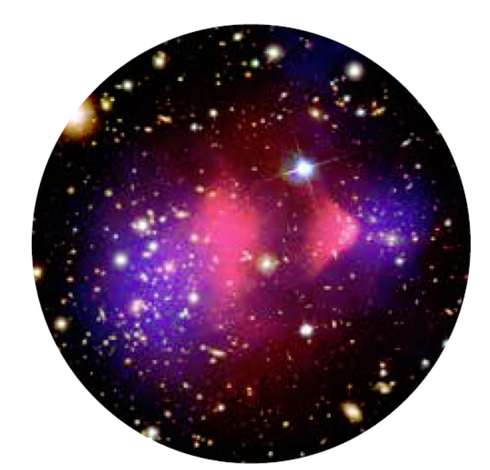
Image: The famous Bullet cluster where one smaller sub-cluster (the bullet) appears to have passed through a larger cluster. Source: NASA/CXC/CIA/STSci/ Magellan /Univ. of Ariz./ESO.The authors of one study claimed that the Bullet cluster (shown below) is a unique merger of two clusters, and that their analysis has “… enable[d] a direct detection of dark matter … .” The supposed evidence comes from visible arcs seen in and around galaxies in the two Bullet sub-clusters. The arcs were interpreted as the result of gravitational lensing from unseen matter.1
Gravitational lensing is a prediction of Einstein’s general theory of relativity. It describes the situation where a foreground galaxy (or cluster of galaxies) acts like a giant light lens and focuses the light of a more distant background galaxy and hence magnifies it like a normal lens would do. According to the theory, the lens distorts the galaxy image, often looking like a cross or a ring around the closer ‘lensing’ galaxy.
Is it really dark matter?
‘Direct proof’ was claimed. But that seems to be stretching things a bit, to put it mildly, given the many assumptions and interpretations necessarily involved. In this case they were out to disprove some alternate gravity theories that purport to explain the anomalies without the need to invoke ‘dark matter’. However, another researcher claims that they are mistaken and that at least one of the alternate theories can explain the arcs observed in this cluster—as gravitational lensing, yes, but without the need for ‘dark matter’.2 And another refutes3 their claims by introducing new physics, while yet another cautioned against “simple interpretations of the analysis of weak lensing in the bullet cluster”.4 In short, cosmology is not operational science5 and there may be many competing explanations for the same evidence. (Ironically, the section below entitled “The Detection of ‘Missing’ Dark Matter” highlights another situation where gravitational lensing was used to detect the non-existence of dark matter in a lensing galaxy.)
References and notes
The Detection of ‘Missing’ Dark Matter
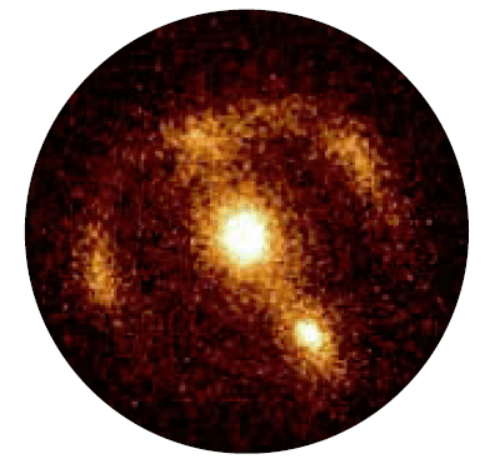
Image: The claimed gravitationally-lensed galaxy seen as an irregular ring of radiation around the distant galaxy in the centre of this 2.2-micron CCD photograph, made with the 10-meter Keck telescope on Hawaii. Credit: ESA and the W. M. Keck ObservatoryRecently, several earth-based radio and optical telescopes and the Herschel Space Observatory were used to image an object, shown here (right), where a gravitational lens (the middle and lower galaxies) is claimed to image a very distant galaxy, allegedly still in early formation. This is the faint ring around the central galaxies.
The central ‘lensing’ galaxy was found to radiate much more far-infrared radiation than the model predicts. So they reported that the central lensing galaxy “… contains an unexpectedly low fraction of mysterious dark matter ….”.1
Here is a situation where according to the standard big bang model and the theory of galaxy formation more unseen dark matter should exist in the lensing galaxy than expected from modelling the lensing galaxy. No dark matter is actually seen, but the missing matter is mostly missing. Thus, whereas gravitational lensing was used as part of the claimed ‘direct’ detection of the existence of dark matter in the Bullet cluster (See Section “Dark Matter Proof?” above) here it is used to detect its non-existence in a ‘lensing’ galaxy.
References and notes
Recommended Reading
- Book: Apocalypse Now: On the Revelation of Jesus Christ
- Book: Merchants of Death: Global Oligarchs and Their War On Humanity
Follow me
- Telegram.org: @GideonHartnett
- Facebook: Gideon Hartnett
- X (Twitter): @gideon195203
To be notified by email put your email address in the box at the bottom of your screen. You’ll get an email each time we publish a new article.
Click this image to make a secure Donation (Stripe) !
#BigBang #BigBangTheory #CosmicMicrowaveBackgroundRadiation #DarkEnergy #DarkMatter #Einstein #GeneralRelativity #MosheCarmeli #theUnknownGod #Universe